

Spotting a fake perfume is a sensual game of details—the kind luxury brands never miss. It's about the flawless whisper of the cellophane wrap, the satisfying, cool heft of the bottle in your palm. A ridiculously low price is a dead giveaway—authentic fragrances rarely flirt with discounts over 40%. And, of course, the scent itself should be a story that unfolds on your skin, not a one-night stand that vanishes in an hour.
In the captivating world of fragrance, your signature scent is so much more than a pretty smell. It's your invisible armor, a whisper of personality that leaves a delicious impression. It can be a playful wink, a bold statement, or a comforting embrace, all captured in one beautifully designed bottle. But what happens when that intimate expression is a total fraud?
The market for counterfeit perfumes is booming, and the fakes are getting dangerously good at pretending. This isn't just about a bad bargain; it's a game of seduction where the prize is your trust and, more importantly, your safety. Learning how to spot a fake perfume is your secret weapon. It’ll turn you from a hopeful shopper into a discerning connoisseur who can't be fooled.
Consider this guide your little black book for fragrance authentication. We’re going to sashay past the obvious and dive into the subtle, often overlooked details that separate a masterful creation from a cheap knock-off. It’s about understanding the entire seduction, from the satisfying click of a magnetic cap to the complex, intoxicating journey a scent takes on your skin.
Why does this matter so much? Because spotting fakes is about more than just protecting your wallet.
In a world full of imitations, choosing an authentic fragrance is an act of self-respect. You are not just buying a scent; you are buying the craftsmanship, safety, and artistry that comes with it.
Throughout this guide, you’ll learn to trust your senses and sharpen your instincts. We'll explore everything from the texture of the box to the quality of the glass, empowering you to distinguish a genuine treasure from cleverly disguised trash. Get ready to become the most confident perfume buyer you know.
Before you even catch a whisper of the scent—before the first spritz kisses your skin—the hunt for authenticity has already begun. The art of spotting a fake perfume begins with its outfit: the box. Think of it as the fragrance’s first impression. A genuine luxury brand always shows up dressed to the nines, while a counterfeit often looks a bit disheveled. This is your first and most reliable line of defense.
Let's be real, unwrapping a new perfume is a ritual. It’s a tantalizing striptease. The satisfying weight of the box, the crisp sound of the cellophane—it all builds anticipation. Counterfeiters know this, but they almost never get the details right. They bank on you being too excited about the scent inside to notice the packaging feels more like a cheap knockoff than a luxury investment. But you’ll know better.
The very first thing to check is the cellophane wrap. It might be a simple transparent layer, but it speaks volumes. An authentic perfume will have a thick, flawless cellophane that is wrapped tightly and perfectly around the box, like a bespoke suit.
Imagine a machine folding it with surgical precision—that’s the standard you're looking for. The seams should be clean, flat, and sealed professionally with heat, not messy glue. If you see globs of excess glue, sloppy folds, or a wrap so loose it crinkles and shifts, that’s a massive red flag. It’s the packaging equivalent of showing up to a date in a wrinkled shirt; the attention to detail just isn't there.
Once you’ve slid off the cellophane, it’s time to get a feel for things. Pick up the box and notice its weight and texture. Luxury brands pour serious money into their packaging because it’s a direct extension of their identity. The box should be made from high-quality, substantial cardstock. It needs to feel sturdy and protective.
Run your fingers over the surface. Is it smooth and impeccably constructed? Or does it feel flimsy and cheap, like it could be easily crushed? Counterfeiters cut corners here to save on costs, often using thin, low-grade cardboard that completely lacks that premium feel.
Paying attention to these seemingly minor details is how you can spot fake perfume. Counterfeiters thrive on the assumption that you're too eager to notice the small stuff. It's a huge issue, with fakes making up 3.3% of global trade. Within the luxury sector, a worrying 9% of authenticated items were found to be fake, and that number is climbing. You can dive deeper into the perfume market trends to see just how big this problem has become.
Beyond protecting your wallet, avoiding fakes is about safeguarding your health and appreciating the true artistry of perfumery.
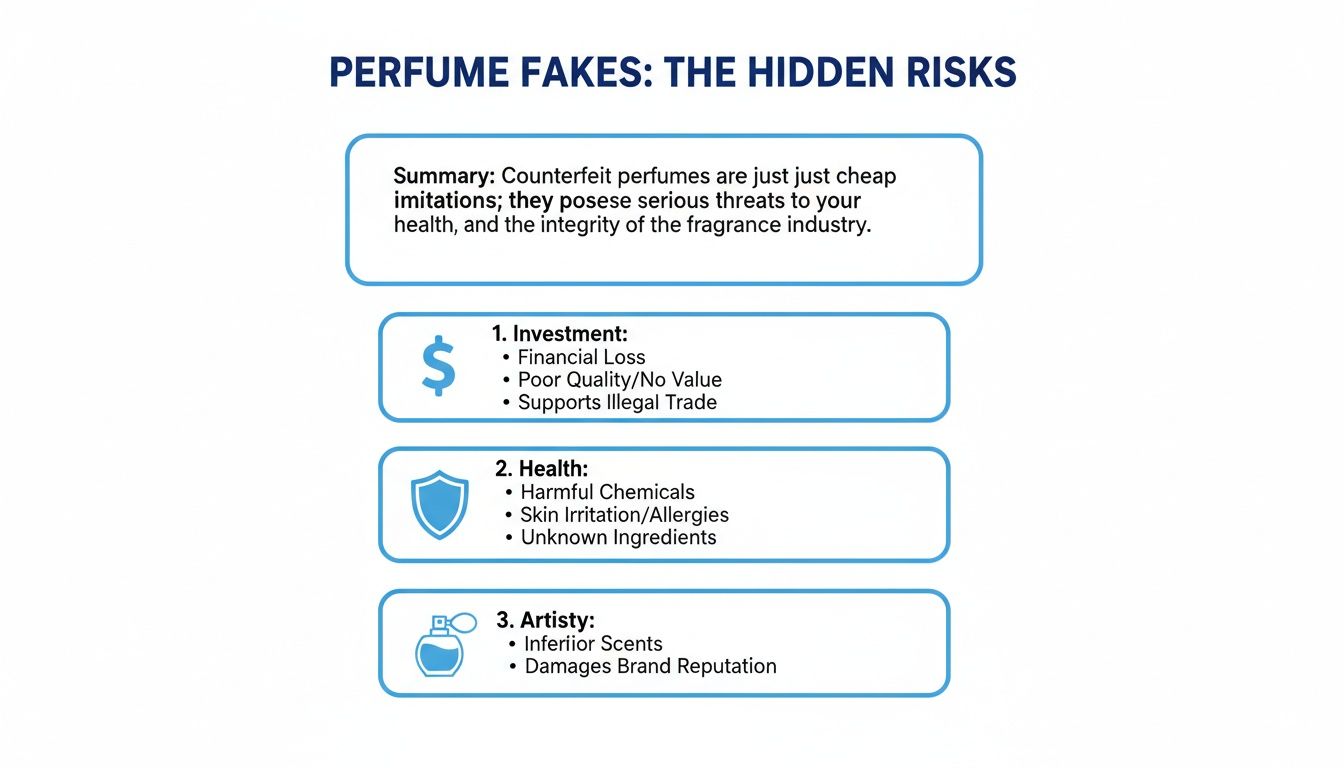
This quick look shows that fakes aren't just a financial loss; they can pose real health risks from unlisted chemicals and completely devalue the creative work of master perfumers.
To make it even clearer, here’s a quick side-by-side of what to look for in genuine vs. fake packaging.
| Feature | Authentic Perfume | Common Fake Signs |
|---|---|---|
| Cellophane Wrap | Thick, tight, and flawlessly sealed. | Loose, crinkly, with messy glue seams. |
| Box Material | Heavy, high-quality cardstock. | Flimsy, thin, low-grade cardboard. |
| Printing & Text | Crisp, clear, and perfectly aligned. | Blurry, smudged, or misspelled text. |
| Logo | Exact match to the brand's official logo. | Slightly off-brand font, spacing, or color. |
| Inner Cradle | Sturdy and custom-fit to the bottle. | Loose, ill-fitting, or made of cheap material. |
This table is your cheat sheet. Keep these points in mind, and you'll be able to spot the imposters from a mile away.
Now, lean in and inspect the text and logos. This is where many fakes totally give themselves away. Authentic brands are obsessed with perfection, meaning every letter, logo, and symbol will be printed with razor-sharp clarity.
Keep an eye out for these dead giveaways of a counterfeit:
Remember, luxury is in the details. A genuine Tom Ford box has a specific, satisfying texture. A real Dior box often has lettering that is slightly embossed. Counterfeiters can't—or simply won't—replicate these expensive subtleties.
Finally, open the box and look inside. A real perfume will be nestled securely in a well-constructed inner cradle designed to protect the bottle during shipping. If the bottle is rattling around in a flimsy piece of cardboard, you’re almost certainly holding a fake. This protective interior is another corner counterfeiters love to cut, making it a final, obvious clue for a discerning eye. By turning yourself into a packaging detective, you'll spot these red flags with ease.
You’ve gotten past the cellophane and felt the quality of the box. Now for the main event—getting your hands on the perfume bottle itself. This is where a brand’s soul truly lives, where craftsmanship either shines or shatters under a close look. Fakers can get a box right, but replicating the flawless, sensual feel of a luxury bottle is a whole different ballgame.
Think of it like spotting the difference between a costume jewel and a real diamond. From a distance, they might look similar, but up close, the quality, clarity, and perfect construction of the real thing are impossible to miss. Learning how to spot fake perfume often comes down to this hands-on, intimate inspection.
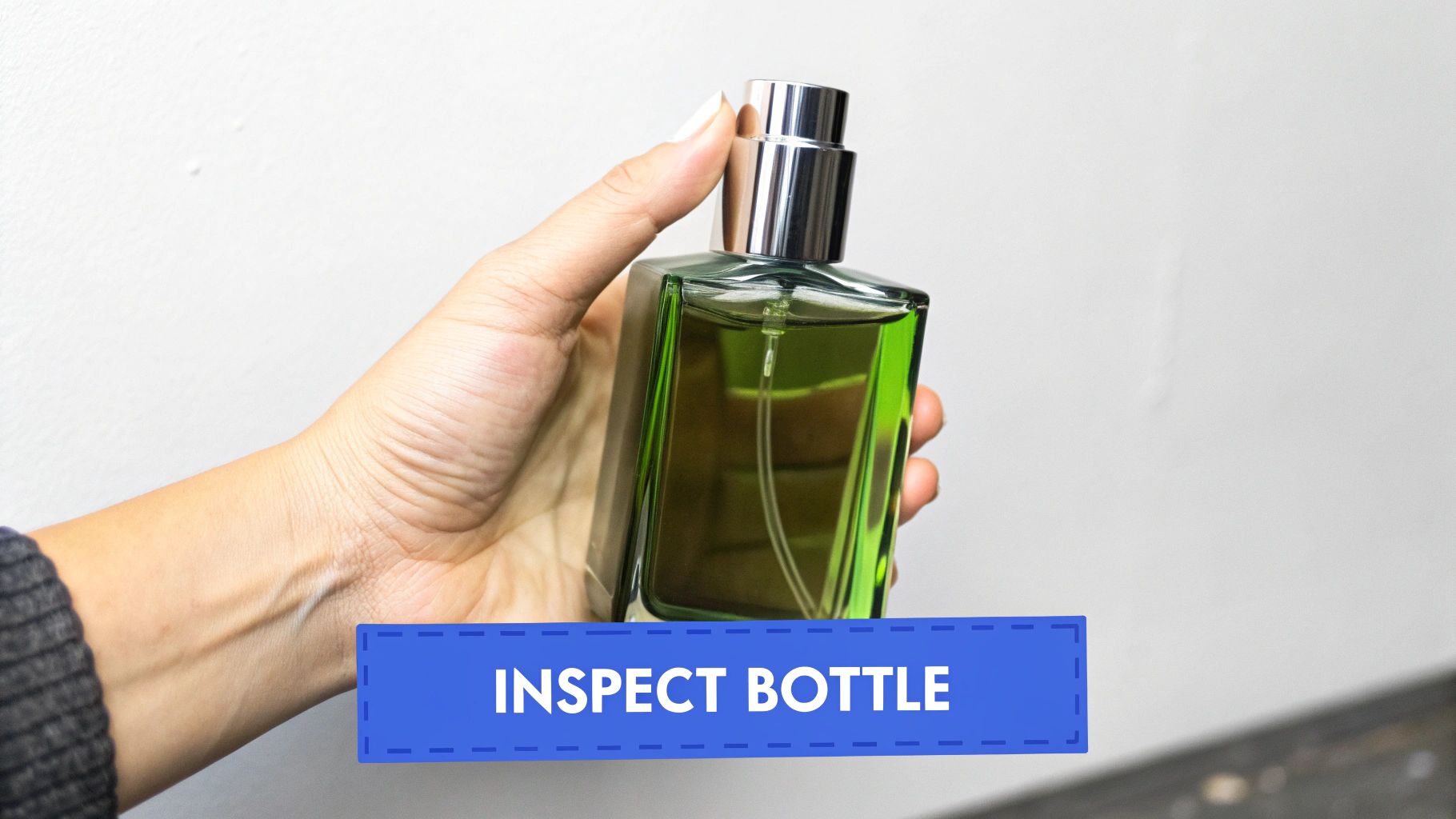
First thing's first: pick it up. A genuine bottle has a satisfying weight and feels substantial in your palm. Luxury brands invest in high-quality, thick glass that’s molded to perfection. Run your fingers along the surface; it should feel completely smooth and seamless.
Counterfeiters, on the other hand, almost always cut corners with cheaper, thinner glass. This leads to a few tell-tale imperfections that give them away instantly.
This meticulous attention to detail is a hallmark of luxury. Fakes just can't compete.
Next up, the cap. This is an area where counterfeiters almost always skimp to save a few bucks, and it’s one of the easiest ways for you to spot an imposter. A genuine cap is a small piece of engineering—designed to fit perfectly.
Does it click securely into place with a satisfying snap? Is it perfectly symmetrical and centered? Many high-end perfumes, like Dior Sauvage or Bleu de Chanel, even feature magnetic caps that elegantly pull themselves into the correct position every single time. A fake will often have a flimsy plastic cap that sits crooked, wiggles around, or doesn't close tightly.
Now, let's talk about the sprayer, also known as the atomizer. This is the functional heart of the bottle.
A genuine perfume atomizer delivers a fine, even, cloud-like mist that distributes the fragrance delicately. A fake often sputters, leaks, or shoots out a messy, uneven stream of liquid.
The plastic tube inside the bottle should also be subtle and barely visible. If you spot a thick, clunky, or overly long tube that bends awkwardly at the bottom, you’re almost certainly looking at a fake.
Ready for a neat little trick? Give the bottle a gentle shake. Don't worry, you won't hurt it. Now, watch the bubbles.
In an authentic perfume, which has a higher concentration of aromatic oils and quality alcohol, the bubbles should disappear pretty slowly, taking about 10-15 seconds to settle. In a fake perfume, which is often watered down with cheap alcohol, the bubbles will vanish almost instantly—gone in just a couple of seconds.
This simple test is a fun but surprisingly effective way to judge the quality of the juice inside. It isn't definitive on its own, but when you combine it with the clues from the glass, cap, and sprayer, it helps paint a very clear picture of authenticity. It’s these small, intimate details that separate a true masterpiece from a cheap knockoff.
You’ve played detective with the packaging and given the bottle a thorough once-over. Now for the most crucial part of the investigation—the scent itself. This is where a fake perfume can no longer hide behind clever packaging or a convincing bottle. It’s here, on your skin, that the imposter is finally unmasked.
A genuine fragrance isn't just a smell; it's a story that unfolds over hours. Think of it as a complex dance of notes that evolve and flirt with your senses. A counterfeit, on the other hand, is a one-note wonder. It comes on strong, makes a flashy entrance, and then ghosts you within the hour, leaving nothing but a cheap, chemical memory.
To really spot a fake, you need to appreciate the artistry of a real fragrance's structure. Authentic scents are built like a pyramid, with three distinct layers that reveal themselves over time. This structure is the soul of the fragrance, and it's something counterfeiters simply can't replicate.
Act One: The Top Notes. These are the sparkling, attention-grabbing notes you smell immediately. Often citrusy, fruity, or green, they’re designed to make a great first impression but are fleeting, lasting only about 15 to 30 minutes.
Act Two: The Heart Notes. As the top notes fade, the true character of the fragrance emerges. These middle notes are usually floral, spicy, or aromatic. They form the core of the scent and linger for a few hours, creating a rich and memorable experience.
Act Three: The Base Notes. This is the grand finale. The base notes are the deep, sensual, and long-lasting anchors of the fragrance—think musk, amber, vanilla, or woodsy scents. They're the final, lingering impression that stays with you, sometimes for eight hours or more.
A fake perfume completely butchers this beautiful progression. It throws all its effort into mimicking the top notes because that's what sells a bottle in the first 30 seconds. But after that initial blast, there's nothing left. No heart, no depth, no lingering romance—just a flat, one-dimensional smell that often turns sour or vanishes completely.
Here’s a crucial pro-tip: never judge a perfume on a paper strip alone. To truly test its authenticity, you need to see how it interacts with the warmth and chemistry of your own skin. This is where a fake's flaws become glaringly obvious.
Spray a small amount on your wrist or the crook of your elbow. Now, pay close attention.
The difference is stark. An authentic scent feels alive; it breathes and changes with you throughout the day. A counterfeit is a static, lifeless copy that falls apart under the slightest pressure.
Ultimately, one of the biggest giveaways of a fake is its staying power. Genuine fragrances are crafted with high concentrations of premium oils designed to last. In contrast, scientific analysis shows that counterfeits fade quickly because they are packed with cheap synthetics and volatile compounds.
Worse, this same analysis of counterfeit fragrances reveals they often contain higher levels of allergens and unlisted chemicals, which can cause serious skin reactions and respiratory problems.
A real perfume will gracefully evolve over 6-12 hours, while a fake will often smell harsh and alcoholic before disappearing completely in under two hours.
Training your nose to recognize this complexity and longevity is your most powerful tool. Once you learn to spot that artful evolution, no imposter will ever fool you again.
So, you’ve learned to read the packaging like a pro and decode a scent on your skin. Great. Now for the last piece of the puzzle: where you actually spend your money.
Let’s be real, that jaw-droppingly good deal you found on some obscure website feels like a thrilling little secret. But more often than not, it's a trap. You’re the one who ends up with a broken heart and a bottle of disappointment.
Navigating the perfume marketplace is an art form. It's about knowing when to flirt with a discount and when to commit to a trusted source. The truth is, luxury brands like Chanel, Dior, and Tom Ford are notoriously protective of their pricing. They control distribution with an iron fist to maintain an air of exclusivity.
So, when you see a brand-new bottle of a hot fragrance selling for a massive, year-round 70% discount, your alarm bells shouldn’t just ring—they should scream.
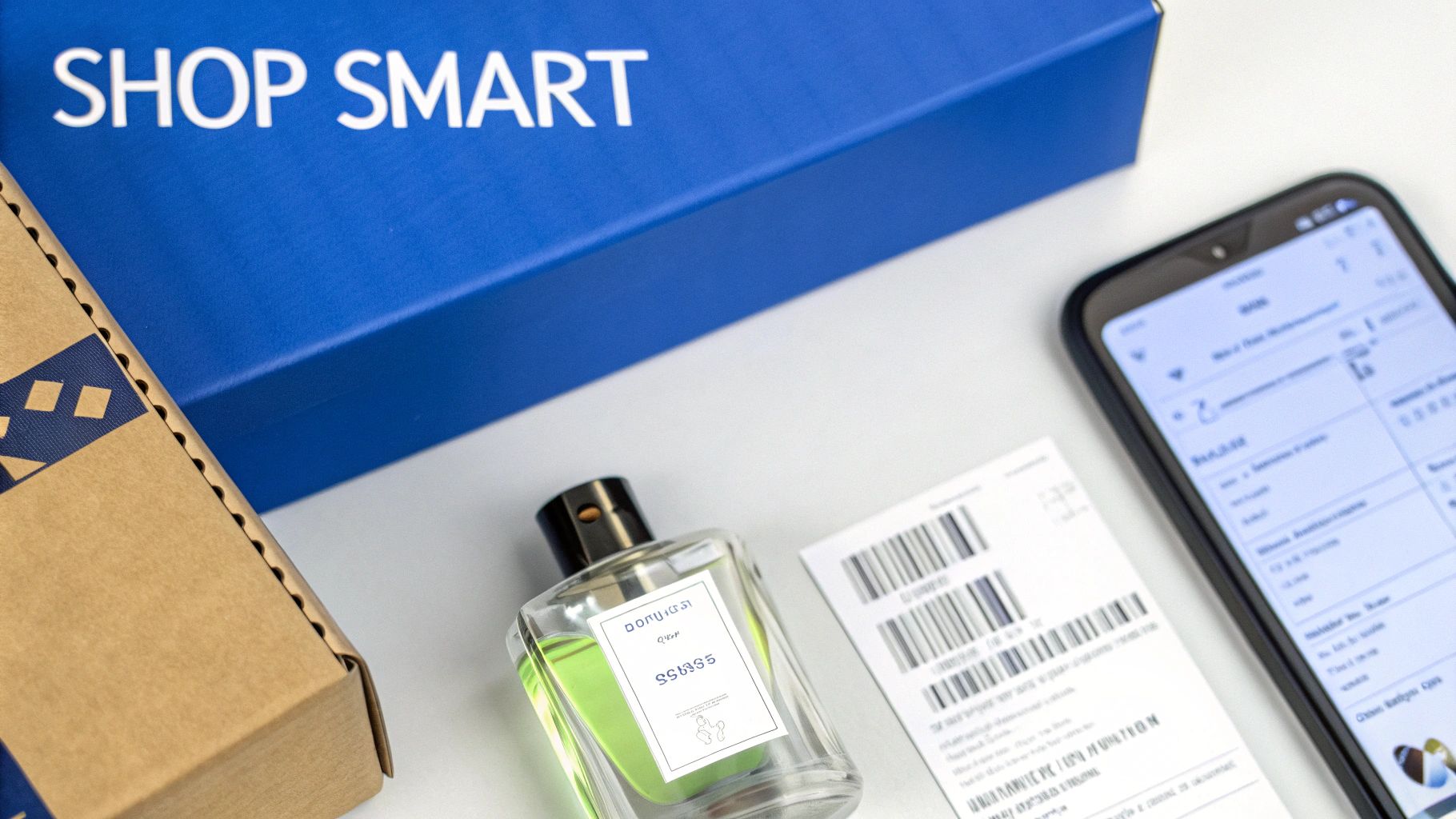
The key to protecting your investment—and your skin—is knowing where to shop. Think of it as choosing a date. You can go with the reliable, vetted partner your friends recommend or take a chance on a mysterious stranger with a questionable backstory.
Your safest bets are always authorized retailers. These are the establishments that have a direct, contractual relationship with the brands they sell.
Then, there's the online world—the Wild West of fragrance shopping. This is where you find unauthorized online marketplaces, auction sites, and social media sellers. While some legitimate deals exist (often from sellers in the "grey market" who acquire authentic stock through unofficial channels), these platforms are breeding grounds for fakes.
If you decide to venture into the world of third-party sellers, you need to be a savvy detective. Don’t get swept up by a pretty picture and a low price. Before you even think about clicking "buy," run the seller through this checklist.
Here's a playful but powerful tip: Treat your perfume purchase like a first date. Do your homework, ask the right questions, and if something feels off, trust your gut and walk away. There are plenty of other fish (or fragrances) in the sea.
Now for your secret weapon: the batch code. This is one of the most definitive ways to verify a perfume's legitimacy, turning you from a hopeful buyer into a confident one.
A batch code is a short series of numbers and/or letters printed or etched onto both the bottom of the perfume box and the bottom of the bottle itself.
Crucially, the code on the box must match the code on the bottle. If they don't match, or if a code is missing entirely, you're almost certainly looking at a fake.
Once you have the code, you can use online batch code checkers. These sites maintain databases that can tell you when your specific bottle was manufactured. Counterfeiters often use fake or endlessly repeated codes that these checkers will flag as invalid.
Inspecting the price and your purchase source is fundamental. Genuine luxury fragrances rarely drop below 70-80% of their retail value, unlike the deep-discount fakes that litter unauthorized sites. The global counterfeit market is massive, accounting for about 3.3% of all world trade. Even professional authenticators report a 9% failure rate, meaning one in eleven items they check is a fake. To get a better grasp of the scale, you can explore more insights on the perfume industry here.
Shopping smart isn't about giving up the thrill of the hunt; it's about making sure you bring home a prize, not a problem.
So, you're getting serious about your fragrance journey, but a few nagging questions keep popping up. Let's clear the air. Answering these common curiosities is the final piece of the puzzle, helping you learn how to spot fake perfume and shop with total confidence.
Think of this as your private cheat sheet, where we tackle the worries that can surface when you're on the hunt for your next signature scent.
Absolutely, and that’s precisely how they trick you. Counterfeiters have mastered the art of the first impression. They put all their effort into mimicking the top notes—that bright, beautiful burst you get in the first 15 minutes. It’s a clever deception designed to fool a quick spritz and sniff.
The real story, however, unfolds in the dry down. An authentic perfume has depth and character; it’s built with complex middle and base notes that blossom on your skin over several hours. Fakes completely lack this artistry. They often fall flat, turn sour, or just disappear within an hour, leaving you with nothing but a whiff of cheap alcohol and regret.
Not always, but you’re navigating much riskier waters. While some legitimate sellers do operate on these platforms (often called the "grey market"), they're also a hotbed for counterfeiters. To stay safe, you have to put on your detective hat.
When in doubt, it’s always better to buy from an authorized retailer. Your peace of mind is worth the extra few dollars.
"The real danger of a fake isn't just a disappointing scent; it's the unknown, unregulated ingredients. Authentic perfumes undergo strict safety testing. Your health is the number one reason to always insist on the real thing."
First and foremost, stop using it immediately. You have no idea what's in that bottle, and those unregulated chemicals can cause nasty skin reactions or worse. The next step is to contact the seller right away and demand a full refund.
If you purchased it through a platform with buyer protection, like eBay or PayPal, open a dispute immediately. Report the seller for selling counterfeit goods and provide clear photos as evidence. This doesn't just help you get your money back; it protects other fragrance lovers from getting scammed. It's about holding these sellers accountable and keeping the perfume world safe for everyone.
Ready to find your next authentic signature scent without the guesswork? At Gotham Fragrances, we guarantee 100% genuine designer fragrances at prices that make luxury accessible. Explore our curated collection of iconic brands and discover the confidence that comes with the real deal. https://www.gothamfragrances.com