
Bergamotto di Calabria is the Calabrian citrus crop behind approximately 90 to 95 percent of the world's bergamot, not a guarantee of certified PDO essential oil in a perfume. A bergamot note describes a scent, while PDO identifies a particular protected ingredient.
Say you spray an Italian-sounding fragrance before a date. The opening is delicious: bitter peel, a little floral sweetness, something green against warm skin. You've found a beautiful perfume, but you haven't necessarily found certified Calabrian oil. That distinction is where the romance gets interesting.
Bergamotto di Calabria names bergamot associated with Calabria, especially the Ionian coastal strip between Reggio Calabria and Locri. It isn't a perfume house, a fragrance concentration, or a certification automatically attached to every bottle bearing the name.
An academic review of bergamot production places approximately 90–95% of world production along this coast, with around 1,400–1,500 hectares of orchards and roughly 200,000 kilograms of bergamot annually cited in its production account. The region's soil and climate support both cultivation and the distinctive character of the peel oil.
Those figures need their labels attached. A 2025 regional account reported by Best of Calabria describes approximately 1,200 hectares, average fruit production of 19,800 tonnes, and around 6,000 people involved in the sector. Different reporting scopes and product descriptions aren't interchangeable, particularly when fruit and extracted material enter the same conversation.
The legal and commercial distinctions are more useful than any sweeping claim of rarity. HerbalGram's bergamot profile records EU protection for Bergamotto di Reggio Calabria essential oil since 2001, with certified output of 56 kilograms in 2017 and 41 kilograms in 2018.
For the fruit supply chain, Great Italian Food Trade's 2024 account describes approximately 1,500 hectares, with wholesale fruit around €800 per tonne for oil extraction and €1,200 per tonne for the fresh market.
| Claim | What it covers | Scale or status | What a shopper can infer |
|---|---|---|---|
| Geographic crop | Bergamot grown on Calabria's Ionian coast, mainly Reggio Calabria to Locri | About 90–95% of world supply; reported grove estimates span 1,200–1,500 hectares | Most bergamot fruit is Calabrian, not every bottle |
| PDO essential oil | Bergamotto di Reggio Calabria olio essenziale | EU protected since 2001; certified oil output of 56 kg in 2017 and 41 kg in 2018 | PDO applies to certified oil, not to a perfume name |
| IGP fruit chain | Bergamotto di Reggio Calabria fruit supply | About 1,500 hectares; 2024 wholesale prices around €800/tonne for oil fruit and €1,200/tonne for fresh fruit | Fruit protection isn't the same as oil in a fragrance |
| Perfume note | Bergamot listed in a designer or niche formula | Calabrian oil, another origin, a reconstructed accord, or a blend | The fragrance name alone proves nothing about PDO |
A perfume's note list isn't a sourcing ledger. EastFruit's account of Calabria's bergamot industry distinguishes regional origin from protected oil and the broader use of bergamot in fragrance.
The certified chain also has commercial ambitions beyond its recorded output. HerbalGram describes a 2022 assessment exceeding €10 million in potential value, involving 28 operators, with interest from France, Germany, the United States, Japan, and China.
Meanwhile, Future Market Insights estimates put 2025 retail sales of bergamot from Calabria at $180 million, with a projection of $300 million by 2035. That's market heat, not a perfume's price tag or evidence of its ingredients.
An Italian name can set the mood. Only appropriate documentation supports a PDO claim.
Think of a grower deciding whether to keep an orchard. The trees occupy land, harvesting requires workers, and a buyer must want what comes from the rind. A perfumer's preference eventually becomes someone else's decision about whether those trees stay standing.
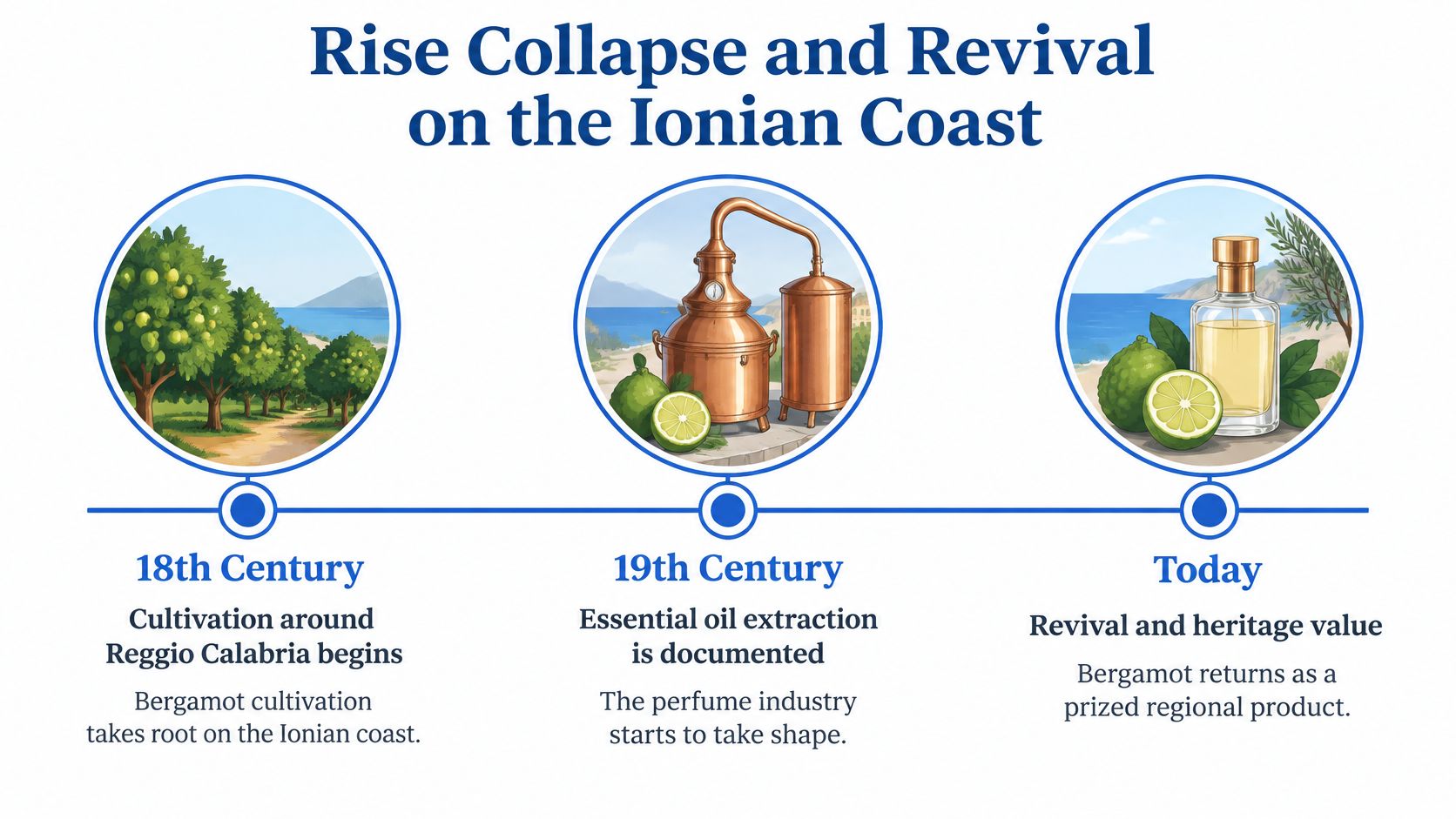
Calabrian bergamot's story begins with established regional cultivation and the later development of documented oil extraction. Growers supplied fruit; processors captured its aromatic peel; perfumers found a citrus material that could sit comfortably beside flowers, woods, and richer compositions.
The rupture came in the late 1960s, when synthetic bergamot oil depressed the value of natural material, according to CBC's reporting from Calabria. Some landowners cut down trees, cultivation stopped in parts of the region for nearly 25 years, and interest returned in the early 1990s, helped by enthusiasm for organic products and demand from French perfumeries.
That's a less polished story than the usual luxury origin tale. A cherished ingredient wasn't continuously cherished enough to protect every orchard. Growers had to respond to what buyers would purchase.
The milestones make that interrupted history tangible.
Producers organized to restart essential-oil production rather than waiting for fashion to swing back. Their work connected agricultural survival with renewed interest in natural fragrance ingredients.
CBC describes the protected production area as supplying about 80% of global bergamot. That's a narrower geographic description than the broader coastal estimate used for the Calabrian crop, not a measurement of how much oil receives certification. These accounts shouldn't be treated as a perfectly reconciled statistical series.
A large growing region and a small certified supply can coexist. Growing the fruit and certifying the oil are different activities.
For a fragrance shopper, the recovery adds substance without requiring mythology. You don't need to believe that synthetic materials are inferior, or that every natural ingredient deserves a premium, to appreciate an agricultural specialty that growers rebuilt.
The seductive part isn't sunshine on a label alone. It's knowing that the citrus you enjoy belongs to a place where people chose to cultivate it again. A bright opening can carry history without becoming a museum piece.
A green bergamot on a tree isn't a finished perfume ingredient waiting to be collected. The grower must choose when to pick, and the processor must decide how to capture the rind's aroma. Those decisions affect what a perfumer receives.
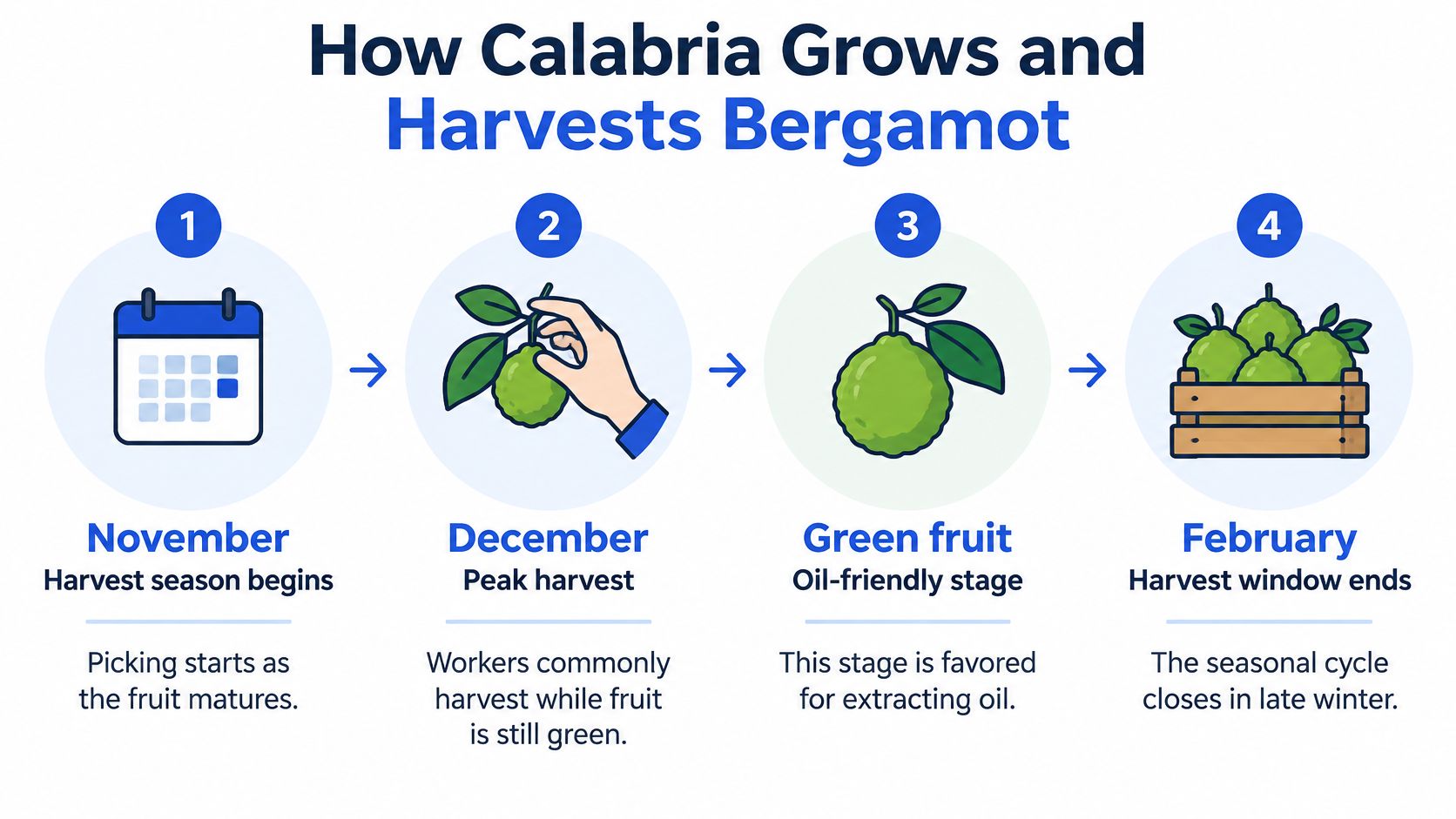
A study of Calabrian bergamot cultivars and harvest stages describes a November-through-February harvest season, comparing varieties including Femminello and Fantastico. Workers commonly favor green fruit for oil extraction, so the familiar shopper's instinct that riper must mean better doesn't translate neatly to perfumery.
Across the tested cultivars and harvest periods, monoterpenes dominated, with limonene the most representative compound. Linalyl acetate and neryl acetate were the most abundant esters, while Fantastico showed higher volatile-organic-compound production and stronger volatile concentration at its second and third harvest points.
That finding isn't permission to declare every later harvest superior. It shows that cultivar and picking stage can change the aromatic material before a perfumer has touched it.
The seasonal sequence is easier to follow when fruit color and extraction purpose sit beside the calendar.
Cold pressing is easiest to understand by bending a piece of citrus rind near your nose. The aromatic spray comes from the peel, not from the juice dripping into a glass. Industrial expression captures that peel oil on a different scale.
Distillation is a different extraction route, not a more elegant synonym for pressing. The resulting materials need their own specifications, particularly when a formulator is considering the heavier constituents that can accompany expressed oil.
Think of the difference as fresh peel versus a more rounded citrus impression. Harvest-related changes can influence how readily a perfumer emphasizes juicy sparkle, floral softness, or a greener edge.
A perfume's final balance still depends on the whole formula. Agricultural timing gives the perfumer material to work with; it doesn't dictate exactly what you'll smell on your wrist.
The measurable flirt begins with limonene at 37.2%, linalyl acetate at 30.1%, linalool at 8.8%, gamma-terpinene at 6.8%, and beta-pinene at 6.2% in a gas-chromatography study of Reggio Calabria bergamot oil. The investigators identified 55 compounds, a useful reminder that natural oil is a mixture rather than a solitary citrus molecule.
Limonene supplies the recognizable brightness. Linalyl acetate and linalool soften that impression with floral, sweet, and lavender-like facets. If limonene is the grin, that softer pair is the silk shirt: still casual, but considerably more interesting up close.
The scent descriptions below are practical smelling cues, not a claim that each molecule behaves identically in every blend.
| Compound | Share of oil | Scent impression | Role in the opening |
|---|---|---|---|
| Limonene | 37.2% | Bright citrus | The sparkling first flash |
| Linalyl acetate | 30.1% | Soft, floral, sweet | Rounds the juice into something sensuous |
| Linalool | 8.8% | Floral, lavender-like | Adds silky, slightly soapy elegance |
| Gamma-terpinene | 6.8% | Green, herbal | Keeps the citrus from smelling candied |
| Beta-pinene | 6.2% | Fresh, lightly piney | A cool lift under the sweetness |
These are proportions from one studied oil, not a recipe every Calabrian producer must reproduce. A harvest-related shift in the ester balance can change the material's emphasis without making it less recognizably bergamot.
The smaller constituents matter, too. A chemical profile helps explain the structure, but a list of principal components isn't a complete sensory portrait.
Say you test a fragrance expecting lemonade and find something almost floral instead. That doesn't mean the perfumer forgot the citrus. Bergamot naturally offers more than a sharp, juicy effect, which makes it useful for connecting an opening to a softer heart.
Keep these distinctions separate when reading product descriptions:
For a plain-language companion to those terms, Shivora Candles helps readers compare fragrance oils and essential oils. Its candle context is useful for vocabulary, not a substitute for fine-fragrance formulation guidance.
Listen for juicy brightness, soft floral sweetness, and a green or resinous edge. That combination is a smelling exercise, not an authenticity test.
You can admire a reconstructed bergamot accord and still care about agricultural provenance. Pleasure and traceability answer different questions, and neither needs to impersonate the other.
You spray before leaving home, enjoy the citrus in the hallway, and notice something woodier over dinner. The perfume hasn't necessarily failed. Bergamot usually functions as a top note, so its most obvious freshness can recede while the rest of the composition remains.
Don't buy it expecting a fixed-duration citrus performance. Formula, dose, application surface, and surrounding materials all affect what remains noticeable. The layer vocabulary in understanding scent layers with Jackpot Candles offers a useful introduction, although evaporation from skin isn't the same as fragrance release from a candle.
The answer depends on the finished formulation, not the word bergamot. A chemical analysis of 128 genuine Calabrian cold-pressed oils found bergamottin at 1.02–2.75% and bergapten at 0.11–0.35%. These furocoumarins can participate in phototoxic reactions following ultraviolet A exposure.
Expressing the peel captures more than its beautiful aroma. That's why applying raw oil to exposed skin is a different decision from wearing a professionally formulated perfume.
| Material or product | Typical contact | Sun concern | Practical read |
|---|---|---|---|
| Cold-pressed peel oil on skin | Leave-on | Greater concern when phototoxic furocoumarins remain | Identify expressed oil and check its certificate of analysis |
| IFRA-compliant fine fragrance | Leave-on, dosed by formula | Managed through formulation, not inherently absent | Follow directions; don't treat compliance as permission for heavy application before sunbathing |
| Bergapten-reduced or rectified oil | Determined by intended use and process | Lower only when analytical testing supports the claim | Don't assume processing removed every relevant furocoumarin |
| Soap or rinse-off | Brief skin contact | Shorter contact changes exposure | Don't transfer perfume assumptions to wash-off products |
| Candle or home scent | No intended skin contact | Not a skin phototoxicity issue during intended use | Assess it as home fragrance, not wearable oil |
Natural doesn't mean automatically gentle. Equally, the presence of a bergamot note doesn't establish that a finished fragrance is unsafe outdoors.
Formulators should verify the applicable IFRA standard, destination-market cosmetic requirements, and supplier analytical documentation. Distilled or rectified oil shouldn't be assumed phototoxin-free without a current certificate of analysis.
For shoppers, the useful action is specific: use the perfume as directed, don't substitute undiluted essential oil, and don't borrow ingestion or aromatherapy advice for a leave-on cosmetic. If you're planning substantial sun exposure and the product's directions leave you uncertain, choose an application approach that avoids exposed skin rather than guessing from the fragrance name.
A bergamot perfume for an open-neck shirt needn't resemble one for a velvet jacket. The citrus may be familiar, but the materials underneath determine whether the result feels breezy, intimate, earthy, or warm.
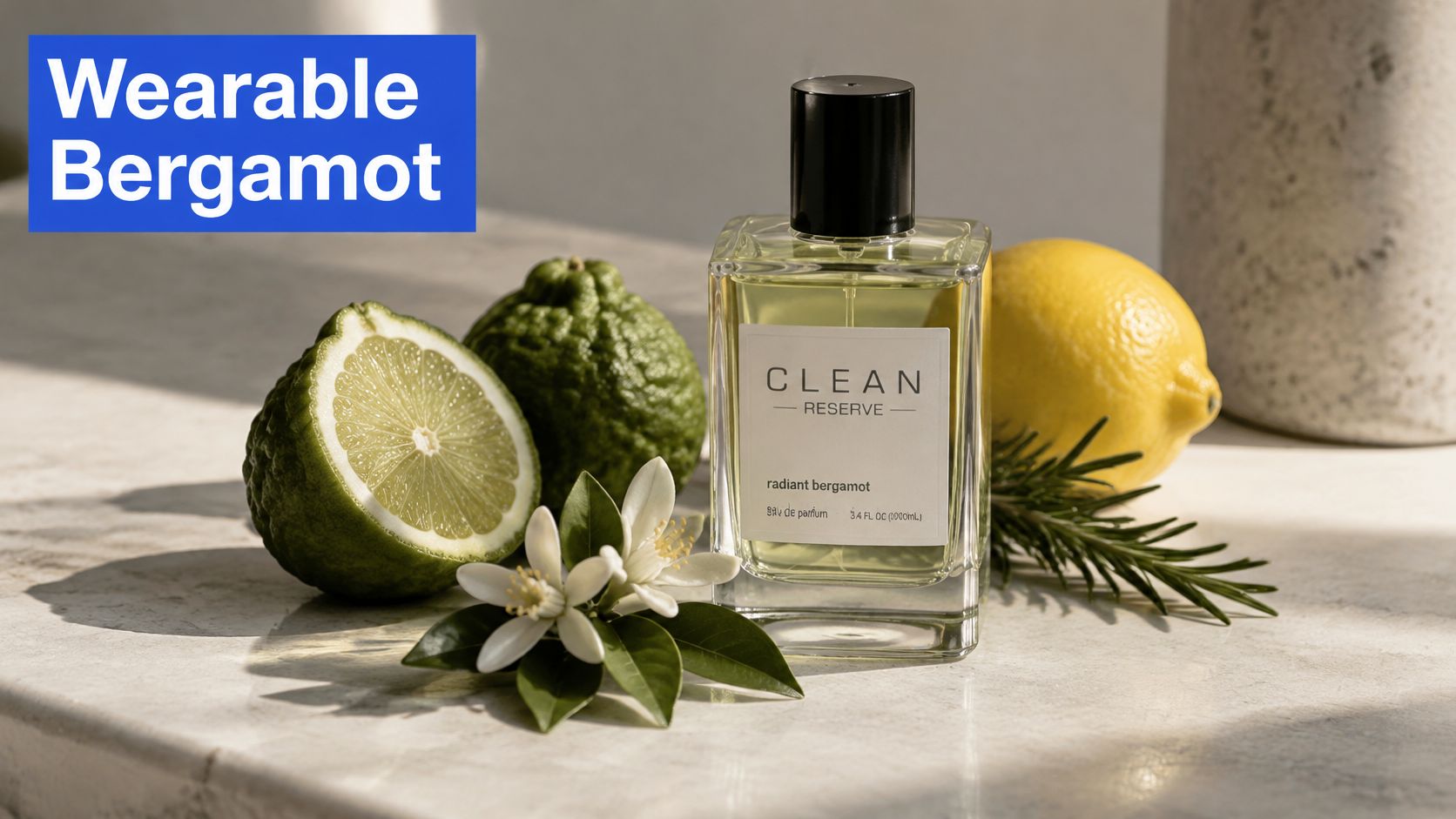
A bottle-and-fruit presentation captures the visual language shoppers often encounter. It conveys citrus appeal, not ingredient certification.
| Style | Typical companions | Best reason to try it | What to assess as it settles |
|---|---|---|---|
| Cologne | Lemon, neroli, rosemary | A crisp daytime fragrance | Whether you enjoy the quieter aromatic finish |
| Floral | Jasmine, orange blossom | A polished, close-to-skin date scent | How the flowers feel after the citrus softens |
| Chypre | Oakmoss, patchouli | A more earthy, grown-up contrast | Whether the mossy base suits your taste |
| Amber woods | Warm woods, amber effects | Evening warmth without an entirely heavy opening | How much sweetness remains underneath |
A cologne style often feels the most immediately refreshing. A chypre or amber-wood composition can seem more persistent because its underlying materials remain perceptible after the citrus becomes less obvious.
Concentration is a clue, not a stopwatch. An eau de parfum may emphasize richness, but that doesn't guarantee a longer bergamot impression than an eau de toilette.
For another format of fragrance exploration, the accompanying video is below.
Start with the heavier fragrance, then add the lighter bergamot scent sparingly. Test the combination on separate blotters first so you can abandon an awkward pairing without wearing it all evening.
Keep citrus-on-citrus modest. More sharpness doesn't necessarily produce more freshness, especially when aromatic or woody materials are already prominent.
Refresh the lighter scent only when needed, rather than loading the base with extra sprays. The goal is a balanced combination, not a larger cloud.
Outdoor occasions bring another practical consideration. If you also use insect repellent, sensitive skin repellent advice from Misaj addresses that separate product choice; perfume isn't repellent, and combining scented products doesn't replace either product's directions.
Choose by the occasion you have: a shared office, a warm terrace, dinner close together. Two bottles listing bergamot can suit entirely different versions of the same evening.
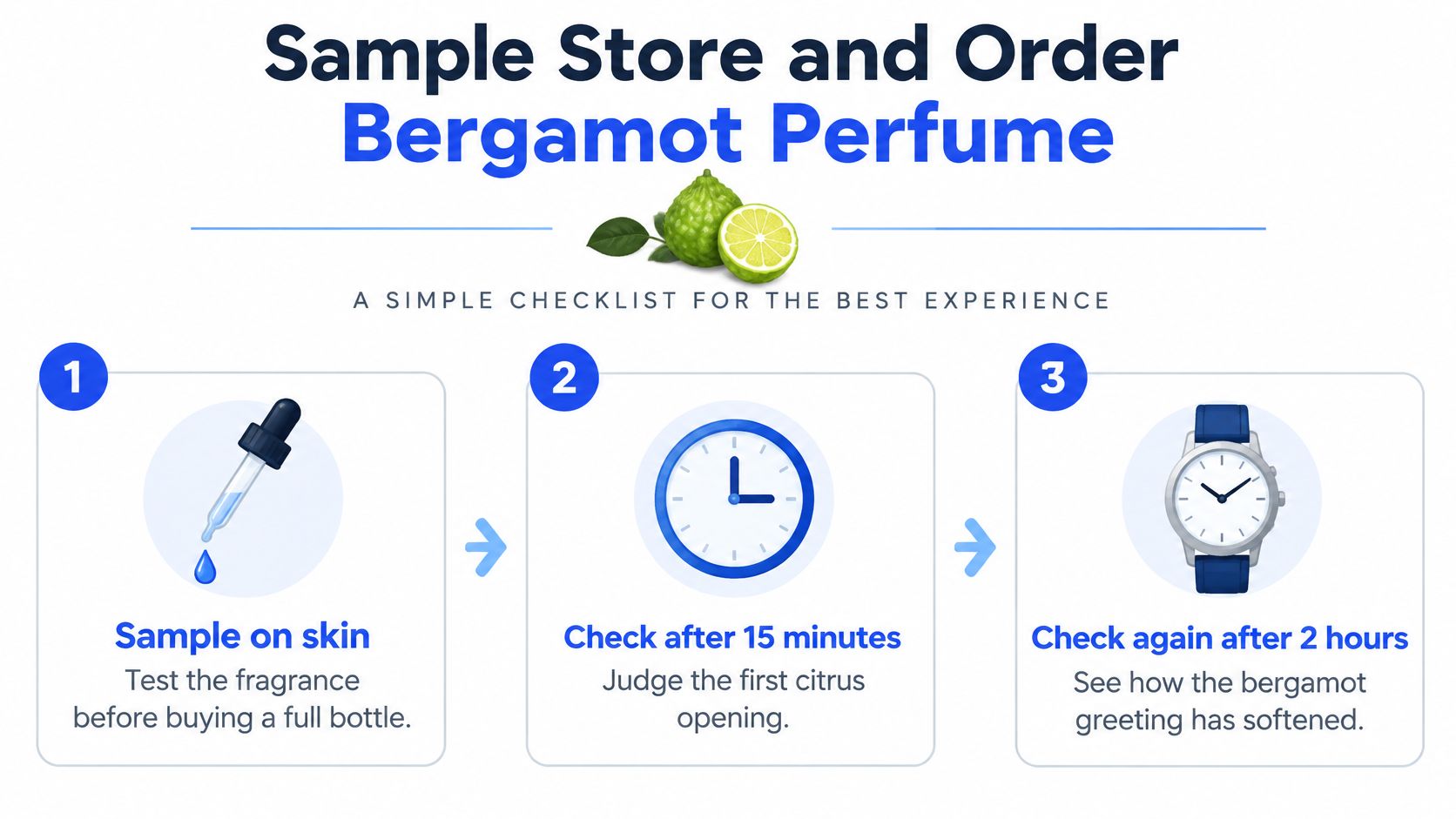
Test on clean, dry skin before committing to a full bottle. Leave a patch unscented for comparison, avoid rubbing the application site, and write down what you notice once the initial spray has settled and again later in the wear.
The useful question isn't just whether you love the opening. It's whether you'd still choose the fragrance when someone leans closer after the obvious citrus has softened.
This checklist gives the testing routine a simple visual form.
A note pyramid tells you the intended scent experience. Brand and concentration help identify the product, while sourcing documentation serves a different purpose. If certified origin matters to your purchase, look for the protected oil's proper designation in the ingredient documentation rather than treating a scenic name as evidence.
At Gotham Fragrances, our Chrome by Azzaro Gift Set for Men has the key scent notes pineapple, neroli, lemon, bergamot, rosemary, coriander, jasmine, oakmoss, and cyclamen. That combination makes it a concrete option for exploring a citrus-aromatic opening with floral and mossy contrast, rather than choosing solely by the word bergamot.
Keep the bottle upright, capped, and away from direct sunlight and heat. A bedroom drawer or shaded cupboard is a better home than a sunny windowsill or a steamy bathroom.
Leave the bottle in its box if that makes protecting it easier. You bought the fragrance to wear, not to warm under a spotlight.
A good bergamot purchase should satisfy both your nose and your expectations. Choose the style you want, test how it develops, and order the size you're likely to finish while you still look forward to every spray.
Gotham Fragrances offers authentic designer perfumes and colognes, from fresh daytime choices to warmer evening compositions. Visit Gotham Fragrances to explore a bergamot-led style, consider Chrome by Azzaro for a citrus-aromatic direction, and choose a bottle for the way you want to wear it.