

You bought the bottle everyone raves about. Two sprays, and for twenty minutes it's exactly what the reviews promised. Then you sit down at your desk and it's a whisper, and by lunch you're convinced it has vanished, while the same perfume on a coworker smells deeper, sweeter, and lasts until she gets home.
Nothing is wrong with the bottle. A skin scent is built to sit close and merge with your own body odor, so the final result is a collaboration between the formula and your skin. That makes it the hardest category in fragrance to buy blind, and the easiest one to judge badly.
Everything below rests on one rule. Judge a skin scent by how it behaves on your skin across a full day, in the rooms you sit in. Not by a bestseller badge, and never by a paper strip.
A skin scent isn't a fixed smell. It's a behavior: low projection, close wear, and enough base material to sit on your skin for hours. Judge it by hour six on you, not by the label on the box.
Three starting points cover most tastes. Chrome by Azzaro Gift Set for Men is the clean, fresh option for a man who wants something versatile enough for work and weekends. Halston Z-14 Gift Set for Men brings cedar, amber and citrus in a woody-mossy direction that suits cooler days and heavier clothes. MCM Mini EDP for Women is the floral-oriental pick for evenings, and the small bottle makes it a low-cost way to learn whether amber and green notes agree with your skin.
| Scent | Key notes | Fragrance family | Size listed |
|---|---|---|---|
| Chrome by Azzaro Gift Set for Men | pineapple, neroli, lemon, bergamot, rosemary, coriander, jasmine, oakmoss, cyclamen | Aromatic Fougère | gift set |
| Halston Z-14 Gift Set for Men | cedar, amber, citrus | Woody Mossy | gift set |
| MCM Mini EDP for Women | green notes, amber, wood | Floral Oriental | .23 oz |
| Versace Woman Eau de Parfum for Women | jasmine, frangipani, bergamot, musk, soft woods | Floral Woody Musk | 3.4 oz |
| Organza by Givenchy Eau de Parfum for Women | honeysuckle, gardenia, nutmeg, vanilla, amber | Floral Oriental | 1.7 oz (tester), 3.3 oz |
| Obsession by Calvin Klein Eau de Parfum for Women | mandarin, bergamot, vanilla, amber, sandalwood | Oriental Spicy | 1 oz, 1.7 oz, 3.4 oz, gift set |
Read the table in three passes. Key notes tell you what you'll smell in the first quarter hour, so scan for anything that turns sharp or soapy on you. Fragrance family tells you the overall character, which is how you avoid buying two bottles that do the same job. Size listed is the practical decision: a 3.4 oz bottle is a commitment, a .23 oz mini or a tester is an experiment.
Some listings itemize only the headline notes, so the notes shown for Versace Woman, Organza and Obsession come from each house's published profile rather than a full store breakdown. A thin listing is a gap in the listing, not a verdict on the scent. Our men's fragrance section and women's section are split for exactly this kind of browsing, with collection pages for Bestsellers and Iconic Scents and for Night and Evening Scents if you'd rather shop by occasion than by note.
Shortlist two rows that match your taste, then run the on-skin tests before you spend a cent.
Your friend's favorite scent turns sweeter on her wrist and quieter on yours. Same bottle, same two sprays, and by mid-afternoon you're wearing what looks like two different fragrances.
The mechanism is not mysterious. Skin emits its own volatile organic compounds, and a fragrance applied close to the body mixes with that existing odor signature instead of replacing it. A peer-reviewed study of skin emissions indexed by the National Institutes of Health identified and quantified 64 volatile organic compounds across 31 healthy volunteers using gas chromatography–mass spectrometry. The molecules ranged from C4 to C10, and aldehydes and hydrocarbons dominated the mix, with 18 aldehyde species and 17 hydrocarbon species measured.
The number that explains your disappointing Tuesday is the spread. Median emission rates ran from 0.55 to 4,790 femtomoles per square centimeter per minute, a range of more than 8,700-fold.
Plain translation: two people can wear identical sprays and be running completely different chemistry sets. Your skin isn't a hanger for the fragrance. It's an ingredient in it.
Four things move the needle, and none of them are fixed:
Your nose is part of the story too. Receptor genetics change how strongly you register certain materials, which is why one person's airy musk reads as loud and animalic on somebody else.
There's a social layer on top. A study of 137 volunteers reported by Science asked people to rate perfume ingredients two ways: whether they'd want a partner to smell that way, and whether they'd want to smell that way themselves. People with similar immune-system genetics tended to choose similar scents for personal use, but not necessarily for partners. The researchers proposed that perfume may amplify your natural scent rather than mask it, which is the most useful way to think about close-wearing fragrance. You're not putting on a smell. You're turning up the volume on one you already have.
The only test that counts: spray it on your own skin and check it several hours later. A paper strip tells you what the perfume smells like. Your wrist tells you what it smells like on you.
The bottle promises a story in three acts. Your skin decides how long each act runs.
Think of a fragrance the way you think about a layered outfit on a long day. There's the jacket you take off by noon, the shirt that stays until evening, and the boots that are still there at midnight. Every layer of a perfume is made of molecules that evaporate at a different speed, and that speed is what you're smelling when a scent "changes" on you. Nothing has been added. Something has left.
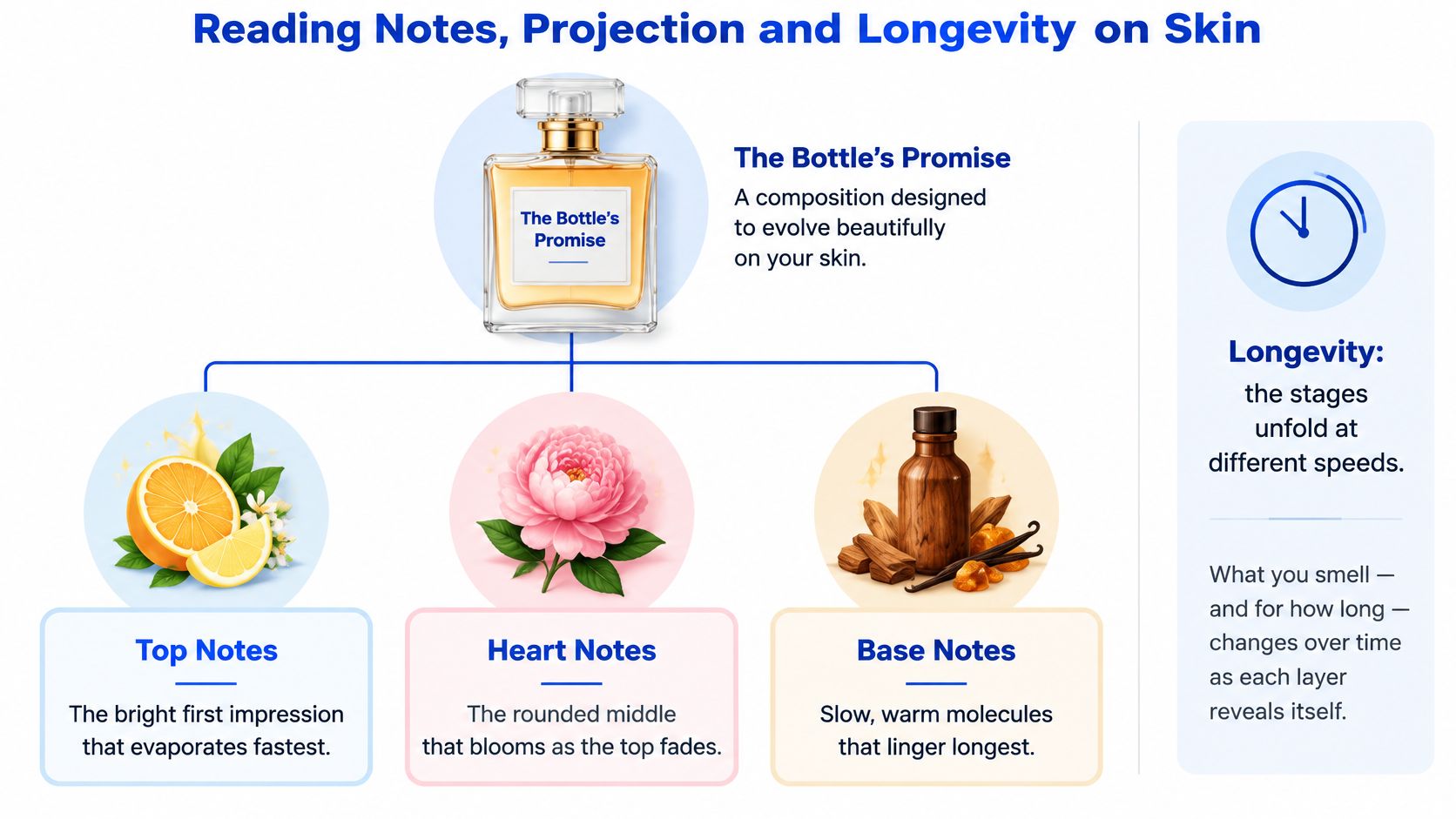
| Layer | Typical notes | When you notice it | Why it matters on skin |
|---|---|---|---|
| Top | citrus, bergamot, lemon, neroli | first 15 to 30 minutes | sets the first impression but fades fastest |
| Heart | jasmine, rosemary, coriander, floral or green notes | about 30 minutes to 2 hours | shows the character of the scent once the opening settles |
| Base | musk, cedar, amber, oakmoss, soft vanilla | 2 hours and beyond | creates the close-skin finish that drives longevity |
Molecules differ in volatility, polarity, and how tightly they cling to the skin surface. The light, volatile materials create the initial aura. The heavier, oil-loving materials, including many musks and woody or amber molecules, stay available for slower release, as a review of fragrance behavior on skin sets out. Skin temperature changes how much escapes into the air, so warmth can briefly make a scent feel stronger than it will an hour later.
If close-to-skin longevity is the goal, prioritize formulas with a noticeable musk, woody, amber or soft-vanillic base. Apply to moisturized skin, because hydration slows evaporation and gives the molecules something to hold onto.
Projection is distance: how far the scent travels from your body. Longevity is time: how long you can still detect it at all. A skin scent with low projection and eight hours of longevity is doing its job perfectly, and a faint result at hour two is not automatically a failure. It's the design.
Read every scent on one clock: opening at 15 minutes, heart at 2 hours, base at 6, with a 30-minute recheck if the opening feels too sharp. If you want the three-layer structure explained visually before you test anything, this walkthrough covers it in a few minutes:
The notes listed on a product page tell you which layer you'll meet first and which one will still be there at dinner, and every fragrance page we publish carries those notes alongside an overall scent profile. Then check the concentration. An eau de parfum carries a higher oil load than an eau de toilette and generally holds longer, so read that line next to the base notes rather than instead of them. If you're deciding between a spray and an oil-based format, Aroma Warehouse's comparison of perfume oil and spray perfume explains how the carrier changes both the opening and the tail end.
If you have eczema, reactive skin or a known fragrance allergy, don't start with your wrist. Read the safety guidance at the end of this guide first, then come back.
For everyone else, here's the protocol. It takes a day, costs nothing, and saves you from a bottle you'd otherwise talk yourself into.
Wash and let the skin cool. Clean skin at room temperature is your baseline. The slip is testing over yesterday's lotion, yesterday's perfume, or a coffee spill, which means you're judging three things at once.
Moisturize one wrist or inner elbow with something plain and unscented. Hydrated skin holds fragrance molecules longer and releases them more slowly. The slip is a scented body lotion, which adds a second fragrance to your test and ruins the reading.
Spray one sample on the moisturized area and leave the other arm bare. The bare arm is your control, and you'll need it later. The slip is spraying the same spot twice "to be sure," then wondering why the scent suddenly feels loud and cloying.
Smell at 15 minutes and note the opening. This is the stage most bottles are designed around, which is exactly why it's the least trustworthy. The slip is deciding here, from a paper strip, which shows you top notes and nothing about how your skin treats the base.
Check at 2 hours. The heart has arrived and the opening has burned off. Ask whether you still like it, not whether it has faded. The slip is buying at this point because the middle is usually the prettiest part of the ride.
Check at 6 hours and compare against the bare arm. The difference between the two arms is what the scent contributes to your skin, and it tells you whether the base lasts. The slip is testing on dry skin, which fades early and makes a perfectly good scent look weak.
Ask one other person for their read. Your nose adapts fast to a constant musk, so a scent that feels like nothing to you may be clear to the person across the table. The slip is trusting only your own nose on a fragrance you've been wearing for six hours.
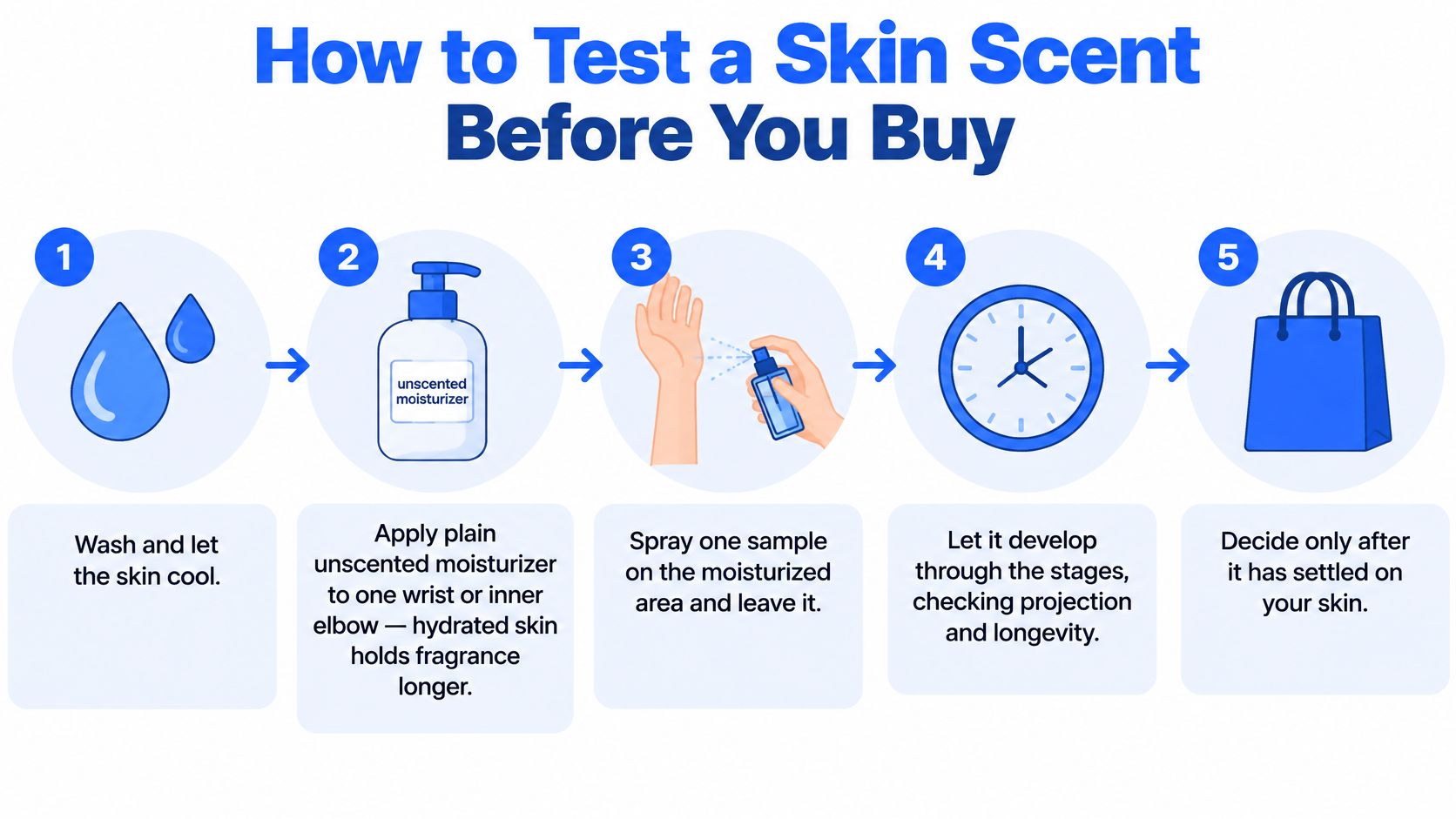
The pass test: still noticeable at 6 hours, pleasant at every stage, and appropriate for the places you go. Two out of three isn't a pass. If one stage turns sour on you, it will turn sour on you again tomorrow.
One more rule: test no more than two or three options in a day. Beyond that, your nose stops distinguishing them and everything starts to smell like the inside of a perfume shop. If your results are ambiguous, our fragrance specialists can help you narrow a shortlist from what you noticed at each checkpoint.
Skin scents are built to stay close, but "close" is relative. Intensity depends on the room, the weather, and how many people are within arm's reach, so the same fragrance can be perfect on a Sunday walk and too much in a shared office.
| Setting | Projection to aim for | Application spot | Test note |
|---|---|---|---|
| Office or shared indoor space | low, close to the body | wrist or inner elbow, one light application | musks and ambers can still reach colleagues in enclosed rooms |
| Date night or dinner | moderate, noticeable at arm's length | pulse points, neck or collarbone | warmth lifts the scent, so test it in similar warmth |
| Hot, humid day or workout | low to moderate | moisturized skin, one light spray | sweat and heat speed diffusion and shift the profile |
| Air-conditioned venue | moderate | clothing or upper back | cool air slows diffusion, so it can seem weaker than outdoors |
| Long travel day | moderate, with one planned reapply | one application on skin, reapply once before evening | reapply rather than doubling the first spray |
A skin scent can feel gentle to you and still carry to arm's length for everybody else. Musks and ambers are the worst offenders in closed rooms, because they're heavy enough to hang in the air and warm enough to bloom when a room heats up.
There's a second problem, and it's on your side of the nose. Wear a musk continuously and your sense of smell adapts until it seems to disappear. The research on musk perception and olfactory receptors explains why this varies so much between people: perception links to receptors including OR5AN1 and OR5A2, and one reported OR5A2 substitution reduced sensitivity by roughly 50-fold. Variation in OR5AN1 was associated with different responses to muscone and macrocyclic musks. So a fragrance sold as clean and intimate can smell airy to one person and considerably stronger, sweeter or more animalic to another.
Practical consequence: never assume a "your skin but better" scent is office-safe just because the marketing says so. Test it around other people, not just on your own wrist.
Here's where the playful part belongs. A study summarized by the National Institutes of Health had participants evaluate dating-show contestants through odor samples, and contestants were rated as having higher self-esteem and greater attractiveness when their natural body odor was presented with a fragranced body spray rather than alone. Fragrance didn't replace body odor. It changed how people read the person wearing it.
The biology gets stranger, and more interesting. A 2025 University of Tokyo study used gas chromatography–mass spectrometry to identify three body-odor components that increased during women's ovulatory periods. When researchers added a mixture of those compounds to model armpit odor, male participants rated the samples as less unpleasant, and faces associated with the samples were rated as more attractive and feminine. The researchers explicitly said the findings are not proof of human pheromones. Read that as permission to be seductive with a skin scent, not as a promise that any bottle will do the flirting for you.
For a dinner where you'll be sitting close, choose a moderate projection on the neck or collarbone and let body heat do the work. Warmth lifts the base notes and pushes them into the space between two people, which is exactly the distance a skin scent is built for.
Layering works on the same principle as salt. A pinch improves the dish. A handful takes over. Follow four rules and you'll rarely go wrong:
The clash is predictable once you've smelled it. A cedar-amber eau de parfum over unscented lotion stays warm, dry and close to the skin, which is what you wanted. Spray a fruity body mist on top of that and the whole thing turns sweet and crowded, with the wood fighting the fruit for the same air.
If the scent is too weak at the 30-minute check, add one light spray at the same spot rather than doubling up at the start. Doubling at the start gives you a loud first hour and no extra longevity, because the extra alcohol pushes everything off faster.
Three signs of trouble: notes that fight each other, an intensity that gives you a headache, or a scent that vanishes inside an hour. All three mean the same thing. Strip back to one fragrance on clean skin, retest, and stop adding things.
A scent that feels intimate on your wrist can still leave your skin red or itchy. “Hypoallergenic” and “clean” are marketing terms, not safety certifications. A natural or beautifully made fragrance can still contain ingredients that trigger a reaction.
Fragrance allergy is fairly common in the general population and more frequent among people undergoing patch testing. Irritation usually causes redness, stinging or tightness where the fragrance touched your skin. Allergic contact dermatitis is an immune response that may spread or appear later. If a rash keeps returning, stop using the fragrance and ask a dermatologist for advice.
A fragrance-free moisturizer can hydrate skin without adding another scent to the mix. For guidance on choosing one, see Mesoderm RX on fragrance-free moisturizers.
Three questions decide it, in this order:
Pick two options from the table above that match your taste, then test them on different days across one week using the protocol you just read. Start with a mini, a tester, or the smallest bottle, so the six-hour check decides instead of the first fifteen minutes. Use the notes column to predict which layer you'll meet first, and the family column to avoid buying two scents that do the same job.
Every bottle we ship is 100% authentic and sourced directly from authorized distributors and trusted partners, and our discounts run up to 70% off retail, which makes trying the smaller size a cheap decision. Younger shoppers already treat fragrance as a wardrobe rather than a signature: Circana data reported by BusinessWorld found that households with a Gen Z member accounted for about 38% of fragrance spending in the 26 weeks ending July 2025.
Do this today. Choose two options, apply each to moisturized skin on one wrist, and set a six-hour check on your phone.
Gotham Fragrances exists so you can test that shortlist without paying department-store prices: authentic designer and niche bottles, everyday discounts of up to 70% off retail, free shipping over $80, and complimentary samples with first orders so you can put a scent through a full day before committing to a full bottle. Browse the Gotham Fragrances bestsellers and evening collections, pick the two that match your taste, and let your own skin make the final call.