
You've got a vanilla perfume open in one tab, a glowing recommendation in another, and one very reasonable question: will this smell like warm, irresistible skin, or a cupcake you can't escape? Both can be fun. Only one might belong in your everyday wardrobe.
The best vanilla perfumes for women aren't all sweet, and they certainly aren't interchangeable. Choose by the mood you want, how close you want someone to get before they notice, and what your skin can comfortably tolerate. My starting picks range from Shalimar's dressed-up warmth to Angel's unapologetic gourmand personality, with practical daytime options in between.
| Perfume | Vanilla character | Concentration | Best for |
|---|---|---|---|
| Shalimar by Guerlain | Warm, classic, powdery vanilla | Eau de Parfum or Eau de Toilette, depending on the release | Evenings and special occasions |
| Opium by Yves Saint Laurent | Spiced, resinous vanilla | Eau de Parfum or Eau de Toilette, depending on the release | Cooler evenings |
| Angel by Mugler | Sweet, gourmand vanilla | Eau de Parfum | Cozy days and playful wear |
| Obsession by Calvin Klein | Sweet vanilla within a fuller composition | Eau de Parfum | Everyday wear |
| Organza by Givenchy | Floral vanilla, lighter in mood than a dessert gourmand | Eau de Parfum | Office and daytime wear |
| Vanille Planifolia Extrait 21 by Guerlain | Pure, rich vanilla | Extrait | Persistent signature-scent ambitions |
Want cozy sweetness? Start with Angel.
Want evening drama? Compare Shalimar with Opium.
Want daily versatility? Try Obsession or Organza, and put Guerlain's extrait on your sampling list when persistence is the priority.
Read the table this way. Vanilla character tells you the direction to assess on skin: powdery warmth, resinous spice, or full dessert sweetness. Concentration gives you the format to look for, because the same fragrance name can sit on the shelf in very different strengths. Best for is my recommended setting, a starting suggestion rather than a dress code.
My strongest advice: don't buy Angel because you like vanilla desserts, and don't dismiss Shalimar because you don't. A fragrance has to stay enjoyable at hour four, while a paper strip only shows you the first five minutes.
For work, start with Organza if you want a floral impression or Obsession if you prefer a warmer everyday direction. Both are easy to find: Gotham Fragrances lists Obsession in 1 oz, 1.7 oz and 3.4 oz sprays plus a gift set, and Organza in a 1.7 oz tester and a 3.3 oz bottle. Neither earns an automatic office pass, though. How much you spray and how warm the room runs matter as much as the label.
If your skin pushes back on heavier formulas, order your sampling by strength: eau de toilette first, eau de parfum second, extrait last.
Buying rule: Choose the scent you want around you for an ordinary afternoon, the one you still enjoy hours in.
Let the opening attract you. Let the drydown decide.
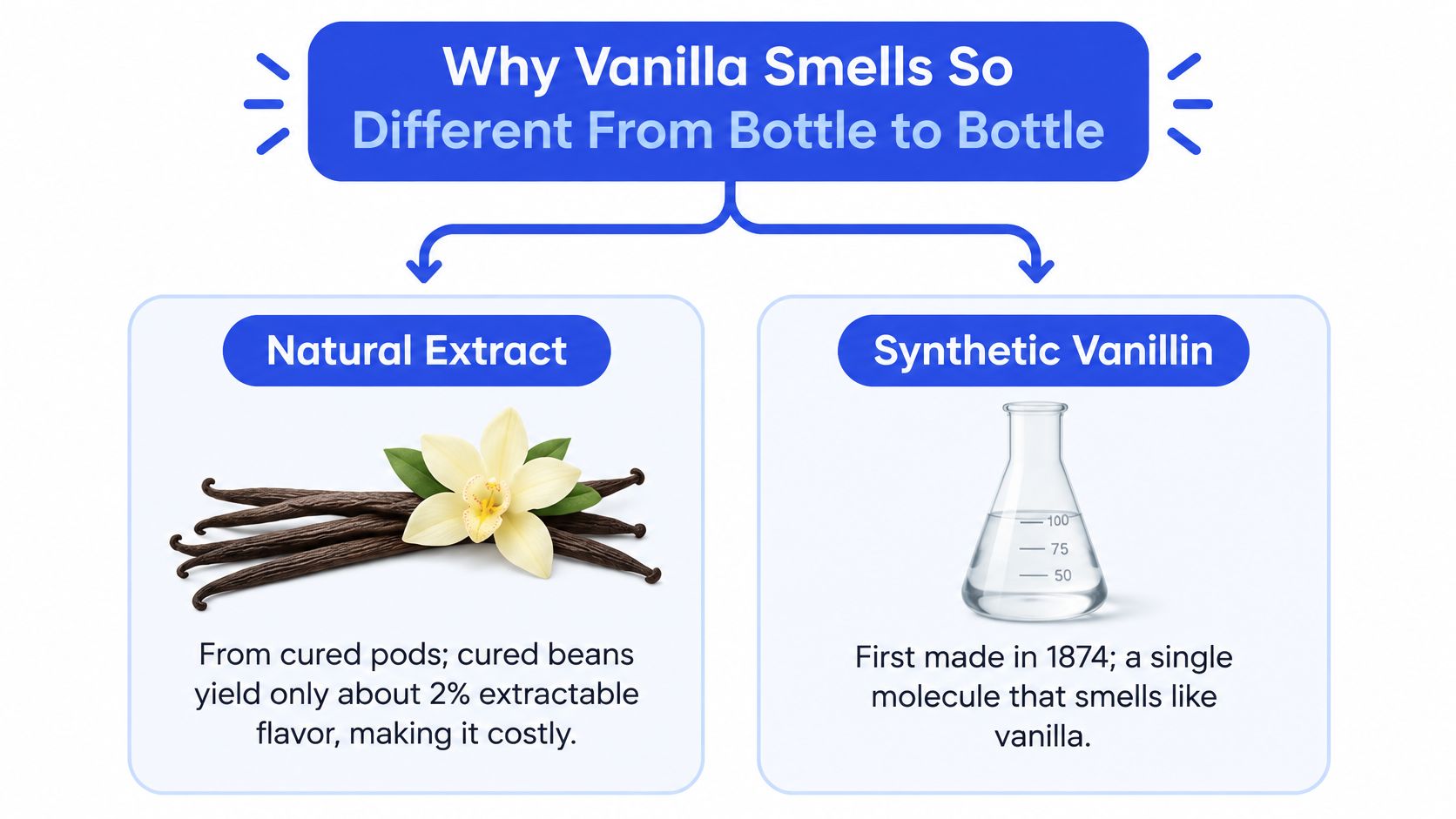
Perfumers can build vanilla character from natural extracts of cured pods, synthetic vanillin, or a combination. Natural vanilla brings more than a straightforward sweet impression; vanillin offers a recognizable vanilla core that can be shaped with flowers, citrus, resins, woods, and musk.
The agricultural economics explain why those options matter. The U.S. International Trade Commission working paper describes cured beans yielding about 2% extractable flavor, with approximately 500 kilograms of pods needed for 1 kilogram of vanillin. It also traces Ferdinand Tiemann and Wilhelm Haarmann's synthesis of vanillin from coniferin in 1874, Jicky's combination of synthetic vanillin and natural materials in 1889, and vanilla's central role in Shalimar in 1925.
The distinction is easier to understand visually:
Judge a vanilla perfume on sweetness, supporting notes, development, and overall style. Vanilla with caramel suggests something edible; vanilla against dry woods can feel considerably less sugary.
The pairing guidance in Glamour's vanilla fragrance guide highlights citrus, florals, woods, amber, and soft musks as useful companions. Citrus can provide lift, while woody and resinous materials give the composition a deeper foundation.
Vanilla styles and the notes that shape them
| Style | Supporting notes | Mood | Best wear time |
|---|---|---|---|
| Creamy gourmand | Caramel and soft musk | Cozy and sweet | Evenings and cold weather |
| Ambered vanilla | Amber, benzoin, and sandalwood | Warm and sensual | Night out |
| Citrus vanilla | Bergamot and soft musks | Light and bright | Daytime and warm weather |
| Floral vanilla | Jasmine and rose | Soft and romantic | Dates and social events |
| Spicy or smoky vanilla | Spice, resin, or smoke | Dramatic and bold | Cooler months |
These are style combinations, not promises that every perfume contains those exact materials. A listed note describes an olfactory impression, so don't treat a note pyramid as a full formula.
Check our product pages for fragrance notes and the overall scent profile before choosing. Look for the contrast you enjoy, whether that's sparkling citrus, powdery flowers, or darker resins, rather than assuming every bottle with vanilla will smell creamy and sweet.
Choose your mood first: polished and sensual, sweet and playful, or easy enough to wear while answering emails. These profiles are editorial starting points, not claims of personal wear testing or guaranteed performance.
For a broader look at preferences beyond vanilla, Cleverfy Beauty's guide to scents women adore most can help you identify whether flowers, woods, or sweeter accords belong on your comparison list.
Keep the application simple while you compare:
Shalimar by Guerlain is my classic-evening starting point. Its warm, powdery vanilla direction suits someone who wants elegance with a little mystery, rather than an obvious dessert effect. Wear it with whatever makes you feel composed and slightly dangerous.
Best occasion: Dinner, a special celebration, or a cold evening when you want a substantial fragrance. Your test: Follow the transition from the opening to the settled base and decide whether the powdery impression feels intimate or too formal.
Opium by Yves Saint Laurent takes the darker route, surrounding vanilla with a spiced, resinous mood. It's my choice for someone who wants presence, but I wouldn't make a crowded, overheated room its first outing.
Best occasion: A cooler evening with room for a bolder scent. Your test: Notice whether you still enjoy the spice once you've moved indoors; attractive richness can become more than you want in close quarters.
Angel by Mugler is the gourmand choice here. Pick it when you want a playful, dessert-like mood rather than discreet vanilla softness. If sweetness usually tires you out, don't mistake curiosity for compatibility.
Best occasion: Cozy leisure time or a social outing where an expressive perfume feels welcome. Your test: Begin sparingly, then assess the settled sweetness after you've stopped actively paying attention to it. Do you want another sniff, or a break?
Obsession by Calvin Klein is a practical comparison for a warm daily fragrance. Think of it as a complete perfume with vanilla character, not a clean vanilla soliflore. Our women's selection lists Eau de Parfum sprays in 1 oz, 1.7 oz, and 3.4 oz, plus a gift set.
Best occasion: Everyday wear when you prefer warmth to freshness. Your test: Wear it through a normal afternoon and check whether its presence stays comfortable at your desk and during your commute.
Organza by Givenchy is my daytime starting point for someone who wants flowers around the vanilla. Floral doesn't automatically mean faint, so apply with restraint before choosing it for a shared office. Our selection includes a 1.7 oz tester and 3.3 oz Eau de Parfum.
Best occasion: Daytime plans and office wear where fragrance is welcome. Your test: Decide whether the floral character remains enjoyable after the opening settles, rather than judging it solely on initial brightness.
Versace Woman by Versace is worth considering if your search reveals that you want a women's fragrance more than a vanilla-led fragrance. We list its 3.4 oz Eau de Parfum Spray for women, but that listing alone doesn't establish a dominant vanilla character.
Best occasion: Your everyday-fragrance comparison. Your test: Evaluate it beside Organza for floral appeal, sweetness, and comfortable projection, without expecting a vanilla substitute.
Vanille Planifolia Extrait 21 by Guerlain is the luxury sampling target for someone who wants to explore rich vanilla itself. Put it ahead of a dessert-style bottle if your interest is texture and depth rather than confectionery.
Best occasion: Signature wear when you want a concentrated vanilla experience. Your test: Ask whether the late dry-down remains compelling enough to justify choosing it over a more versatile composition. Richness should earn its place, not merely impress at first sniff.
| Concentration | Fragrance concentrate | Typical longevity |
|---|---|---|
| Parfum or extrait | 20 to 30% | 6 to 12 hours |
| Eau de Parfum | 15 to 20% | 4 to 8 hours |
| Eau de Toilette | 5 to 15% | 2 to 4 hours |
| Eau de Cologne | 2 to 5% | 1 to 2 hours |
These approximate concentration and wear ranges come from ChemFYI's perfume chemistry overview: parfum or extrait at 20 to 30% and 6 to 12 hours, Eau de Parfum at 15 to 20% and 4 to 8 hours, Eau de Toilette at 5 to 15% and 2 to 4 hours, and Eau de Cologne at 2 to 5% and 1 to 2 hours. Treat them as category expectations, not product guarantees.
The stages of a perfume help explain what you're noticing:
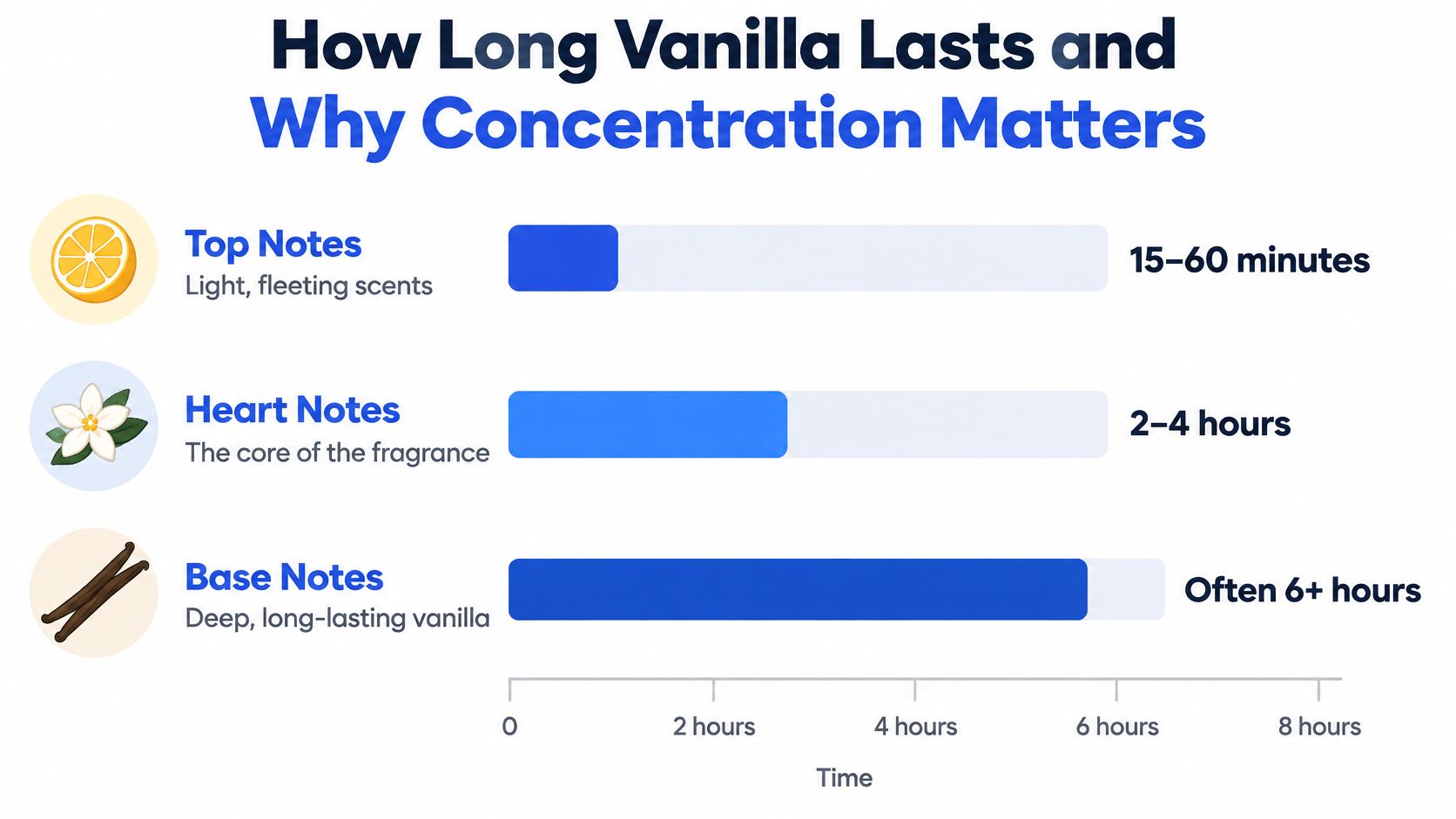
Vanilla is generally used as a low-volatility base material. The Osmetheca longevity guide gives approximate stages of 15 to 60 minutes for top notes, two to four hours for heart notes, and five to twelve hours or longer for base materials including vanilla.
Those overlapping stages aren't timers that switch ingredients on and off. You may smell vanilla immediately, but the balance can become warmer or woodier as brighter materials fade.
For a concentrated benchmark, Vogue's modern vanilla perfume feature describes Guerlain Vanille Planifolia Extrait 21 as using 30% vanilla tincture and absolute, with vanilla planifolia cold-soaked in alcohol for 21 days. That makes it an interesting persistence candidate, not proof that it will outlast every other perfume on your skin.
A scent can stay close and last beautifully. Loudness isn't the same thing as staying power.
Projection is the distance at which others can notice the scent; longevity is how long it remains detectable. ArtNaturals' explanation of eau de toilette vs eau de parfum is useful when you're comparing bottle designations rather than choosing the strongest-sounding name.
Apply to comfortably moisturized skin, using an unscented moisturizer so it doesn't complicate the comparison. Assess the opening, the settled middle, and the end of your day; note whether vanilla, woods, or another accord dominates.
For a visual companion to your wear comparison:
Record skin wear separately from clothing wear, and don't keep adding sprays during the test. A stronger concentration won't guarantee all-day satisfaction when your skin, climate, or application works against it.
A beautiful scent isn't a good purchase if wearing it leaves you itchy. A peer-reviewed study of scented-product exposure and fragrance allergy found a significant association with contact allergy to fragrance allergens, with an odds ratio of 1.70 and a 95% confidence interval of 1.14 to 2.52. That's an association, not proof that vanilla itself caused the reactions.
Disliking a fragrance and being allergic to it are different problems. A perfume can smell too sweet without harming your skin, and a scent you love can still trigger a reaction.
Fragrance mix I and balsam of Peru are important names in fragrance-allergy assessment. Balsam of Peru has a sweet, vanilla-like aroma, but that resemblance doesn't mean every vanilla perfume contains it, or that all vanilla-smelling materials cause the same reaction.
Ingredient lists can include named substances alongside umbrella terms such as fragrance or parfum. Neither natural nor synthetic is a reliable shortcut for skin tolerance.
Use this cautious screening routine if you don't have a known fragrance allergy:
If you have diagnosed fragrance allergy, active eczema, or a history of substantial reactions, ask your dermatologist before deliberately testing another perfume. A home spot trial isn't diagnostic patch testing and can't establish that a formula is allergy-safe.
Skin-first advice: Don't keep wearing an irritating perfume just because someone promised exceptional longevity.
Your tolerance matters more than performance claims. Hydration and climate may change your wearing experience, but they don't make a known allergen suitable for your skin.
Vanilla can be sexy without turning the room into a bakery. Its most persuasive quality is often intimacy: warmth, familiarity, and the pleasure of wanting to lean closer.
In a functional MRI study of vanilla-related odorants, 44 participants showed stronger activation from vanillin than from structurally similar comparison odorants in the left amygdala and parahippocampal gyrus, despite similar intensity, pleasantness, and familiarity ratings. Those regions are associated with emotion and memory processing, not a scientifically guaranteed ability to make your date swoon.
A separate Chemical Senses study of odor and emotion associated vanillin mainly with happiness. That supports a cheerful, inviting interpretation, but your memories and the surrounding formula still matter.
Consumer preferences also reach beyond sweetness: a discussion of young consumers' fragrance choices reports that 64% of surveyed people aged 18 to 25 preferred sweeter-smelling perfumes, while 80% chose products partly according to how the scent made them feel. Your own preference is still the deciding vote.
If vanilla appeals to you but frosting doesn't, sample Shalimar before Angel. Its classic, contrasted direction is a more useful starting comparison than assuming the sweetest option will satisfy your craving for warmth.
Check the exact product's notes if citrus or woods are your priority. Don't infer a specific accord from the brand name or from the word vanilla alone.
Make your final judgment on sweetness, projection, and season. Ask whether the sweetness stays enjoyable, whether the scent reaches farther than you want, and whether you'd welcome that same presence on a warmer day.
Buy the vanilla that matches your mood and wear goal, and choose a sample or small bottle before committing to a large one. A signature scent should suit your actual life, not an imagined calendar full of candlelit dinners.
Build a manageable shortlist. For example, compare Organza for daytime, Shalimar for evening elegance, and Angel for gourmand pleasure if you're still deciding which personality feels most like you.
If you already dislike edible sweetness, replace the gourmand trial with Opium. If rich vanilla itself is the fascination, make room for Vanille Planifolia Extrait 21 rather than collecting several bottles that answer the same question.
Use a small written scorecard so the most dramatic opening doesn't win by default:
| Decision | What to record |
|---|---|
| Character | The impression you actually smell, not just the listed notes |
| Sweetness | Comfortable, too sugary, or not sweet enough |
| Projection | Private, noticeable nearby, or too expansive |
| Persistence | Gone too soon, sufficient, or longer than you want |
| Setting | Workday, relaxed weekend, date, or special event |
| Tolerance | Comfortable skin or a reason to stop testing |
Complete the skin-screening routine before broader wear, and test candidates on separate occasions. Use comparable application and avoid layering them with scented lotion while deciding.
Assess the opening, the afternoon impression, and what remains when your day is done. Notice whether you still enjoy the perfume when the vanilla gives way to woods or when the warmer base becomes more prominent.
The winner isn't necessarily the perfume you notice most. It's the one you're happiest to notice again.
Our search tools can help you find specific fragrances, while Bestsellers, Iconic Scents, and Night/Evening Scents collections offer different starting points. Use those collections to discover candidates, then return to the product's notes, concentration, and size before choosing.
Our FAQ also addresses whether perfumes expire, how to store them, and the difference between perfumes and eau de toilette. Keep your bottle away from heat and direct light, close it after use, and note its purchase date so you can track changes without guessing.
Don't buy a larger bottle because it looks like better value. First establish that you enjoy the settled scent, can wear it comfortably, and have somewhere in your routine for it.
Choose your vanilla by the wear you want, not the name on the label. Sexy might mean a warm whisper on your wrist, not a cloud that arrives before you do.
Explore authentic designer perfumes for women at Gotham Fragrances, including Obsession and Organza in several bottle sizes. Use our search and occasion-based collections to narrow your choices, then choose the size that lets you discover your signature vanilla without rushing the commitment.