
Most rose perfume advice is backwards. You'll be told to buy the most expensive bottle you can afford, hunt for the longest-lasting formula, and trust the word "rose" on the box. All three shortcuts fail on skin. The priciest rose can be a room-filling cloud you can't wear to work, and the longest-lasting one is usually the bottle you reach for least, because heavy projection is a costume, not a daily habit.
Here's the rule I'd give a friend: pick the rose for the room you'll be standing in. Something transparent and bright for the office, something warm and spicy for a night out, a light veil for August. That's the whole game. Price tells you what a brand thinks of itself, not how a scent behaves on your skin, and "natural" tells you nothing about whether your skin will tolerate it.
The rest of this guide breaks rose down by chemistry, concentration and occasion, then hands you a sampling routine you can run in one afternoon with two paper strips and one forearm. Rose rewards that work more than almost any other note, because no other flower swings so wildly between clean, jammy, powdery, clove-spicy and animal-dark depending on which trace compounds the perfumer leaned on.
Allure named Parfums de Marly Delina Eau de Parfum its best overall rose perfume at $220, and the fragrance had already won the magazine's 2024 Best of Beauty Award for best floral scent (Allure). Vogue Scandinavia went softer, choosing Lancôme Mille et Une Roses as its best overall pick at €211 (Vogue Scandinavia). ELLE flagged Diptyque Eau Rose Eau de Parfum at $183, a 29% discount from its listed $260 (ELLE).
Three winners, three moods. That disagreement is the useful part: rose is a context note, and the bottle that earns applause can still be wrong for your Tuesday.
| Pick | Brand | Reported price | Recognition |
|---|---|---|---|
| Delina Eau de Parfum | Parfums de Marly | $220 | Allure best overall; 2024 Best of Beauty floral winner |
| Mille et Une Roses | Lancôme | €211 | Vogue Scandinavia best overall |
| Eau Rose Eau de Parfum | Diptyque | $183 (listed $260) | ELLE pick; 29% off listed price |
Cosmopolitan UK's team tested more than 40 rose scents before settling on 16 recommendations, a sensible sample size for a flower with this many personalities (Cosmopolitan UK). One editor's favourite is a lead, then skin gets the vote.
Choose by room, not trophy. Delina is a bright, fruity rose with a litchi-and-rhubarb opening that carries across a room, so it earns dinner and earns suspicion at a quiet desk. Mille et Une Roses sits closer and rounder, better behaved in a small office. Eau Rose reads green and dewy, nearer to a cut stem than a bouquet, and the discounted price makes it the easiest first bottle here.
Before a full bottle, wear rose in the cheapest small format you can find for a week: roll-on, travel spray, counter sample. A low-cost example is the Loyaltie listing for Moonlight Rose, useful for learning how rose warms on your skin rather than standing in for the picks above. Shortlist two that match your calendar, then let your forearm break the tie.
A label that says rose gives you almost no useful information. It can mean a wet green stem, a powdery violet cosmetic, a dark spoon of plum jam, or a clean floral mist that disappears by lunch. The romance is in the name. The behaviour is in the trace materials.
Abundance is the trap. Rose oil can be rich in citronellol and geraniol and still have its character set by far smaller players such as damascenone and ionones, because your nose does not vote by volume. It votes by threshold, by what stays detectable when the loud opening has burned off. That is why the most expensive or longest lasting rose is not automatically the easiest daily wear. Power can become syrup in a warm office, and quiet can turn gorgeous by late afternoon.
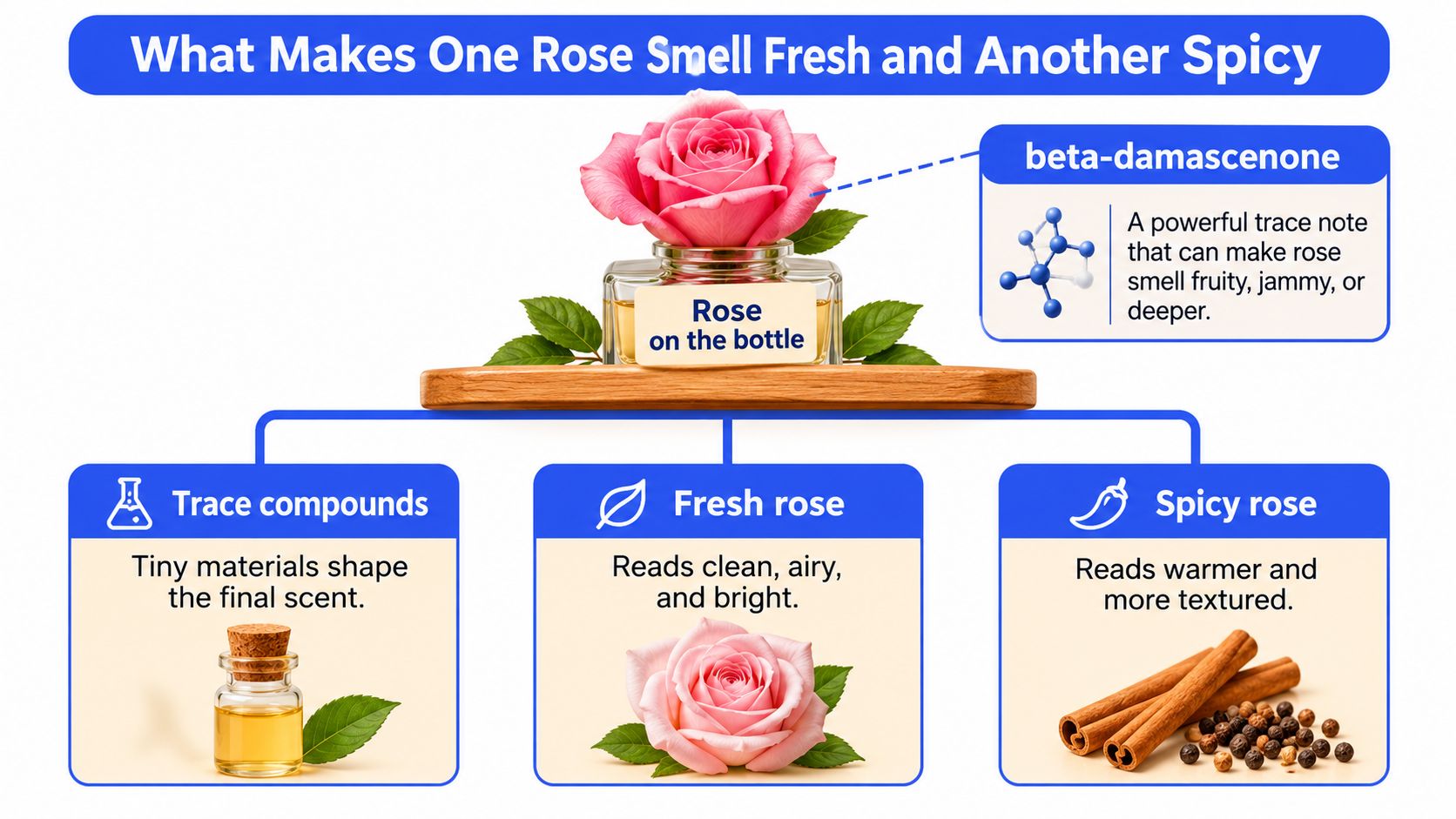
That explains why two bottles both labelled rose can smell unrelated. A composition leaning on citronellol and geraniol reads fresh, lemony and clean, like a stem snapped in half. One built around damascenone and ionones reads honeyed, violet-like, jammy or powdery, closer to rose conserve than to a garden. Same flower, opposite moods.
Botanical research summarized by the World Federation of Rose Societies puts a hard number on the myth: about 25% of rose varieties have no scent at all, about 20% are strongly scented, and the rest fall somewhere in between (World Federation of Rose Societies). A quarter of the roses on earth smell of nothing. Anyone who tells you rose perfume is automatically sweet or romantic has not met enough roses.
The three-hour test: a rose that smells sharp and soapy at minute two can turn gorgeous by hour two, and a stunning opening can collapse into powder. Judge the late dry-down, because the high-impact trace materials often surface only after the bright top notes burn off.
Read a note list with a map in your head. Rose sits in the centre, and four branches lead away from it:
When a listing says "rose" and nothing else, the supporting notes and the base tell you which branch you are on. A rose over cedar and musk will land fresh enough for daylight. A rose over patchouli, vanilla and saffron will land dark and slow. Pick the branch for the room you will be entering, not the mood you wish you were in.
The best rose perfume is decided by the room, not the shelf. Most shoppers meet four style families, and each solves a different problem. Transparent classic rose is bright, dewy and polite. Oud rose layers rose over resinous wood and saffron, heavy and unmistakably evening. Musky rose sits close to skin and reads as warmth rather than flower. Rose gourmand wraps the note in vanilla, praline or fruit and smells deliberately edible.
The chemistry behind those families is documented. Analytical research separates rose chemotypes: a classic European profile built on citronellol, phenylethyl alcohol and geraniol, an oriental profile richer in eugenol, methyl eugenol and alpha-farnesene, and a tea-like profile carrying compounds such as 3,5-dimethoxytoluene and theaspirane (Journal of the Science of Food and Agriculture).
Translate that into wear. Citronellol, geraniol and phenylethyl alcohol give you the recognizable fresh rose that works in daylight, on public transport and in an open-plan office. Eugenol brings clove-like warmth and drama, which is exactly what you want at 9pm in November and exactly what you don't want at a 10am meeting. Rose oxide adds green, minty and citrus lift, and it's the reason some roses feel cooling in heat rather than syrupy.
Rose's sensual reputation isn't a marketing invention. An Odeuropa encyclopedia entry records Cupid traditionally depicted wearing a wreath of roses, and traces how roses became symbols of sensuality and desire across religious and artistic traditions (Encyclopedia of Smell History and Heritage).
The chemistry backs the mood. A 2024 study on rose odour found ionones, phenylethyl alcohol and its derivatives, and oxylipins were key contributors to perceived pleasantness, and that the proportions of phenylethyl alcohol-related compounds were associated with how attractive a rose smelled (2024 rose odour study). Phenylethyl alcohol gives the soft honeyed haze; ionones add the powdery violet shadow. That combination is why some roses feel alluring and others feel like soap. It is not an aphrodisiac, and no perfume is.
Spray both shortlisted bottles on skin, one on each forearm, and write down three impressions: the first 15 minutes, the one to two hour heart, and the dry-down. That schedule catches the moments when the trace compounds take over. If a rose is going to turn jammy, spicy or powdery, it happens in hour two, not at the counter.
Reality check: the longest-lasting rose is often the worst desk companion. A trail that follows you down a corridor is a liability at work and a pleasure at dinner.
| Occasion | Rose style | Projection | Climate fit |
|---|---|---|---|
| Office and shared transport | Fresh classic rose with citronellol and geraniol | Soft | Any climate |
| Weekend brunch | Green rose with rose oxide lift | Moderate | Warm months |
| Date night | Spicy oriental rose with eugenol warmth | Strong | Cool evenings |
| Summer heat | Light rose eau de toilette or body mist | Light | Hot climates |
| Gift for someone new | Transparent, approachable rose | Moderate | Any climate |
Two roses are enough, not five: one soft daytime bottle and one warmer evening bottle. Buy the third only when a specific gap appears, like a summer trip or a wedding.
Two things govern how long a rose stays on your skin. How much aromatic material you sprayed, and how fast each material evaporates. Citrus and aldehydes leave in minutes. Woods, musks, resins and amber stay for hours.
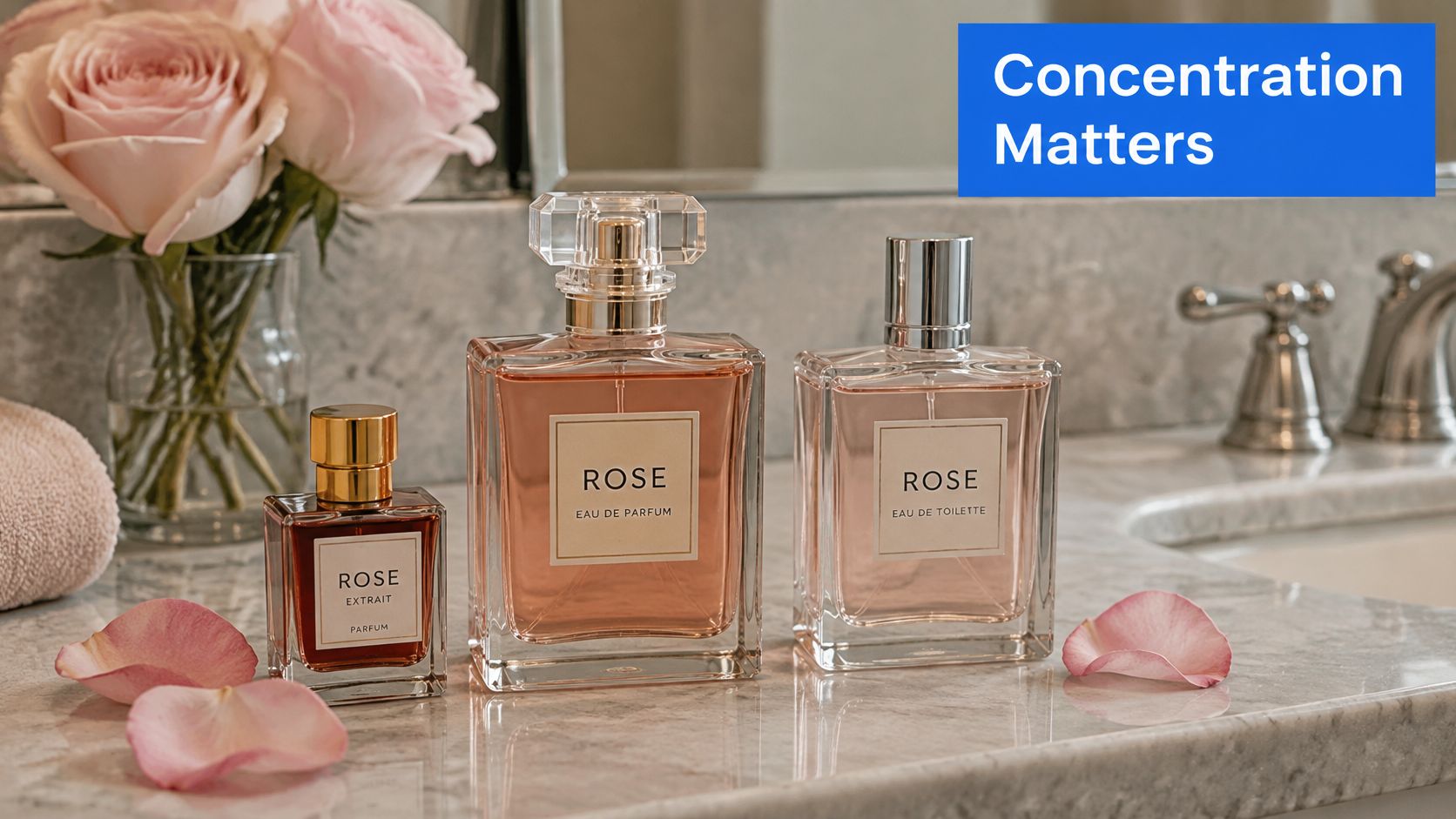
The concentration gap is wider than the tidy label suggests. An extrait puts the most perfume material on skin, an eau de parfum sits in the wearable middle, and an eau de toilette reads thinner and sooner gone; longevity still depends on the raw materials underneath the rose (Osmetheca olfactive basics). The formats look like this side by side.
Rose almost always lives in the heart of a composition, which is why the note shifts so much across the wear. What you smell at hour four is rarely the rose you smelled at the counter. Heavier base notes remain after the brighter opening fades, and they reshape the rose into something drier, muskier or sweeter.
The honest answer sits under the flower. A rose over patchouli, oud, vetiver or amber will run long. A rose over citrus, aldehydes and light florals will fade before lunch, which suits a scent you enjoy reapplying.
| Concentration | Aromatic concentrate | Longevity pattern | Best use |
|---|---|---|---|
| Extrait de parfum | Highest | Longest, richest dry-down | Special evenings |
| Eau de parfum | High | Long, rounder dry-down | Everyday wear and gifting |
| Eau de toilette | Moderate | Lighter, shorter | Office and warm weather |
| Body mist | Lightest | Shortest and sheerest | Layering over a stronger rose |
An eau de parfum is the right daily purchase because it balances projection against cost and will not suffocate a meeting room. Save the extrait for evenings when the richness earns its place. Keep a body mist for hot afternoons, either alone or layered under a stronger rose to soften it.
Shopping rule: read the base notes before the concentration on the label. A light eau de toilette built on musk, amber and woods can outlast a heavier blend that opens on citrus and evaporates into nothing.
Natural rose is not automatically gentle. Rose materials naturally contain geraniol and citronellol, both recognized fragrance allergens, which means an extract straight from the field can irritate reactive skin just as readily as a lab-made molecule (Prosody London rose perfume guide). "Natural" describes origin. It says nothing about tolerance.
Separate presence from proof of harm. A material showing up in a formula, or detected in a biological sample, doesn't establish that it injured anyone. What it establishes is that a small share of people react to it, and that a patch test costs you almost nothing.
A "clean" label doesn't mean allergen-free. It usually reflects a brand's own exclusion list, which varies from house to house and rarely addresses fragrance allergens at all. If your skin is sensitive, the ingredient list is more useful than the marketing: geraniol, citronellol, eugenol, linalool and coumarin are the names to look for.
Synthetic rose molecules are sometimes the smarter choice, not the compromise. They give a perfumer consistency from batch to batch, they avoid harvest swings, and they let a composition be built without the specific components that trigger a reaction. A reconstructed rose can be lower risk for a reactive wearer than a rich natural absolute, and it can smell cleaner and more modern besides.
Transparency and restraint do more for sensitive skin than any "non-toxic" badge. One spray instead of four, applied to clothing, is often the whole fix.
Start with the occasion, not the shelf. Decide which of the five situations in the table above happens most in your actual week, then match the rose style to it. Someone who works in an office and takes the bus needs a soft fresh rose far more than a projection monster, and someone whose social life is dinners in cold weather will get more from a spicy oriental.
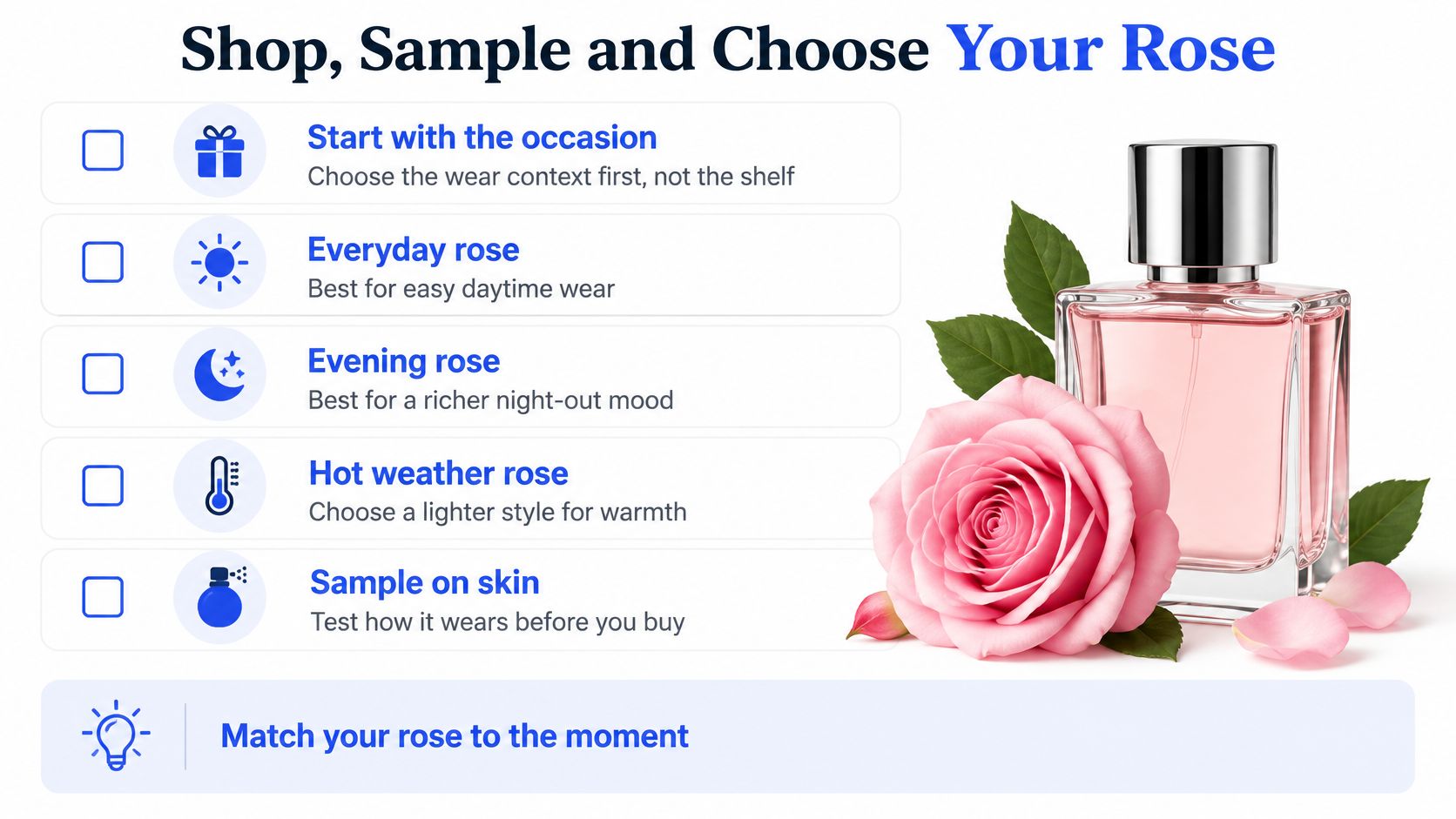
An everyday rose handles work and errands: transparent, soft projection, fresh chemotype. An evening rose brings warmth and spice for dinners and cold weather. A hot-weather rose is a light eau de toilette or mist you can reapply without announcing yourself. Three bottles cover nearly every occasion in a year, and two cover most of them.
Our Bestsellers and Night and Evening Scents collections are organised around that split, and our product pages list fragrance notes and an overall scent profile for each bottle, so you can check whether a rose leans green, jammy or spicy before you buy.
The most expensive or longest-lasting rose is not automatically the right daily choice, and it's worth repeating until it sticks. A $220 projection bomb can be the wrong bottle for a shared desk, and a lighter eau de toilette at a third of the price can be the one you finish. Use our search tools to filter by brand or name once you know the style you're after, and let the wear test decide, not the price tag.
Rose has been the smell of desire for a few thousand years. Give it one afternoon on your own skin, and one honest glance at your calendar, before you decide it isn't for you.
Gotham Fragrances brings together authentic designer scents from Chanel, Dior, Tom Ford, Prada, Gucci and more, with everyday discounts of up to 70% off retail and fragrance notes listed on every product page so you can match a rose to the room you'll wear it in. First-time buyers can claim complimentary product samples, which makes the two-rose test in this guide cheap to run before you commit to a full bottle. Visit Gotham Fragrances and find the rose that fits your week, not just your wishlist.