

The usual advice sounds irresistible: switch to alcohol-free cologne and you'll smell better, feel gentler on your skin, and stay irresistible all evening. Say you're buttoning a shirt for a date, though, and all you want is a scent someone discovers when they lean closer, not evidence that you fogged the bathroom. Alcohol-free is a delivery choice, not a skin-safety badge or an attraction guarantee.
That distinction makes shopping more interesting. You can choose a warm oil, a pocketable balm, or a water-based spray for the way you want to wear fragrance, then judge the formula on its own merits.
Alcohol free cologne for men generally means a fragrance carried in oil, wax, or a water-based system instead of ethanol. The word cologne describes the product's place in your grooming routine here, rather than promising a particular concentration or performance.
Think of ethanol as an usher. It helps dissolve aromatic materials, then evaporates quickly, giving volatile citrus and herbal notes an energetic introduction. Without that usher, the entrance can be quieter, while woods, resins, musks, and other less-volatile materials become especially important to the experience.
Removing ethanol is not just a matter of topping up the bottle with water. Fragrance oils need a compatible delivery system to remain evenly distributed, whether that involves esters, solubilizers, or an emulsion.
A published ethanol-free formulation disclosure describes systems containing approximately 5–75% water with compatible esters, and warns that poorly designed microemulsions can become foamy, sticky, or irritating because of their surfactants. That's a formulation example, not a recipe every alcohol-free fragrance follows.
For the man getting dressed, this matters more than a romantic label. A lovely cedar composition isn't much use if the pump spits an uneven mixture onto his wrist.
The delivery differences are easier to see side by side.
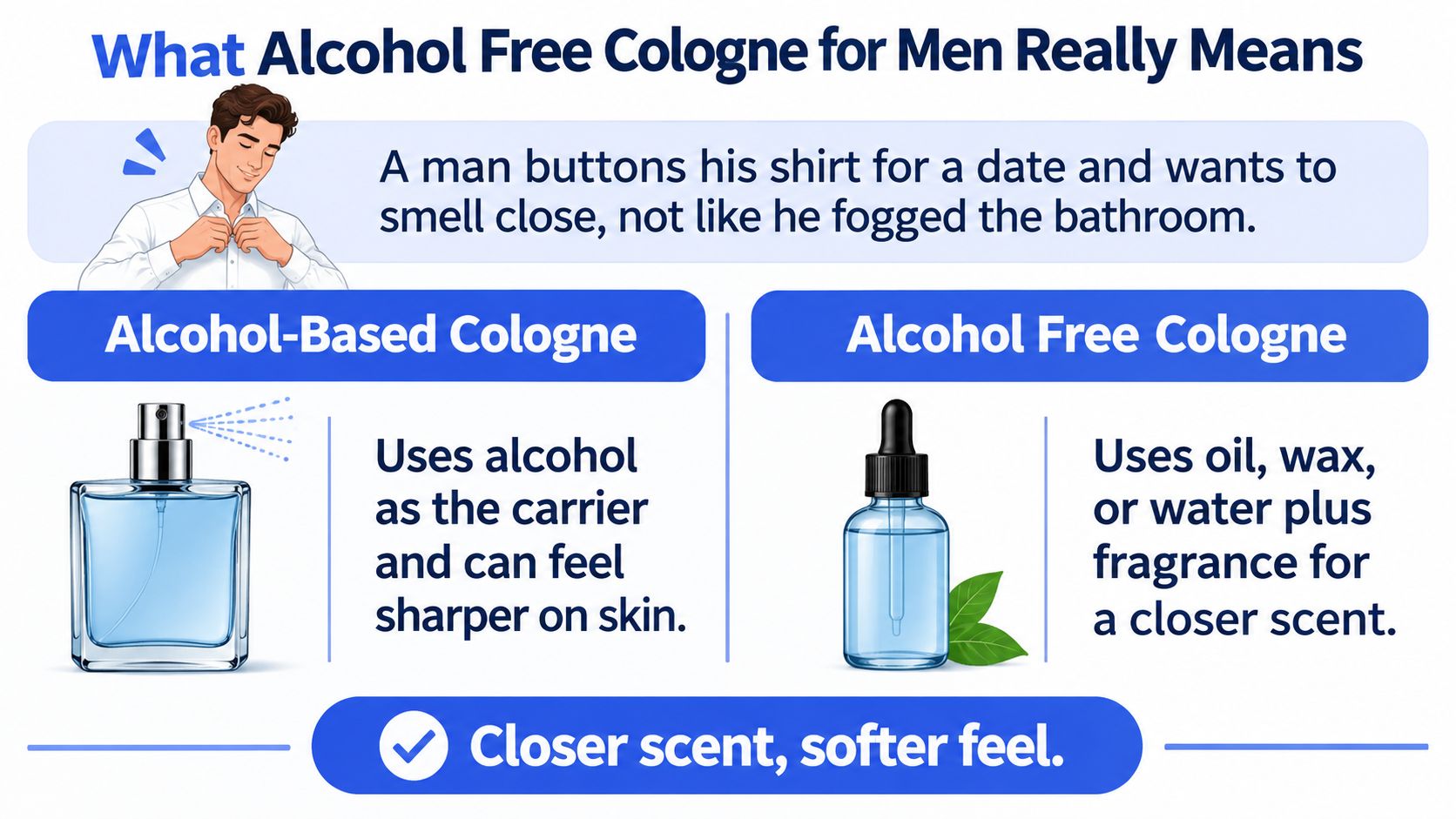
Ethanol cologne versus alcohol-free delivery
| Delivery | First impression | On skin | What keeps it going | Best moment |
|---|---|---|---|---|
| Ethanol cologne or EDT | Loud early throw | Can sting or dry | Alcohol flash, then base notes | An entrance or night out |
| Perfume oil or attar | Close and personal | Richer, sometimes oily | Base materials and fixatives | A date or pulse-point wear |
| Solid balm | Softest cloud | Waxy, low drip | Warmth of skin releases the fragrance | Pocket, gym bag, quick redo |
| Water-based spray | Softer open than ethanol | Light if the mix stays stable | Fragrance materials and fixatives in a stable delivery system | Office or a hot day |
Read the ethanol row as an entrance strategy, not a declaration that every spray is overpowering. Dose and composition still matter. An airy herbal EDT and a dense amber spray won't behave identically just because both contain alcohol.
Oil puts the emphasis on proximity. A solid adds portability and controlled application, while a well-made water-based spray offers a familiar gesture without necessarily reproducing the same opening burst.
The category isn't a curiosity anymore: Growth Market Reports' commercial market estimates place global alcohol-free fragrance at approximately USD 1.8–1.9 billion in 2025, with men representing 38.2% of alcohol-free perfume consumers. These are private research estimates, not government statistics or proof that any particular formula performs well.
Your sample tells you more than category growth does. Use these practical checks:
Also examine the pump, cap, and ingredient panel. Consistent delivery and clear instructions are more useful than claims about purity that never explain what's inside.
Buying rule: Alcohol-free is a format, not a weaker scent and not a doctor's note.
Choose the stable, unglamorous-looking formula over the poetic label on a bottle that separates in heat. The romance belongs in the fragrance, not in excuses for the packaging.
A sting after shaving and an itchy rash aren't interchangeable complaints. Ethanol-containing fragrance can feel uncomfortable on freshly shaved skin, but removing it doesn't remove the aromatic ingredients that can cause allergic contact dermatitis.
An oil or balm may solve a texture preference without solving an allergy. Preservatives, solubilizers, carrier ingredients, and fragrance materials still deserve scrutiny.
A dermatology review of fragrance allergy describes a 4.1% estimate in a multinational European population study, fragrance-mix reactions in 1% of a Danish population, and prevalence of 5–25% among patients referred for patch testing; it also reports that, in 2019–2020 North American Contact Dermatitis Group testing, reactions occurred in 12.8% for fragrance mix I, 5.2% for fragrance mix II, 11.1% for linalool hydroperoxides, and 3.5% for limonene hydroperoxides, while identifying more than 100 fragrance ingredients as potential allergens.
Those populations aren't interchangeable. Clinic patients often arrive because someone already suspects a reaction, so their results aren't your personal odds of reacting to a new cologne.
The useful conclusion is narrower: the fragrance itself can be the problem. A botanical oil doesn't receive an exemption because its ingredients came from plants.
The European Commission's fragrance-allergen labeling guidance sets individual disclosure above 0.001% (10 ppm) for designated allergens in leave-on cosmetics and explains that Regulation 2023/1545 added 56 further allergens to the framework. American ingredient panels may group aromatic materials under Fragrance, so a short-looking list doesn't necessarily reveal every scent ingredient.
Use a label screen rather than a reassuring adjective:
If acne-prone skin also complicates your routine, Neutralyze's guide to hydrating ingredients that won't trigger breakouts offers context for choosing a separate moisturizer. Breakout management and fragrance-allergy screening remain different jobs.
Treat hypoallergenic, natural, and clean as claims to examine, not a clinical pass. When skin is actively inflamed, skipping fragrance is more sensible than hunting for a seductive exception.
Start with the day you're dressing for. A desk beside a scent-sensitive colleague calls for a different decision from an evening when someone might rest their head against your shoulder.
After the ingredient screen, choose the format that creates the fewest practical problems. Don't buy an entire fragrance wardrobe to solve a crowded commute.
Berlin Packaging's personal-fragrance trend analysis describes interest in alcohol-free solids, oil-based formats, and hair fragrances, alongside the trade-offs of quieter projection, heavier textures, fabric transfer, and possible sensitization. None is an automatic upgrade over a conventional spray.
Alcohol-free format by situation
| Situation | Format | Projection and fabric | Reapply |
|---|---|---|---|
| Office day | Water-based spray | Softer open; light if stable; let it dry before dressing | Check at a break before adding more |
| Flight or travel | Solid balm or small oil | Quiet projection; wax can soften in a warm pocket | A restrained midday touch-up if needed |
| Hot commute | Water-based spray | Lighter-feeling option; rich oils may feel heavy in heat | Reassess after cooling down |
| Intimate date | Perfume oil or attar | Low to moderate, skin-close; may mark silk or pale collars | Only when the settled scent needs refreshing |
| Sensitive skin | Oil or balm after cautious testing | Not allergen-free; screen the panel first | Only if tolerated and permitted by directions |
| Scent without facial-skin contact | Hair fragrance | Lifts as hair moves; may leave residue over styling products | When styling, according to product directions |
For an office day, think about the person sharing your air, not just your own wrist. A restrained water-based spray can make sense, but a fragrance-free workplace still means leaving it at home.
For an intimate evening, oil offers controlled placement. Let it settle on uncovered skin before putting on a pale collar, and keep it away from silk rather than assuming a tiny dab can't transfer.
A balm won't pour out like a liquid, but wax can soften in a hot pocket. Choose a secure container and keep the applicator clean, especially if it lives beside gym gear.
For organizing fragrance alongside shampoo and grooming tools, Grainmark Leather's packing tips for men's toiletry bags are a useful starting point. Separate anything that could leak from fabrics you can't easily wash.
Hair fragrance suits someone who wants scent with movement rather than another product on the neck. Use a product intended for hair, avoid spraying toward the face, and remember that avoiding facial application doesn't make aromatic ingredients harmless.
Pick the format for the inconvenience you're trying to avoid, not the lifestyle pictured in the advertisement.
Gifts follow that logic too. A sample or a format the recipient has already enjoyed is more considerate than guessing which carrier their skin, clothes, and daily routine will tolerate.
Choose the row that matches your week. Let the next purchase wait until you've worn the first.
Say the date is drinks followed by a walk, not a velvet-rope nightclub. You want a fragrance with a smile in it: a little brightness, something warm underneath, and no suggestion that you've dressed as a dessert trolley.
The finishing touch should look as relaxed as it smells.

A study of fragranced spray and self-presentation found differences in men's confidence and self-perceived attractiveness, with female viewers rating the fragranced group more attractive in videos, supporting a behavioral explanation rather than a pheromone promise. A review of scent-and-face experiments reports that fragrance pleasantness changed male-face attractiveness ratings by approximately 5%, while also describing an experiment where unpleasant odors reduced ratings but pleasant and neutral conditions didn't differ significantly.
Aromatic citrus fits the daylight scene: bergamot, lemon, and herbs with a freshly opened-window character. Picture a clean shirt at an outdoor lunch, not a competition to smell freshly scrubbed.
Soft woods and moss suit the evening shift. Cedar, mossy accents, and amber can suggest warmth without demanding smoke, leather, or theatrical darkness.
Gourmand spice is the mischievous choice. A trace of caramel beneath dry spice can be inviting; a dense sugary blend on a packed commute may feel more like carrying an open pastry box.
Green or watery notes offer a crisp alternative when sweetness feels wrong. Judge the settled fragrance carefully, because an attractive opening won't tell you whether you enjoy what's left underneath.
Keep the grooming mood easy rather than ceremonial.
These are shopping directions, not rules about masculinity. Fruit doesn't make a fragrance childish, and cedar doesn't automatically make it refined.
No note is an attractiveness switch. Wear the sample through an actual evening and notice whether you feel comfortable in it, because relaxed attention is more appealing than repeatedly checking whether your neck smells sexy.
Apply fragrance before you're rushing for the door. Controlled placement is easier when your skin is dry, your collar is out of the way, and you haven't already committed to another scented product.
Start with an unscented moisturizer. Let it absorb before fragrance so you're working on comfortable, conditioned skin rather than applying onto a wet, slippery layer. Don't use perfume to disguise irritation.
Place oil deliberately. Touch a small dab to a wrist, the base of the throat, or behind an ear if that area tolerates it. You don't need every available pulse point, and leaving wrists unrubbed helps avoid spreading oil onto cuffs.
Press a solid into place. Warm a little balm with a clean fingertip, then press rather than scrub. A thick waxy streak is more likely to reach your collar than improve the scent.
Keep water-based spray controlled. Follow its application directions and begin lightly, aiming away from eyes and letting skin dry before dressing. Spray clothing only when the product permits it and you've checked an inconspicuous area for marking.
The routine should feel like a finishing touch, not a shower.
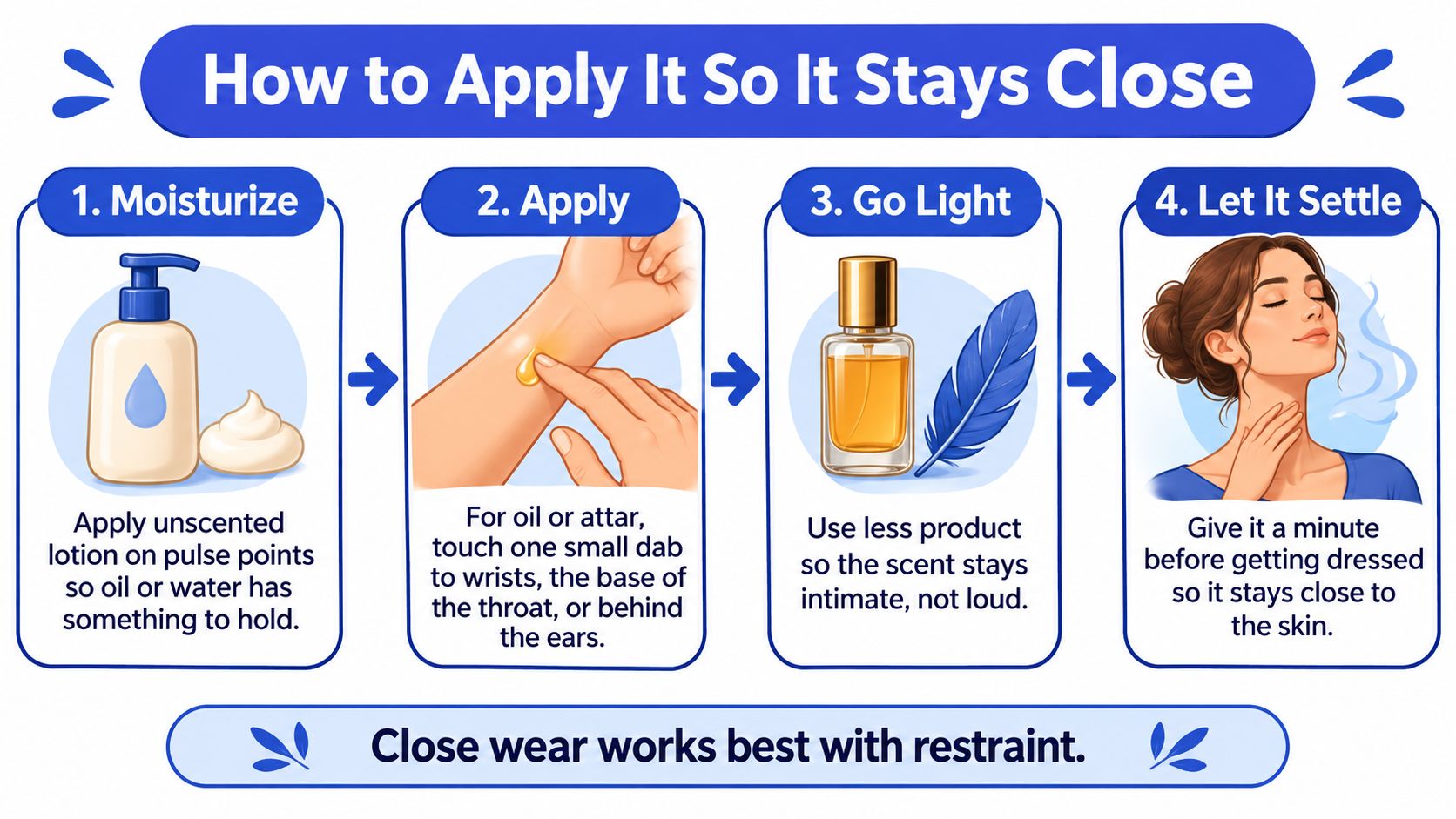
Wait before judging. Give the application time to dry or settle, then assess it during normal wear. A quiet opening isn't an instruction to keep applying.
Pack for containment. Choose a secure solid or small oil when practical, check your carrier's current travel rules, and put liquid fragrance in a leak-resistant pouch. Don't decant into a dirty bottle or leave an unlabelled mixture you can't identify later.
Store it somewhere temperate. Keep fragrance out of direct sun and hot cars, with the cap secured. A bathroom windowsill is a poor home for a formula whose appearance you're trying to keep consistent.
The common misses are treating a delicate mist like body spray and adding a heavy oil over an existing cologne until neither smells distinct. Test layering separately rather than improvising while dressed for an occasion.
Personal radius test: Someone hugging you should notice; someone across the table shouldn't have to.
Ask a trusted person at conversational distance before adding more. Your own nose isn't the only useful judge of how much fragrance you've applied.
It can be a fully composed fragrance in a different carrier, not merely scented skincare. Check whether the product is intended as personal fragrance, then judge its development on skin rather than dismissing the tin or rollerball.
Cloudiness alone doesn't prove a defect, because some emulsions are intentionally opaque. Unexpected streaks, persistent layers, or a pump that starts spitting deserve a check against the product directions; don't keep experimenting with a bottle whose mixture has visibly changed.
Choose a mood first, then eliminate carriers that don't suit your routine. For example, wanting something fresh doesn't commit you to a spray, but needing clean hands during a workday may make a fingertip-applied balm inconvenient.
No. Brand recognition tells you little about whether the particular product meets an ethanol-free requirement, and familiar fragrance names can appear across different product types. Read the actual panel rather than treating the name on the box as a formulation description.
Wear it on a day that resembles the use you have in mind. A date fragrance needs to please you through dinner, while a work fragrance needs to remain comfortable around your clothes, routine, and shared space.
A sample has done its job even when it saves you from buying the full bottle.
Say a café owner wants a close-wearing scent for long shifts. A product page can list the notes, size, and price, but only a real wear test can show whether the fragrance suits the routine, the applicator feels practical, and the scent still feels like his after a commute.
Check the carrier first if avoiding ethanol matters to you. Then weigh practical fit and personal preference. A familiar designer name cannot tell you whether a particular formula meets your needs.
Gotham Fragrances sells authentic designer fragrances for men and women, with separate sections for men's and women's fragrances. Its name-brand selection offers options to compare, but a brand name alone does not establish a product's carrier.
For price context, Cigar by Remy Latour Eau De Toilette Spray 3.4 oz for Men is priced at $20.80. That price is useful for comparing a listed fragrance, not for judging whether its formula is alcohol-free.
Customer Liam R. puts the value this way:
“The colognes are legit. I got a designer brand I usually can't afford for way less, and it smells just like the one from the department store.”
His review speaks to authenticity and value. Your carrier requirement still calls for a product-specific check.
First-time buyers can claim complimentary product samples. Use one to explore a scent, while checking that the sample itself fits any ingredient restrictions.
Gotham Fragrances offers shipping with tracking and free shipping on orders over $80. Users of its website must be at least 18 years old.
A bottle should earn its place through the wear test. At Gotham Fragrances, browse the men's and women's sections to compare scents, confirm the carrier before choosing an alcohol-free option, and let the way it wears decide which bottle comes home.