
American Eagle 1977 refers to the first American Eagle store, which opened at Twelve Oaks Mall in Novi, Michigan, in 1977. It's an apparel retail origin, not a fragrance.
Say you find a faded sweatshirt with that date across the chest, then spot a resale listing calling it an original. Don't follow the tempting advice to date the garment by the number alone. A founding date can look deliciously vintage on something made much later.
The same caution applies when a search drops you into perfume listings. Before you buy the story, establish what's for sale: a garment, a bottle, or a little nostalgia with a handsome typeface.
American Eagle 1977 identifies a retail beginning, not a documented fragrance launch. The historical accounts establish an apparel business; they don't establish a scent bearing that name.
Brothers Mark and Jerry Silverman opened the first store as a concept within Silvermans Menswear, the family-owned business founded in McKees Rocks, Pennsylvania, in 1904, according to Adweek's history published by American Eagle Outfitters. Their new venture offered a way to reach shoppers beyond the parent company's established young-men's clothing business.
| Year | Milestone | Merchandise Focus | Positioning |
|---|---|---|---|
| 1904 | Silvermans Menswear founded in McKees Rocks, Pennsylvania | Men's and young men's clothing | Family-owned retail base |
| 1977 | First American Eagle store opens at Twelve Oaks Mall, Novi, Michigan | Branded leisure apparel, footwear, hiking and camping gear | Outdoor-leisure concept inside Silvermans |
| 1992 | Schottenstein family repositions the chain around its own AE brand | Private-label casual apparel, including men's bootcut and worker jeans | House-brand fashion retailer |
| 1994 | NASDAQ offering of 2.3 million shares under AEOS | Denim and casual basics scaled for store growth | Public specialty retailer |
| 1997 | Sales rise 24.3% to $405.7 million | Youth-oriented casual apparel | National mall chain |
The repositioning and public offering appear in Encyclopedia.com's company history, which records the 1992 private-label shift and 1994 offering of 2.3 million shares under AEOS. A separate Encyclopedia.com business account records 1997 sales rising 24.3% to $405.7 million.
Those milestones distinguish the company's origin from its later merchandise. A founding year isn't a release date for every jacket, jean, or accessory carrying it. Nor does it promise that a modern piece reproduces an original design.
For a shopper, that distinction saves a surprisingly expensive misunderstanding. A soft, faded tee can be lovely without being a founding-era artifact, and a perfume can smell gorgeous without having any historical connection to this retailer.
Use these quick checks:
Walk into the original concept in your mind and leave the denim wall outside. You're shopping for an outdoor-minded life, not yet the familiar wardrobe of fitted jeans and flirtatious graphic tees.
The company's corporate history dates the first store to 1977 and describes its beginnings within Silvermans Menswear. Its assortment combined branded men's and women's leisure apparel, footwear, and accessories with merchandise for hiking, mountain climbing, and camping.
This illustration evokes that outdoor-retail setting rather than serving as an archival photograph.
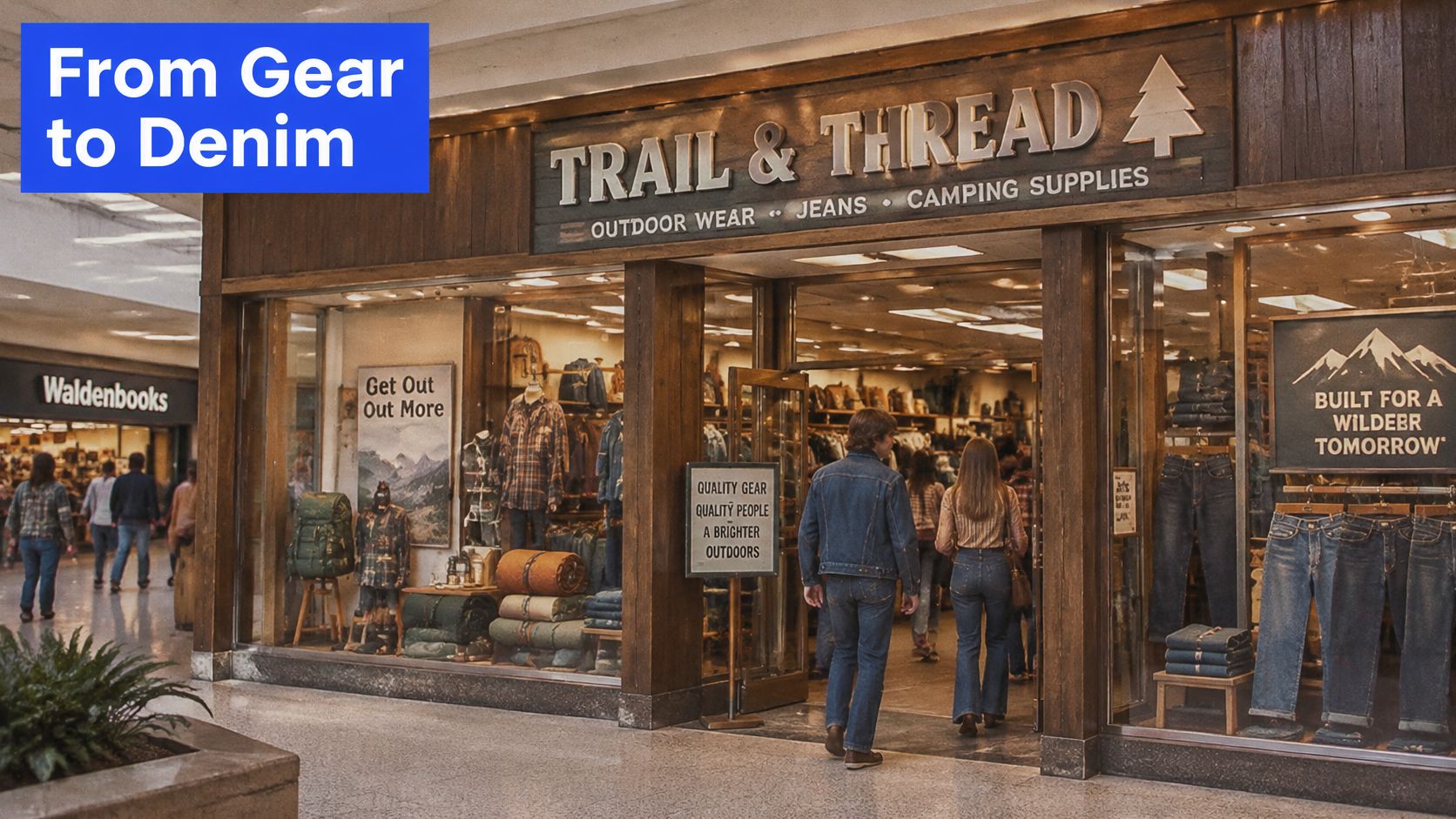
The Silverman brothers weren't just adding another version of their existing menswear shop. They were building a different reason for mall shoppers to come through the door.
Think boots, packs, and branded jackets as an illustration of the shopping mission, not a verified inventory of opening-day stock. The confirmed categories describe a customer dressing for recreation, with apparel and equipment sharing the same outdoor story.
That breadth mattered. A retailer selling other companies' brands assembles a selection; a retailer selling its own label can develop a recognizable product identity across successive collections.
After financial difficulty and the Schottenstein family's acquisition, management shifted toward proprietary casual apparel while retaining an outdoors-oriented appearance. Men's bootcut and worker jeans belonged to the early house-brand assortment.
The change gave the retailer more control over design, fit, sizing, presentation, and margin decisions. Instead of relying primarily on customers recognizing outside labels, it could encourage customers to return for American Eagle's own products.
The public offering subsequently supplied capital for expansion. The resulting business was overwhelmingly house-brand driven: Encyclopedia.com's broader business profile reports that roughly 98% of chain sales came from private-label brands after repositioning.
A shared brand name doesn't mean two garments belong to the same retail era.
That's the collector's useful distinction. An early outdoor-oriented find and a later fashion piece can both belong to the company's story without sharing the same design purpose.
You can also enjoy that history without dressing as an archival exhibit. Buy Me Japan's Japanese street-style inspiration for denim lovers offers a useful styling reference for cropped proportions and oversized denim, not evidence for dating American Eagle garments. Wear the jacket with confidence; authenticate it with something more substantial than a good silhouette.
Say a seller offers a jacket with a crisp neck label, beautifully worn cuffs, and no photograph of the inside. The contrast deserves a question, not an immediate accusation: labels can be replaced, garments can be repaired, and photographs can hide useful evidence.
Use this visual checklist to organize the inspection.
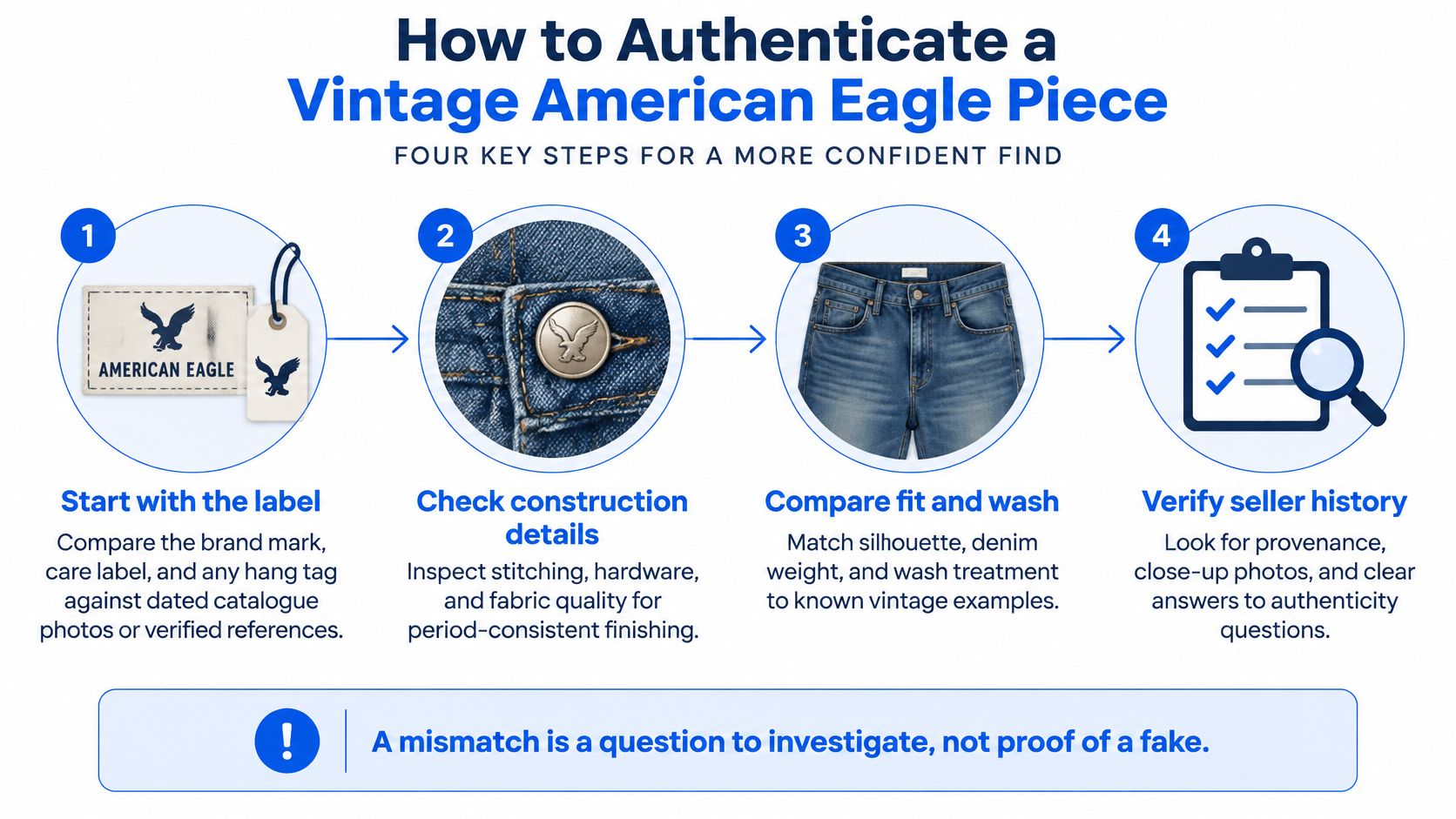
Start with the label. Compare the brand mark, care label, and any hang tag with dated catalogue photographs or references whose dates you can verify. Check lettering, placement, fabric information, and whether the labels appear original to the garment; a mismatch is a question to investigate, not proof of a fake.
Inspect construction closely. Ask for inside-out photographs showing seam finishing, stitch density, hems, and reinforcement around pockets and belt loops. Skipped stitches or weak stress points can expose poor construction, but they don't independently establish a counterfeit or a manufacturing date.
Read the hardware. Examine zipper pulls, rivets, and both sides of buttons for markings and consistent wear. A shiny replacement zipper on a worn jacket may indicate an ordinary repair, so ask the seller to disclose replacements rather than assuming every component left the factory together.
Compare fabric, wash, and cut. Look at denim texture, silhouette, pocket shape, and fading against securely dated examples of the same garment type. Heavy fabric doesn't automatically mean old, and deliberate distressing can imitate years of wear surprisingly well.
Verify the seller's evidence. For a valuable piece, choose a seller who supplies provenance or consult an independent authenticator with relevant apparel knowledge. Request sharp close-ups before paying, and ask what supports the claimed age beyond the date printed on the garment.
Record your reasoning. Save the listing, photographs, measurements, and seller's answers together with your comparisons. Mark conclusions as confirmed, plausible, or unresolved so you can revise the assessment if a better reference appears.
For an additional visual reference, the embedded video is available below; assess any dating claims against documentary evidence.
A seller's confidence isn't provenance. Neither is an appealing backstory about a relative who supposedly bought the piece when the store first opened.
Use a conservative personal rule: if three checks disagree with the listing, walk away. That's a purchasing threshold, not a scientific authentication test. One attractive label rarely justifies ignoring several unresolved problems.
Deadstock means unworn with original tags, although storage can still leave damage. Excellent describes a lightly worn piece without visible flaws.
Good allows visible wear while the garment remains structurally sound. Fair covers heavy wear or repair needs, and should leave room in your budget for restoration.
These are working buying grades, not a universal appraisal standard. Compare like-for-like garments before treating any premium as justified.
| Grade | What It Looks Like | What to Check | Effect on Price |
|---|---|---|---|
| Deadstock | Unworn with original tags | Tags intact, no odour, no sign of wear | Highest premium |
| Excellent | Lightly worn with no visible flaws | Seams, hem, zipper and print | Strong premium |
| Good | Visible wear but sound structure | Fading, minor pilling, small stains | Moderate discount |
| Fair | Heavy wear or needs repair | Holes, broken hardware, stretched necklines | Lowest price, for collectors or repairers |
Say two similar sweatshirts appear in your saved listings. One has attractive fading and firm cuffs; the other has a stretched collar and a stain cropped out of the main photograph. The second isn't automatically the better buy because its asking price is lower.
Inspect fading, pilling, holes, stains, stretched collars, zipper function, and intact original tags at every grade. A tagged garment with storage stains shouldn't receive a clean deadstock premium merely because nobody wore it.
Measure pit to pit, waist, inseam, and rise, as relevant, and compare them with clothing that fits you comfortably. Vintage label sizes aren't dependable substitutes for actual dimensions.
A neat repair can make a piece wearable while reducing its appeal to a collector seeking untouched condition. Let-out hems may be reversible if fabric remains; cut-off hems aren't, and persistent odour may not disappear with routine cleaning.
Grading rule: If it needs repair before you can wear it, price it as fair, not good.
Before you pay, establish what happens between the seller's wardrobe and your front door. A great-looking listing isn't much comfort if the garment arrives late, doesn't fit, and can't be returned.
Run this checkout checklist while the listing is still open:
The photograph below illustrates parcel preparation, not an American Eagle authentication reference.
Resale and vintage marketplaces make comparisons convenient, but protection comes from the platform's actual terms, not the appearance of its checkout page. Check whether the transaction qualifies for buyer protection before moving any conversation or payment elsewhere.
Specialist vintage dealers may charge more for selection, inspection, and contextual knowledge. Ask what their authentication support includes rather than assuming a polished shop guarantees provenance.
Private sellers can offer interesting wardrobe finds, but their knowledge, dispatch speed, and return arrangements differ. Allow breathing room before a gift date rather than relying on an optimistic delivery estimate.
Photograph the discrepancy immediately, retain the original packaging, and contact the seller through the platform. Open a dispute within the applicable window, keeping your explanation factual: wrong measurements, undisclosed damage, or an unsupported description.
Don't wash or alter a disputed garment before checking the return conditions. Buy from sellers who show their work, describe flaws plainly, and answer measurement questions without evasive charm.
The historical accounts don't connect American Eagle's founding reference to a fragrance. If you arrived looking for a bottle, choose the feeling you want rather than assuming the date identifies a perfume.
Say your ideal scent feels like a clean shirt, cool air, and someone leaning a little closer. Translate that mood into citrus freshness, aromatic heart notes, and woody or mossy bases.
| Scent family | Best occasion | Key notes to look for |
|---|---|---|
| Woody | Camping and outdoor daywear | Woody and mossy bases |
| Citrus | Warm weather and daytime | Fresh citrus openings |
| Floral oriental | Evenings | Floral notes with warm amber and wood |
These are selection suggestions, not rules about where a fragrance belongs. For actual camping, consider other people, wildlife guidance, and the setting before wearing a noticeable scent.
Woody fragrances offer the closest imaginative match to the retailer's outdoor beginnings. Look for a dry, textured impression rather than assuming every woody perfume smells like a forest.
Citrus fragrances suit someone who wants brightness without the heavier mood of an evening perfume. Aromatic notes can add a clean, herbal character between the sparkling opening and the base.
Floral oriental fragrances lean toward a warmer, more enveloping interpretation. They're a useful direction when you want the nostalgia to feel less trail-ready and more date-night, with an open collar rather than a backpack.
Start on a blotter, then test a promising candidate on clean skin. Let the opening settle before deciding, because the first impression may differ substantially from the later wear.
For a practical trial, wait about 30 minutes, then revisit it later and compare again on another day. Treat that interval as a testing routine, not a promise that every fragrance reaches its final dry-down on schedule.
Try samples before committing to a full bottle. Match concentration and application to the occasion, but don't assume a concentration label alone predicts projection or staying power.
Choose the mood first. Shortlist designer alternatives only after you know whether you want bright, wooded, or warmly sensual.
Collect vintage apparel if era, construction, and provenance are what excite you.
Choose a scent if you want an outdoor-inspired feeling rather than a historical object.
Use the company timeline to interpret a reference, not to certify the item carrying it.
A collector might adore a beautifully worn tee with a well-supported history. Someone seeking an everyday signature may prefer designer cologne, while a gift card can be kinder than guessing at an unfamiliar vintage fit.
For apparel, obtain the recipient's measurements in centimetres and inches, ideally from a garment they already love. Don't rely on their current label size or hope that a charming oversized fit will solve every mismatch.
Include the receipt and a short care card. For a washable vintage piece, note cold washing inside out, flat drying, folded storage away from light, and no hangers for heavy knits or stretched necklines, while preserving any garment-specific care instructions.
Keep the presentation considerate, too. Don't spray fragrance onto a vintage gift: the recipient may dislike the scent, and you'd be adding an odour they didn't choose.
At Gotham Fragrances, we sell name-brand colognes and perfumes, and you can request samples while exploring your shortlist. Orders over $80.00 ship free, but build the gift around the recipient's taste rather than adding a bottle just to reach a shipping threshold.
The best find doesn't need an embellished origin story. It needs a description you can trust, a fit or scent the recipient will enjoy, and terms you understand before paying.
For the fragrance route, visit Gotham Fragrances to explore name-brand perfumes and colognes that suit your own interpretation of that outdoor-leisure mood. Start with a woody, citrus, or warm floral shortlist, and request samples before choosing the bottle you'll wear or give.