

At its core, the difference between cologne and perfume is simple, and dare we say, a little sexy: perfume has a higher concentration of fragrance oils, making it a more powerful, lingering embrace. Cologne, on the other hand, is a lighter concentration, a fleeting, playful kiss of scent. It’s really all about the intensity and staying power you crave.
Let's look past the marketing and get right to what’s inside that bottle. When we compare cologne and perfume, we're not just talking about who it's "supposed" to be for. We're getting into the chemistry of seduction—the concentration of pure fragrance oils that dictates everything from how long a scent clings to your skin to the tantalizing trail you leave in your wake.
Think of it like a good cocktail. A splash of Eau de Cologne is like a light, refreshing spritzer, a perfect little flirtation. An Eau de Parfum, however, is a rich, complex old-fashioned meant to be savored over a long, decadent evening.
The real secret is in the juice itself. The key difference between cologne and perfume is the concentration of fragrance oils, which directly affects longevity, sillage (the scent trail you leave behind), and, of course, the price.
Perfumes, typically sold as Eau de Parfum (EDP), pack a punch with 15-20% fragrance oils. This is why they can easily last 6-8 hours or more, a steadfast companion for any adventure. In contrast, colognes—officially Eau de Cologne (EDC)—contain just 2-5% oils, offering a bright, fleeting vibe that fades within 2-4 hours. This distinction actually goes all the way back to 1709, when Giovanni Maria Farina created 'Eau de Cologne' in Cologne, Germany, as a light, citrus-based tonic. If you're interested in market trends, you can learn more about the ever-growing fragrance industry on freeyourself.com.
The bottom line? It’s not about gender—it’s about strength. A powerful, long-lasting scent comes from a higher oil concentration, regardless of whether it’s labeled cologne or perfume.
Once you grasp this, building a versatile scent wardrobe becomes much more fun. Knowing the concentration levels empowers you to choose the perfect fragrance for any moment, whether you need a subtle whisper of scent or a commanding statement.
To make it even clearer, here’s a simple side-by-side comparison. This little cheat sheet breaks down the core differences at a glance before we dive deeper into the full spectrum of scent types.
| Characteristic | Eau de Cologne (EDC) | Eau de Parfum (EDP) |
|---|---|---|
| Fragrance Oil | 2-5% | 15-20% |
| Typical Longevity | 2-4 hours | 6-8+ hours |
| Scent Intensity | Light and refreshing | Rich and potent |
| Best For | Daytime wear, casual outings, a quick refresh | Evening events, special occasions, all-day wear |
This table highlights the fundamental trade-offs: cologne for a light, fleeting experience and perfume for deep, all-day presence. Now, let’s explore how these differences play out in the real world.
So, you get the basic cologne vs. perfume difference. But are you ready to become truly fluent in the language of scent? It's time to move beyond the basics and explore the entire, seductive spectrum of fragrance concentrations. Think of it as going from knowing just "hello" and "goodbye" to being able to write poetry.
Each category—from the lightest whisper to the most profound statement—offers a different experience, a unique character, and a specific role to play in your life. This isn't just about technical percentages; it's about mastering your aura.
This hierarchy diagram shows the main fragrance categories and how they relate, from the most concentrated perfumes down to the lighter colognes.
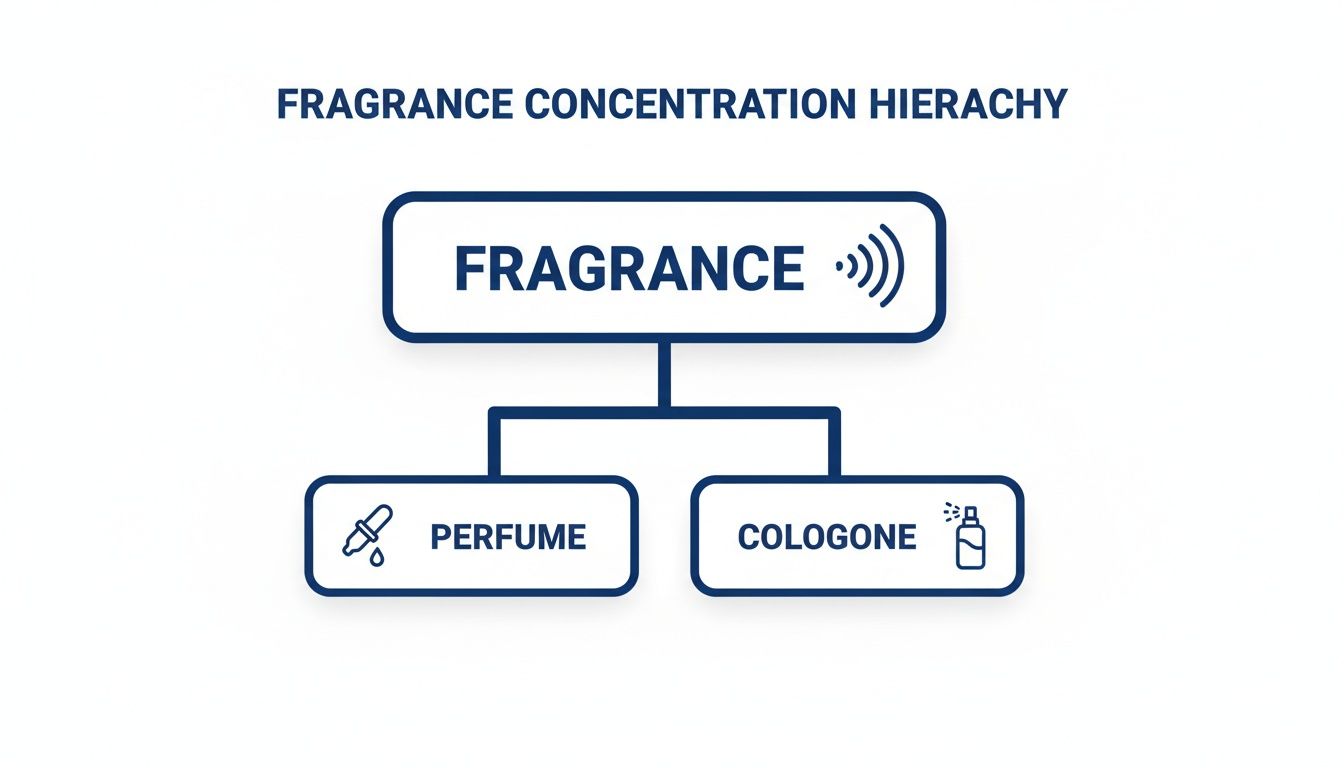
As you can see, the core distinction is the amount of pure fragrance oil, which dictates both the intensity and the longevity of the scent you choose.
At the very top of the hierarchy sits Parfum, also known as Extrait de Parfum. This is the most potent, luxurious, and concentrated form of fragrance you can get, boasting a powerful oil concentration of 20-30%.
A single dab of Parfum is all you need. It’s a scent that doesn't just enter a room; it owns it. Because it contains less alcohol, it clings to the skin intimately, creating a rich, deep, and complex aura that can last for an incredible 8 to 24 hours.
Parfum is reserved for moments when you want to leave an unforgettable impression. It’s the black-tie gala, the anniversary dinner, the scent you wear when you want your presence to be felt long after you’ve left. It's less of a shout and more of a mesmerizing, confident whisper that draws people closer.
Parfum is pure indulgence. It's the scent equivalent of a velvet jacket or a silk dress—designed for maximum impact and an experience that is both personal and profoundly memorable.
Next, we have the beloved Eau de Parfum (EDP). With a fragrance oil concentration of 15-20%, the EDP strikes the perfect balance between power and wearability. It's the charismatic heart of the fragrance world.
An EDP will confidently carry you through a full workday and well into the evening, typically lasting 6-8 hours without needing a touch-up. It projects beautifully, creating a noticeable but not overwhelming scent trail, or sillage.
This is your go-to for making a statement, whether it's a first date or a crucial presentation. It’s strong enough to be noticed and sophisticated enough to be admired. Many of the most iconic scents from brands like Dior and Chanel are offered in this popular concentration. For those looking to explore a wide range of designer EDPs, check out the curated selection at Gotham Fragrances.
The Eau de Toilette (EDT) is the energetic, approachable friend in the fragrance family. Containing 5-15% fragrance oil, it's lighter, fresher, and perfect for everyday wear.
An EDT offers a bright burst of scent right upon application, making it ideal for the office, a casual brunch, or running errands. Its longevity is typically around 3-5 hours, so you might want to reapply it later in the day.
Think of an EDT as your favorite crisp white shirt—effortlessly stylish, reliable, and suitable for almost any daytime scenario. It’s less about making a heavy statement and more about feeling put-together and refreshed.
Finally, we arrive at the lightest concentrations. The classic Eau de Cologne (EDC) contains a mere 2-4% fragrance oil, offering a refreshing splash of scent that lasts for about 2 hours. It's perfect for a quick post-gym refresh or a hot summer day.
Even lighter is Eau Fraiche, which translates to "fresh water." With only 1-3% oil concentration, it's a fleeting whisper of fragrance designed to provide a moment of revitalization.
Both are playful, invigorating, and delightfully unserious. They are the scent equivalent of a wink—a brief, charming gesture that brightens the moment without any long-term commitment.
A great fragrance is more than just a pleasant smell—it's an invisible aura, a signature that announces your arrival and leaves a tantalizing memory. To really get the difference between cologne and perfume, we have to talk about two critical elements that define this presence: longevity and sillage. These aren't just technical terms; they're the secrets to mastering your scent's impact.
Longevity is pretty straightforward: it's how long the fragrance lasts on your skin. Sillage (pronounced "see-yazh") is the French word for "wake," and in the fragrance world, it describes the scent trail you leave behind. It’s that whisper of your perfume that hangs in the air, turning heads long after you’ve left the room.
This is where the magic of concentration comes in. A high-concentration perfume creates a captivating sillage that commands attention, while a lighter cologne offers a more intimate, close-to-the-skin experience designed for you and those you let get close.
An Eau de Parfum doesn't just sit on your skin; it becomes a part of it. With its 15-20% concentration of fragrance oils, an EDP has the richness and depth to last for 6-8 hours or more, creating a scent bubble that projects beautifully.
This lasting power is a huge reason perfume is so popular. Digging into the market stats, perfumes outsell colognes by a wide margin in premium segments. The global fragrance market is on track to hit USD 101.47 billion by 2034, with perfume segments claiming the largest share in 2024. In the U.S., women’s perfumes capture over 60% of sales, while men's colognes trail at around 25-30%. This preference is often driven by superior longevity and sillage, making perfume a worthwhile investment for a lasting impression—a trend we cater to at Gotham Fragrances with our curated bestsellers. You can find more fragrance market trends on bestcolorfulsocks.com.
An EDP’s sillage is designed to be noticed. It’s the scent that earns compliments from across the dinner table, a statement piece that communicates confidence without a word. It’s the perfect choice when you want your presence to be felt.
An Eau de Cologne, on the other hand, is all about subtlety. Its low oil concentration of 2-5% means it's built for a much more personal experience. The longevity is brief, typically 2-4 hours, and its sillage is minimal.
A cologne’s scent trail stays very close to the body. Someone would need to be standing right next to you or leaning in for a hug to really catch it. This makes it perfect for times when you want to feel fresh without being overpowering, like at the office, the gym, or on a hot summer day. It's a scent for your own enjoyment—a quick, bright refresh that feels like a secret just for you.
The choice between a captivating sillage and an intimate scent aura is a powerful one. Perfume says, "I am here," while cologne whispers, "Come closer."
Beyond how long it lasts and how far it travels, the scent's profile—its journey from top to base notes—also behaves differently. Every fragrance is a pyramid of notes that unfolds over time.
A perfume, with its higher oil concentration, offers a more robust and complex journey. Its rich base notes of woods, amber, or musk can hang around for hours, revealing new layers of the fragrance's personality long after you first spray it. This evolution is a sensual experience, a story that unfolds on your skin.
A cologne, in contrast, tells a much shorter story. It’s dominated by brilliant but brief top notes—often bright citruses or fresh herbs. It makes a dazzling entrance but fades quickly, rarely giving the deeper base notes a chance to fully develop. It’s more of a brilliant flash of inspiration than a slow-burning romance. Choosing between them is choosing the kind of scent story you want to tell.
Let’s be honest, the idea that perfume is for women and cologne is for men is the biggest myth in the fragrance world. It's nothing more than an old marketing story, a little white lie that’s been whispered across department store counters for decades. It's time to stop reading the labels on the bottle and start trusting your own nose.
The truth is far more personal. A scent's real magic has nothing to do with gender and everything to do with your unique skin chemistry. A fragrance doesn't truly come alive until it meets your skin, creating a story that is entirely, uniquely yours.
Consider this your official permission slip to break the rules. We're here to tear down the tired gender norms that have dictated what you should wear, empowering you to explore fragrances based on the notes you love, not the aisle they happen to be in.
So, how did we even get here? The "cologne for men, perfume for women" narrative is a surprisingly modern invention, cooked up by clever marketing campaigns in the mid-20th century. Marketers quickly realized they could effectively double their sales by splitting the fragrance world right down a gendered line.
They began associating perfumes with delicate florals and sweet fruits, packaging them in elegant, curved bottles to signal femininity. Colognes, on the other hand, were tied to rugged woods, sharp spices, and crisp citrus, presented in bold, angular bottles to project raw masculinity.
It was a brilliant business move, but it has absolutely nothing to do with the art of perfumery. The only real difference between cologne and perfume is concentration, not who is "supposed" to wear it.
Forget the labels. A fragrance is just a beautiful blend of aromatic oils. The idea that a flower is "feminine" or a piece of wood is "masculine" is completely arbitrary. Your nose knows what it wants—it's time to listen.
The moment you step outside these imaginary boundaries, an incredible world of scent opens up. You begin choosing fragrances based on your mood, your personality, and pure, unadulterated attraction rather than some outdated expectation.
Picture this: a woman wearing a dark, smoky oud and leather fragrance. It doesn’t smell masculine; it smells powerful, confident, and utterly captivating. It projects the aura of someone who is unapologetically in charge of her own story.
Now, imagine a man wearing a scent with a heart of rich tuberose and jasmine. It doesn't smell feminine; it smells sophisticated, modern, and deeply intriguing. It suggests a confidence that isn't afraid to embrace beauty in all its forms.
This is the playground of modern fragrance. The lines are blurred, and self-expression is the only rule that matters.
Ready to start your own scent rebellion? The key is to forget the marketing and focus on the notes themselves. Here’s how you can begin writing your own fragrance story.
Explore "Masculine" Notes with a New Perspective:
Discover the Power of "Feminine" Notes:
At Gotham Fragrances, we believe your signature scent is waiting for you, regardless of which department it’s in. Explore our vast collection of men's, women's, and unisex fragrances to find the notes that truly speak to you. Your perfect scent story is just a spray away.
Think of your fragrance collection like you would your actual wardrobe. You have go-to outfits for different settings—a sharp suit for a big meeting, something special for a night out, and your favorite worn-in jeans for the weekend. The same logic applies to your scents. Your fragrance is an invisible accessory, and building the right collection is the art of matching your aura to the moment.
This is your guide to mastering that art. We’re moving beyond the technical differences between cologne and perfume and into the real world, where the right fragrance can seal a deal, ignite a spark, or just make you feel fantastic. It's all about curating a selection that works for you, no matter what's on the agenda.
When you’re walking into a critical meeting or giving a high-stakes presentation, your scent should project quiet confidence, not distraction. The goal is to be remembered for your ideas, with a fragrance that subtly underlines your presence. Overpowering the room is a rookie move that can kill a deal before it starts.
This is where a crisp, clean Eau de Toilette (EDT) truly shines. Its moderate concentration ensures you have a noticeable scent that stays within your personal space, leaving a polished impression without being overwhelming.
When the lights are low and the mood is romantic, your fragrance should be an invitation. This is the moment for a scent that is rich, warm, and complex—something that draws someone closer and leaves a lingering, sensual memory.
An Eau de Parfum (EDP) is your perfect accomplice here. With its higher concentration, it will last through dinner and deep into the night, evolving on your skin to tell a more captivating story as the hours pass.
A date night fragrance shouldn't just smell good—it should make someone lean in a little closer, wanting to know more. It’s a silent, seductive conversation.
For a laid-back weekend brunch, a walk in the park, or just running errands, your scent should feel bright and effortless. It’s the fragrant equivalent of your favorite jeans and a perfect t-shirt—comfortable, easy, and authentically you.
A light, refreshing Eau de Cologne (EDC) or even an Eau Fraiche is the ideal choice here. These are designed to give you a quick splash of feel-good energy that isn't meant to hang around all day.
To make it even easier, here’s a quick-reference guide to help you choose the right scent concentration for any situation. Think of this as a cheat sheet for strategically building your collection and mastering every impression you make.
| Occasion | Recommended Scent Type | Why It Works | Scent Profile Example |
|---|---|---|---|
| The Office | Eau de Toilette (EDT) | Professional and present without being overpowering. | Crisp vetiver, light citrus, or clean woods. |
| Date Night | Eau de Parfum (EDP) | Long-lasting, rich, and seductive for close encounters. | Warm amber, spicy vanilla, or dark florals. |
| Weekend Brunch | Eau de Cologne (EDC) | Light, fresh, and casual for a relaxed vibe. | Zesty bergamot, aquatic notes, or neroli. |
| Formal Event | Parfum or EDP | Luxurious and potent to match a sophisticated setting. | Smoky oud, rich leather, or complex spices. |
| Post-Gym | Eau Fraiche or EDC | A quick, refreshing spritz to feel clean and revitalized. | Mint, grapefruit, or light herbal notes. |
Building your scent wardrobe is a journey of discovery. Start with these scenarios, but don't be afraid to explore the notes and styles that excite you. With the right collection, you'll always have the perfect fragrant accessory for every chapter of your life.
Ever wondered why that stunning bottle of perfume seems to give your wallet a bigger workout than its cologne counterpart? Let's get real about the economics of fragrance. The price difference isn't arbitrary—it's directly tied to the performance, concentration, and the overall experience you're investing in.
The secret is all about the concentration of precious fragrance oils. These are the soul of the scent, often sourced from rare botanicals and expensive raw materials. An Eau de Parfum is loaded with a higher percentage of these oils, and that richness is what initially drives up the cost. But the story doesn't stop there.
Let's talk about a concept savvy fragrance lovers swear by: 'price-per-wear.' A higher sticker price doesn't automatically mean you're spending more over time. In many cases, it's actually the opposite.
Because a perfume has a higher concentration, it boasts serious staying power. A couple of well-placed spritzes are often all you need to carry you from morning coffee to late-night cocktails. This means you use less with each application, making that gorgeous bottle last much, much longer.
On the other hand, a lighter cologne might need a few touch-ups throughout the day to keep the scent alive. You'll find yourself going through that bottle a lot faster. When you do the math, the pricier perfume often turns out to be the more economical choice for a long-term love affair with a scent.
This reality is clearly reflected in how people shop. The numbers don't lie: perfumes command a premium for a very good reason. A typical 50ml EDP might set you back $80-$150, while a similar-sized cologne could be in the $40-$$80 range. In today's booming fragrance market, premium perfumes (like EDPs and Parfums) capture over 50% of the market's value share because shoppers know what they're getting.
In fact, a whopping 64% of consumers globally prefer EDPs specifically for their longevity, viewing them as a smarter investment despite the higher initial cost. It’s a value proposition we make even sweeter here at Gotham Fragrances with our incredible discounts. You can dive deeper into these trends in the fragrance market report on technavio.com.
Think of it like this: a cologne is a fun, fleeting fling—exciting but brief. A perfume is a committed relationship; an investment that pays you back in confidence and compliments, day in and day out.
At the end of the day, choosing a high-quality fragrance isn't just a simple purchase. It's an investment in yourself and how you present yourself to the world. It’s for the person who understands that true value isn’t just about the price you pay, but what you get in return. And in the world of fragrance, spending a little more upfront often means getting so much more in the end.
You've got questions, and when it comes to fragrance, we've got answers. The whole cologne versus perfume thing can seem a little complicated, but once you know the core differences, you’ll be choosing your next scent like a seasoned pro. Let's clear up the confusion and get you ready to find your next obsession.
Absolutely. Let's get one thing straight: fragrance has no gender. The terms cologne and perfume simply tell you about the concentration of fragrance oil, not who should be wearing it.
The best fragrance for you is the one that makes you feel incredible. We always encourage people to explore scents based on the notes they're drawn to—whether that’s a deep floral, a smoky wood, or a zesty citrus. It’s your story; find the scent that helps you tell it.
So you want to give your lighter, fresher cologne a little more staying power? It's all about the prep work. Always start by applying it to well-moisturized skin. An unscented lotion is perfect, as it creates a canvas for the fragrance molecules to cling to.
Next, spray it on your pulse points—think wrists, neck, and behind the ears. These spots are warmer, which helps project the scent. But here’s the most important tip: never rub your wrists together. That friction actually breaks down the delicate top notes and makes the scent fade much faster.
Layering is the ultimate power move for a scent that lingers. Pairing complementary fragrances is an art form that lets you create a signature scent that is completely, undeniably you.
A great way to start is with a simple, single-note scent like vanilla or citrus. Then, spritz a more complex fragrance right over it. The key is to apply the stronger, heavier scent first to create a rich base. Now go ahead, experiment a little and find a combination that feels like pure magic.
Ready to put your newfound knowledge to the test? Explore the curated collections at Gotham Fragrances and find your next signature scent at up to 70% off. Discover authentic designer fragrances that speak your language at Gotham Fragrances.