

Welcome to the ultimate scent showdown, darling. At its heart, the difference between essential oils and fragrance oils is both simple and deeply seductive: essential oils are pure, botanical extracts captured directly from nature's embrace, while fragrance oils are masterful, lab-created aromas designed for performance, pleasure, and pure imagination.
Think of it as the difference between a wild rose you stumble upon in a secret garden, thorns and all, and a perfumer’s wicked dream of what a perfect, otherworldly rose could be. One is raw passion; the other is pure fantasy.
Stepping into the world of perfumery feels like uncovering a delicious secret. Every spritz tells a story, but that tale begins long before the scent ever touches your skin—it starts with the very essence in the bottle.
Are you drawn to the raw, untamed soul of something pulled from the earth? Or do you crave the flawless, inventive artistry of a scent that dares to defy nature itself? This is the central, tantalizing choice between essential oils and fragrance oils.
Essential oils are nature's intimate whispers. They are the concentrated, volatile aromatic compounds meticulously extracted from plants, holding the true spirit of a flower petal, a citrus rind, or a woody bark. They are beautifully complex, sometimes unpredictable, and always authentic.
Fragrance oils, in contrast, are the bold, imaginative compositions born in a perfumer’s lab. They can be synthetic, a blend of naturals and synthetics, or even nature-identical. Their purpose is to create scents impossible to capture from nature—like the crisp air after a thunderstorm, the addictive smell of old books, or the cozy warmth of a cashmere sweater.
The global essential oils market is projected to hit USD 27.82 billion by 2032, fueled by a growing demand for natural ingredients in high-end perfumery and wellness. In contrast, the synthetic-heavy fragrance oil market was valued at a smaller USD 8.50 billion, pointing to a clear preference for authenticity in luxury goods. You can dive deeper into fragrance market forecasts on databridgemarketresearch.com.
This cheeky little table summarizes the core differences between these two scent powerhouses before we dive into the nitty-gritty details.
| Attribute | Essential Oils (The Natural Purist) | Fragrance Oils (The Creative Alchemist) |
|---|---|---|
| Origin Story | 100% plant-derived; extracted directly from botanical sources. | Lab-created; can be entirely synthetic or blend synthetics with naturals. |
| Scent Profile | Complex, nuanced, and can vary slightly with each batch. Wildly authentic. | Consistent, stable, and offers an endless range of imaginative, fantasy scents. |
| Primary Allure | Therapeutic potential and an authentic, raw connection to nature. | Scent stability, potent performance, and complete creative freedom. |
Now that you have a taste, let's explore what truly sets them apart in practice.

To really get the difference between essential oils and fragrance oils, you have to go back to their origins. It’s a classic tale of nature versus nurture, of ancient alchemy versus modern lab artistry. The journey each takes from its source to the bottle is what truly defines the very soul of the scent you experience.
Essential oils are nature’s poetry, captured in a bottle. They are 100% plant-derived, painstakingly extracted to keep the botanical’s true essence intact. It’s like bottling the scent of a sun-drenched Italian lemon grove or the intoxicating calm of a lavender field in Provence—each drop is a direct line to the earth.
Extracting an essential oil is a delicate, almost romantic process. Perfumers and artisans use two main methods to coax these precious aromatic compounds out of their plant homes:
The extraction method dramatically shapes the final aroma. The high heat of steam distillation can alter a plant's delicate chemistry, while cold-pressing preserves a rawer, truer-to-fruit scent. This is why a steam-distilled rose (Rose Otto) smells greener than a solvent-extracted Rose Absolute.
To dive deeper into the aromatic qualities that define essential oils, including different aroma families and safe usage tips, check out our guide on essential oil flavors and aroma families. It's a great resource for understanding how a plant’s origin and extraction method influence its final scent profile.
Now, let's step into the perfumer's playground. Fragrance oils are born from human ingenuity, crafted in a lab to achieve scents that nature simply can't produce on its own. They are the true artists of the scent world, completely unbound by the limitations of the botanical kingdom.
A master perfumer acts like a composer, blending various aromatic components—which can include natural isolates, synthetic molecules, and even essential oils—to bring a specific concept to life. This is how we get those evocative and impossible scents like "ocean breeze," "fresh laundry," or the seductive warmth of a "cashmere sweater." These creations are designed for stability, consistency, and a boundless spectrum of creative expression.
Ever wonder why a spritz of a luxury perfume feels like a living, breathing story that unfolds on your skin all day? Meanwhile, your favorite scented lotion smells delightfully consistent from the moment you apply it. The secret isn't magic; it's the beautiful, intricate difference between essential oils and fragrance oils when it comes to scent.
An essential oil is nature’s symphony. Because it’s a pure botanical extract, it contains hundreds of natural aromatic compounds that create a dynamic, multi-layered experience. Think of it as a pyramid of scent, constantly evolving from one moment to the next.
This pyramid is what separates a simple scent from a true fragrance journey. It’s composed of three distinct layers that reveal themselves over time:
This natural progression is why an essential oil-based perfume interacts so uniquely with your body chemistry, creating a signature scent that is truly yours.
Fragrance oils, on the other hand, are the masters of consistency. They are meticulously engineered to deliver a specific, unwavering scent experience from start to finish. This is what’s known as a linear scent profile.
The beauty of a fragrance oil lies in its stability and power. Perfumers design them to project a bold, consistent aroma that doesn't change over time, making them perfect for products like candles and diffusers where a reliable, room-filling scent is the ultimate goal.
A "Fresh Linen" fragrance oil will smell exactly like fresh linen for the entire life of the candle. While it lacks the evolving complexity of an essential oil, its strength is its predictability and potent projection. It’s not a story with a beginning, middle, and end—it's a powerful statement that holds true.
So, when you appreciate the subtle evolution of a natural perfume versus the bold, unwavering statement of a scented candle, you're experiencing the core difference in their aromatic design. One is a dance of notes; the other, a powerful solo performance.
Now for the fun part—putting all this knowledge into practice. Understanding the difference between essential oils and fragrance oils is one thing; knowing which one to grab to create the perfect vibe is another art entirely. This is your personal guide to making smart, sophisticated scent choices every single time.
Think of it this way: picking an oil is like choosing an outfit. Do you go for the bespoke, breathable linen suit (an essential oil) that adapts to you, or the stunning, perfectly tailored cocktail dress (a fragrance oil) designed to make a singular, unforgettable statement? Both are incredible, but the occasion dictates the choice.
When it comes to your personal scent—the one that lingers on a scarf or pulls someone closer—nothing really compares to the living, breathing complexity of essential oils. They mingle with your own skin chemistry to create a scent that is uniquely, authentically yours.
That said, fragrance oils play a massive role in modern perfumery. Master perfumers often blend them with natural botanicals to achieve scents that are otherwise fleeting or simply impossible to capture from nature.
This is where fragrance oils truly come into their own. They are the undisputed champions of creating a powerful, room-filling ambiance, especially when heat is involved in things like candles or wax melts.
Essential oils are beautiful in diffusers for their therapeutic qualities, but their delicate chemical structures mean they can struggle in high heat, often losing their nuance and potency.
Fragrance oils are engineered for performance. Their stability and potent "scent throw" make them the secret behind that irresistible sandalwood and vanilla candle that makes your entire home feel like a warm embrace. They deliver a consistent, powerful aroma from the first light to the last.
So, for a spa-like, therapeutic atmosphere in your diffuser, pure lavender or eucalyptus essential oils are perfect. But for a bold, declarative statement scent in candles, fragrance oils are your seductive go-to.
Still weighing your options? Let's break it down with a simple guide. This table is designed to help you make a quick, confident decision for any project you have in mind.
| Application | Choose Essential Oils If… | Choose Fragrance Oils If… |
|---|---|---|
| Personal Perfume | You want a dynamic, natural scent that melds with your chemistry. | You love a consistent, powerful, or imaginative designer scent. |
| Aromatherapy | Your goal is therapeutic benefits for mind and body. This is non-negotiable. | Never. Fragrance oils lack the chemical compounds for therapeutic use. |
| Candle Making | You are an advanced crafter aiming for a subtle, all-natural product. | You want a strong, reliable scent throw and endless creative options. |
| Scenting Cosmetics | You want to add the skin benefits of botanicals to lotions or soaps. | You need a skin-safe, stable scent for soaps that won't fade or discolor. |
Ultimately, both types of oils have their place in a well-rounded scent collection. The real magic happens when you know exactly which bottle to reach for to bring your creative vision to life.
Let's get real about what’s inside that chic little bottle. Talking about safety, cost, and labeling might not feel as glamorous as discussing scent notes, but it’s where a true fragrance connoisseur earns their stripes. Getting this right is the difference between a delightful experience and a disappointing—or even irritating—one.
The word "natural" feels safe and cozy, but in the world of scents, it can be a bit of a siren's call. Pure essential oils are incredibly potent. An undiluted drop of cinnamon or clove oil can be a serious skin irritant, while some citrus oils cause photosensitivity, leaving you vulnerable to sunburn. Proper dilution isn't just a suggestion; it's a non-negotiable for safe application.
Ever wonder why a tiny vial of pure Rose Otto essential oil costs a small fortune, while a rose fragrance oil is delightfully affordable? It all comes down to the sheer labor and rarity involved. It can take over 10,000 pounds of rose petals just to produce a single pound of essential oil. That’s an entire field of flowers distilled into a few precious drops.
Fragrance oils, on the other hand, are crafted with artistry in a lab. They don't face the same agricultural hurdles, making them much more accessible from a cost perspective. This chart can help you visualize the decision-making process based on what you want to achieve.
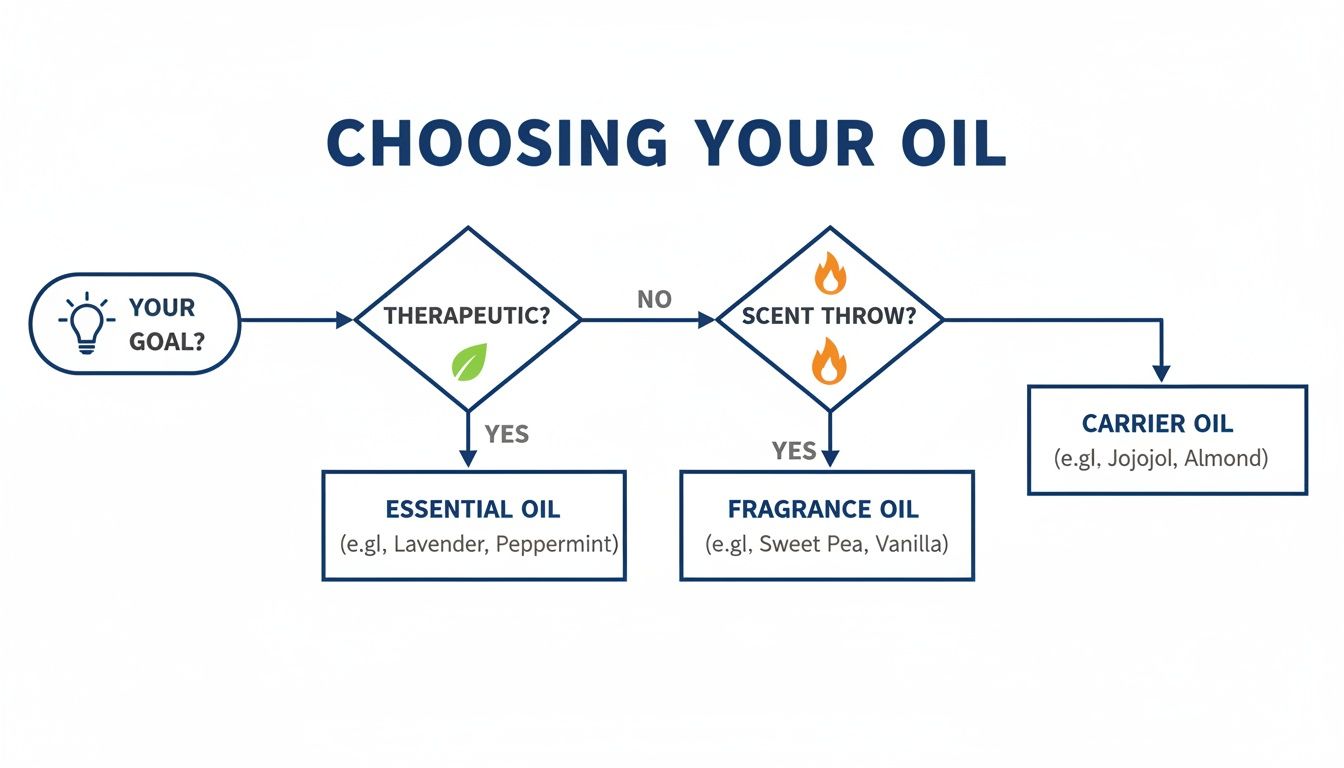
As you can see, if therapeutic benefits are your goal, essential oils are the only path. But for powerful, consistent scent performance, fragrance oils are the real stars.
Fragrance oils have their own set of rules, too. Reputable manufacturers rigorously test their creations to ensure they are skin-safe and free from harmful substances like phthalates. When you're evaluating any type of oil, it's crucial to consider the safety characteristics of perfumery products, especially if they contain flammable solvents, to handle them correctly.
Learning to read a label is your ultimate power move. Here’s what to look for:
A "natural fragrance" label can be tricky. It often means the scent is made from natural isolates—single aroma molecules pulled from a plant—rather than the whole essential oil. It's a hybrid, falling somewhere between the raw authenticity of an essential oil and the pure invention of a synthetic fragrance oil.
Understanding these distinctions empowers you to shop with confidence, knowing exactly what you're bringing into your home. You'll not only choose the right oil for the job but also appreciate the unique artistry and value behind each one.
We’ve traveled from the sun-drenched fields of Provence to the pristine labs of master perfumers. Now, it’s time to get a little more personal and answer some of the burning questions that always pop up when choosing between these two scent powerhouses. Think of this as your private consultation—a little pillow talk about the delicious difference between essential oils and fragrance oils.
You’re not alone in your curiosity. The world of fragrance is complex, but once you know the secrets, you’ll be the one whispering them.
This is the ultimate question, isn’t it? The short answer is a playful maybe. While many high-quality fragrance oils are meticulously formulated to be skin-safe for cosmetics and perfumes, they exist purely for their scent. They simply don't carry the therapeutic, skin-loving benefits of their botanical cousins.
You should never, ever apply a fragrance oil meant for a candle or a diffuser directly to your skin. Instead, always look for oils specifically labeled "skin-safe" or "cosmetic-grade." The most iconic luxury perfumes often blend both essential and fragrance oils to create a complex, safe, and long-lasting masterpiece that's both seductive and stable on the skin.
This is where things can get a little murky, and where a discerning eye becomes your best friend. The term "natural" isn't as tightly regulated as we'd like, which allows for some creative labeling. A product might be labeled "natural" because it uses a fragrance oil containing some natural components, or the brand might just be using the term loosely for marketing.
Pay close attention to the distinction between "natural fragrance" and "pure essential oil." A "natural fragrance" is often a proprietary blend of isolates—single aroma molecules extracted from a natural source. This is a world away from the holistic complexity of a 100% pure essential oil. It’s like comparing a single, perfect note to a full symphony.
Ah, the eternal dance of sensitivity! There’s no simple answer here, as every person's skin has its own unique personality. It’s a common misconception that "natural" automatically means "hypoallergenic."
Some people find their skin reacts to potent essential oils like cinnamon or even tea tree, while others might be sensitive to a specific synthetic compound in a fragrance oil. Your best move is always a patch test: apply a tiny, diluted amount to your inner arm and wait 24 hours. Luxury fragrance houses invest heavily in dermatological testing to ensure their blends are as gentle as they are gorgeous.
In the world of fragrance, you absolutely get what you pay for. A cheap fragrance oil is often a one-note wonder, smelling flat, overly chemical, and sometimes just harsh. They often contain inexpensive fillers and may not be safe for anything other than a reed diffuser.
A high-end fragrance oil, however, is a work of art. It’s a complex, sophisticated blend created by a professional perfumer, designed to evoke a specific mood or memory. These premium creations are free from cheap additives and phthalates, offering a nuanced, rich, and truly beautiful scent experience. Quality is always paramount for a scent that feels like a second skin, not a cheap accessory.
Ready to find a scent that speaks your language? At Gotham Fragrances, we curate a collection of the world's most iconic and authentic designer perfumes, making luxury accessible. Explore our collection and discover the perfect fragrance to tell your story. Shop Our Fragrance Collection