

Let’s get one thing straight, darling: yes, your favorite perfume does expire. But before you start tragically clearing off your vanity, take a breath. Think of it less like spoiled milk and more like a fine wine—it has a peak, and then it begins a slow, sensual transformation. The question isn't really "does perfume expire," but rather, how can we understand and play with the beautiful, ever-changing life of a scent?
That gorgeous bottle sitting on your dresser is more than just fragrant alcohol; it’s a living, breathing composition of delicate molecules. It's a love story waiting to be told, but like any good romance, it has an ending. Knowing its timeline is the key to mastering your fragrance wardrobe, ensuring every single spritz is just as intoxicating as the perfumer intended.
This isn't just about protecting a luxury item. With the global perfume market being a multi-billion dollar industry, knowing the lifespan of your scent is simply smart. Perfumes do have a shelf life, and understanding it is crucial. Generally, an opened perfume will last you about 3-5 years. You can often find a tiny symbol on the box—like 12M or 36M—indicating its best-used-by period in months. An unopened bottle, however, is a completely different animal. Tucked away in its sealed, dark box, it can hold onto its magic for years, sometimes even decades. You can get more insights into the fragrance market and its value from marketdataforecast.com.
This infographic gives a great visual breakdown of what to expect.
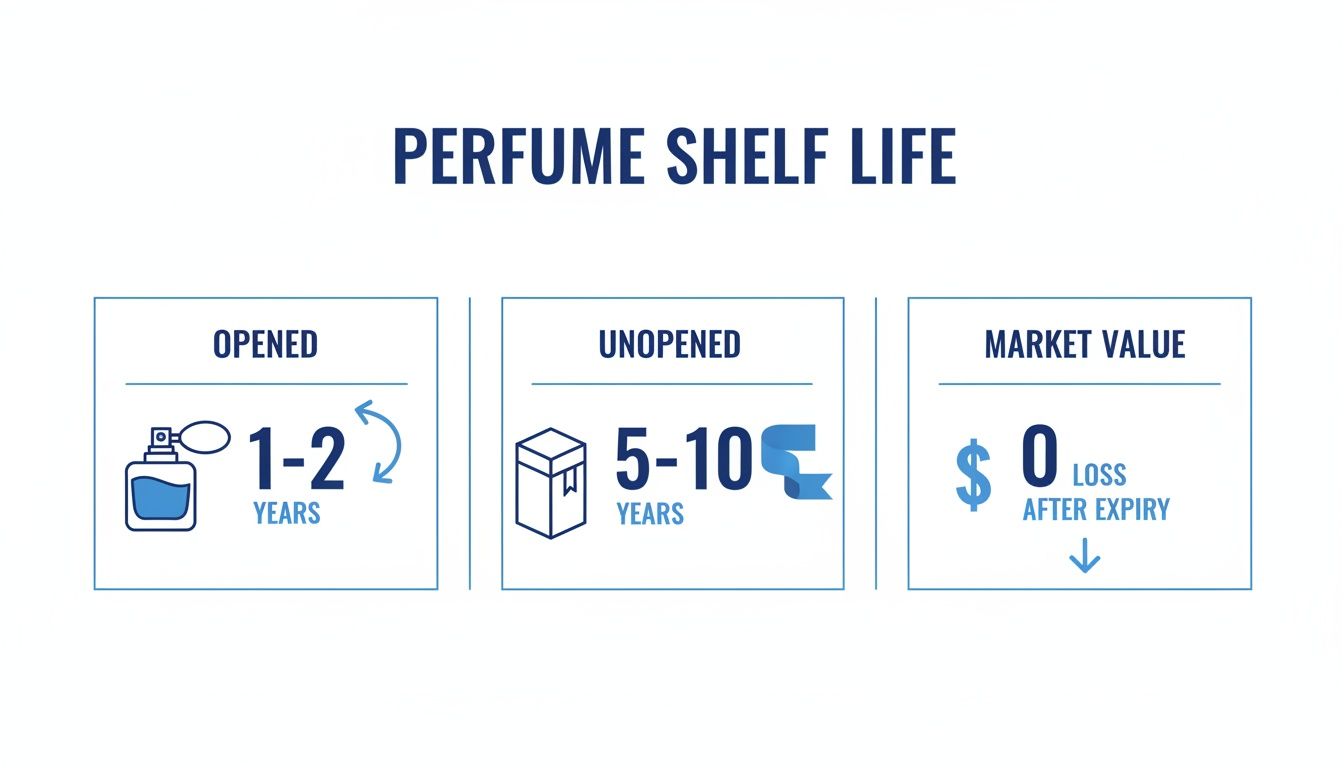
As you can see, an unopened bottle holds its integrity—and its value—far longer than one that's been introduced to the elements.
So, what determines if your fragrance will be a fleeting affair or a long-term love? It all comes down to a few key players. To make it simple, here's a quick look at what you can generally expect.
| Perfume State | Typical Lifespan | Key Influencing Factor |
|---|---|---|
| Opened Bottle | 1 to 3 Years | Exposure to Air (Oxidation) |
| Unopened Bottle | 5 to 10+ Years | Proper Storage Conditions |
Ultimately, a perfume's true lifespan is a delicate dance between its condition, its unique chemical makeup, and how well you take care of it.
So what really makes the difference between a fragrance that lasts a couple of years versus one that sticks around for a decade? It boils down to a few critical factors:
The moment you uncap a new fragrance, a clock starts ticking. Your mission, should you choose to accept it, is to make that countdown as long and beautiful as possible by protecting the precious liquid inside from its natural enemies: light, heat, and air.
This guide will walk you through everything you need to know, transforming you from a casual wearer into a true fragrance connoisseur who knows how to cherish every last drop.
Ever wonder what’s actually happening inside that gorgeous bottle on your vanity? Your perfume is alive—a vibrant, delicate dance of molecules in constant motion. But like any perfect moment, it can be fleeting. Three uninvited guests are always trying to crash the party and alter the magic within: light, heat, and air.
Think of your fragrance not as a static liquid but as a living story. It unfolds in layers, and these environmental factors are the villains trying to rewrite the ending. But understanding them puts the power back in your hands. This isn't a dull science lesson; it’s the secret language of scent.
The most notorious heartbreaker for any perfume is oxidation. It's a simple, yet devastating, chemical reaction. Every time you spritz, or even just leave the cap off for a moment too long, you’re inviting oxygen inside. That air begins to mingle with the fragrance molecules, slowly changing their very structure.
Imagine your perfume taking a long, deep breath that it never fully exhales. Over months and years, this process dulls the bright, sparkling top notes and can introduce a sharp, almost metallic or sour smell. It’s the scent equivalent of a vibrant painting left in the sun, its brilliant colors slowly turning muted and brown.
Oxidation is the primary reason a perfume’s scent begins to turn. It’s an invisible process that gradually breaks down the aromatic compounds, fundamentally altering the fragrance's intended character and story.
Next in our trio of troublemakers is evaporation. The most volatile parts of your perfume are its top notes—those bright, flirty scents of citrus, light florals, or fresh herbs that create the dazzling first impression. By design, they are meant to be fleeting, capturing your attention before gracefully making way for the heart and base.
But when a bottle isn't sealed tightly or is stored in a warm place, this process goes into overdrive. The alcohol, which acts as the carrier for the scent oils, starts to evaporate more quickly, taking those precious top notes along for the ride. What you're left with is a scent that feels flat and heavy, like a conversation that skips the charming introduction and jumps straight to the end. It's a story that has lost its captivating opening chapter.
Finally, let's talk about the dynamic duo of destruction: light and heat. Storing your perfume on a sun-drenched windowsill might look beautiful, but UV rays act like tiny lasers, shattering the fragile molecular bonds that create your favorite scent.
Heat, its partner in crime, accelerates every chemical reaction, basically putting your perfume's aging process on fast-forward. A bottle left in a hot car or a steamy bathroom will degrade exponentially faster than one kept in a cool, dark drawer. Together, they are the ultimate enemies of elegance, working to unravel the perfumer’s art one molecule at a time.
Forget batch codes and timelines for a moment. When it comes to knowing if your perfume has expired, your own senses are the best detectives you have. Learning to spot the tell-tale signs of a fragrance that's past its prime is an art, and this is your training ground.
Think of it as a sensual investigation. A perfume that has turned will send you clues—subtle shifts in its character that whisper its story is over. Your mission is to listen, look, and smell, becoming attuned to the unique language of your scent collection.
The first clue is often visual. Hold the bottle up to the light and play detective. Has that once-clear, golden liquid turned into a deeper, almost syrupy brown? Or maybe it's taken on a cloudy, milky appearance. This change in color is a direct result of the aromatic molecules breaking down over time.
While some rich, amber-based scents can naturally darken and become even more beautiful with age, a dramatic shift in a lighter fragrance is usually a red flag. This visual change is often your first warning that the chemistry inside has been irrevocably altered.
Now for the most important test. When you first spray a perfume, you should be greeted by its bright, sparkling top notes—the flirtatious opening act. An expired perfume often loses this magic entirely.
Instead, your first impression might be a sharp, overwhelming blast of alcohol or a strange, sour, and almost metallic tang. This is a dead giveaway that the most delicate top notes have evaporated, leaving behind a distorted and unbalanced heart.
The most reliable test is always your nose. If the scent has lost its intended sparkle, smells unpleasantly sharp, or no longer brings you joy, it has likely turned. Trust that initial gut reaction.
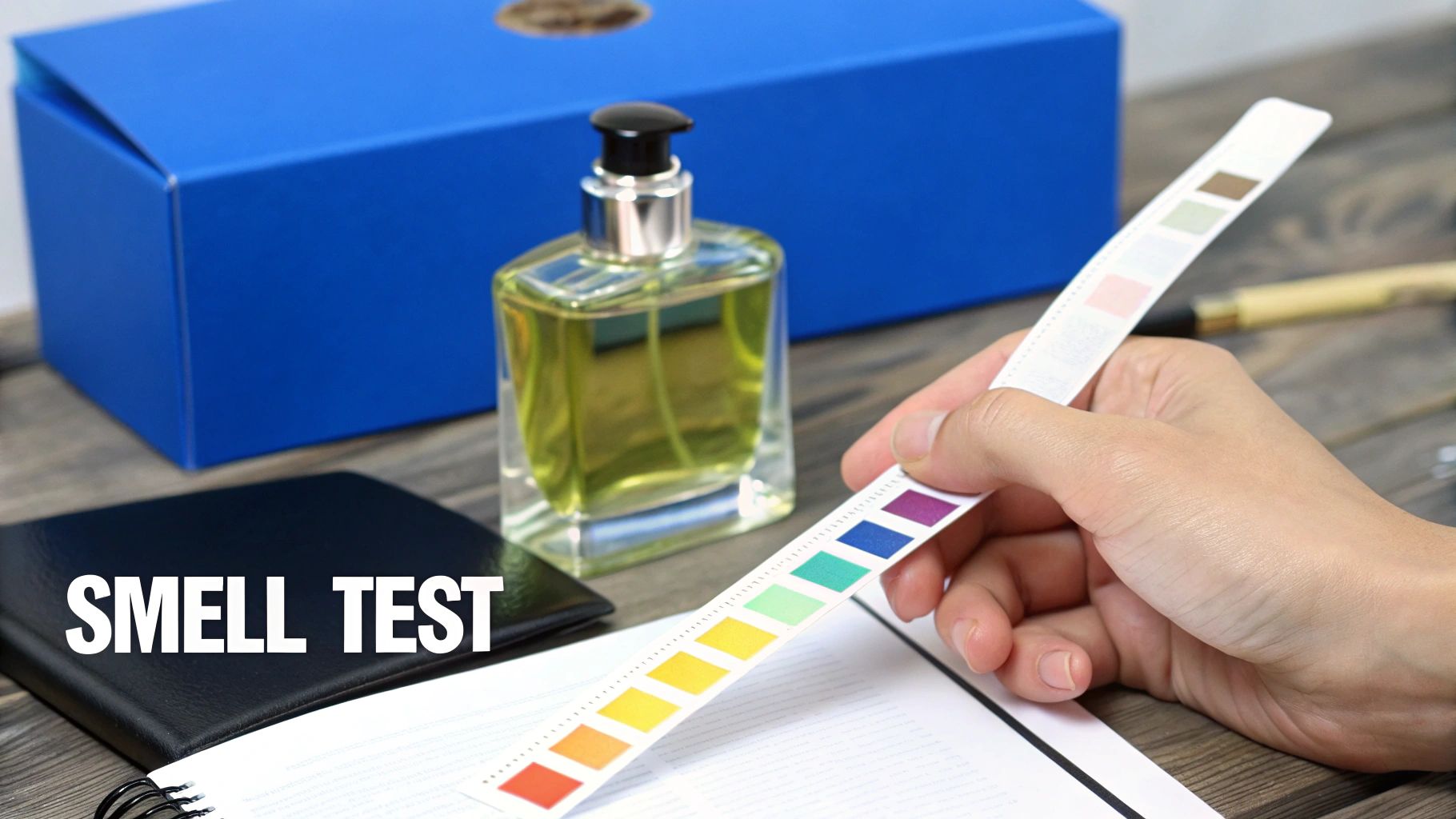
Before you even think of putting a questionable scent on your skin, grab a paper test strip or even a simple piece of cardstock. Spray the perfume onto the paper and let it sit for a minute.
This simple step protects you from potential skin irritation, which can sometimes happen when a perfume's chemical structure degrades. Sniff the paper first; if the scent is off, you have your answer without any risk.
Just as we learn to recognize these changes, understanding how different aromas can influence our well-being is a core part of appreciating the power of scent. This awareness helps you distinguish between a fragrance that has gracefully matured and one that has truly spoiled.
Not all scents are created equal, especially when it comes to how they age. Just like people, different fragrance families have entirely different personalities and lifespans. Getting a feel for this distinction is the secret to building a collection that not only smells incredible today but also holds its own over time.
Think of your perfume collection as a cast of characters in a play. Some are destined for a brilliant but brief moment in the spotlight, while others are built for a long, smoldering performance. Knowing who's who is key.
Some perfumes are all about that dazzling first impression. They are the sprinters of the fragrance world—energetic, vibrant, and impossible to ignore, but they burn out the fastest.
These fragrances are like a passionate, fleeting romance. Enjoy their brilliant opening act, but don't expect them to stick around in your collection for a decade. Their beauty is in their immediacy.
On the other end of the spectrum are the marathon runners—the deep, sultry scents that don't just last, they often get better with age. Their heavier, more stable molecules give them incredible staying power, both on your skin and in the bottle.
These fragrances are constructed on a foundation of robust base notes that can anchor a scent for years, sometimes even decades.
Scents from the Oriental, Woody, and Chypre families are the true investment pieces in your collection. With their rich bases of resins, woods, and moss, they can mature beautifully, much like a fine wine, developing deeper complexity over time.
Examples of these long-haul notes include sandalwood, patchouli, amber, vanilla, and oakmoss. A perfume heavy with these ingredients might see its brighter top notes fade over the years, but the rich heart and soul will remain, often becoming warmer and more profound.
The whole conversation around "does perfume expire" gets a fascinating twist with the rise of modern synthetics. While there’s an undeniable romance to all-natural ingredients, they can be incredibly temperamental.
In the synthetic vs. natural debate, perfumes expire at very different rates. Natural perfumes have an average shelf life of 1-3 years because their volatile essential oils oxidize quickly. Synthetics, on the other hand, can last 4-7 years thanks to stable, lab-engineered molecules. You can explore more research on the modern perfume market and its composition at databridgemarketresearch.com.
This doesn't make one better than the other; it’s simply a different kind of artistry. A perfumer might use a synthetic musk or ambergris accord not just for ethical reasons, but to give a fragrance a predictable, gorgeous backbone that won't easily break down. It’s the secret behind many modern masterpieces with seriously impressive longevity.
Ready to become the ultimate guardian of your fragrance collection? Protecting your precious potions is less about complex chemistry and more about creating a loving sanctuary for them. With just a few simple rituals, you can dramatically extend your perfume's life, ensuring every spritz is as captivating as the first.
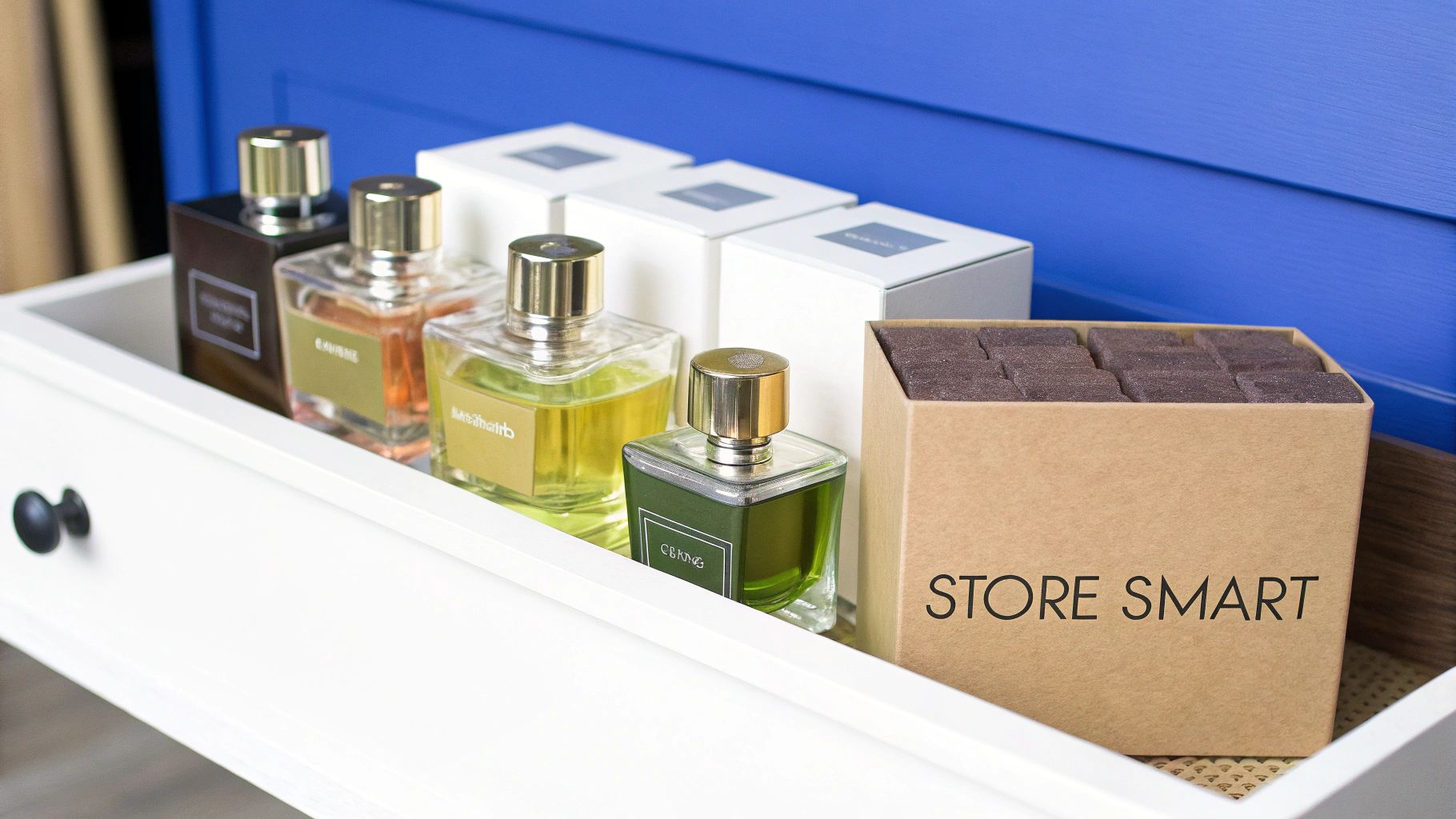
Forget what you’ve seen in movies—your steamy bathroom vanity is the absolute worst place for your perfume to live. Heat and humidity are its mortal enemies, accelerating the breakdown of those delicate scent molecules. Your fragrance craves consistency and tranquility.
Instead, think cool, dark, and dry. The perfect hideaway is often a place you’d least expect, but when you think about it, it makes perfect sense.
Finding the right home for your bottles is the single most important step you can take. Your perfume isn't just décor; it's a delicate composition that needs protection from its environment.
Keeping your fragrances happy is an active process, much like managing other important items in your life. The principles of preservation extend beyond just perfume, and mastering them can be a game-changer. You can learn more about effective methods for tracking essential items with expiration dates to really master the art of preservation.
How you handle the bottle matters, too. There’s a bit of a sensual art to preserving the magic inside, and it starts with a gentle touch and a few firm rules.
First, resist the urge to shake it. Perfume isn't a vinaigrette; it’s a perfectly balanced blend that wants to be left alone. Shaking it vigorously can introduce excess air and potentially damage the delicate molecules, speeding up the oxidation process.
Treat your perfume bottle like a treasured love letter. Handle it with care, open it only when needed, and always seal it tightly to protect the precious message inside.
Finally, always make sure the cap clicks securely back into place. This simple act is your best defense against evaporation and oxidation, keeping the air out and the soul of your scent in. It’s a tiny step that makes a world of difference in the long, beautiful life of your fragrance.
Your journey to a long-lasting and utterly divine fragrance collection begins long before you bring that beautiful bottle home. It starts with becoming a savvy, empowered shopper—someone who knows that the secret to a scent's longevity is choosing wisely from the very start. This is about making smart, sexy investments in your scent wardrobe.
Think of it as fragrance foreplay. You wouldn’t rush a beautiful encounter, so why rush a purchase? Understanding what you’re buying transforms a simple transaction into a strategic acquisition, ensuring every spritz is as perfect as the perfumer intended.
On the bottom of most perfume boxes or bottles, you'll find a small, imprinted string of numbers and letters. This isn't just a random code; it's your perfume's birth certificate, known as a batch code. It tells you the exact date your fragrance was manufactured.
Why does this matter? A perfume that was produced six months ago is going to be fresher and more vibrant than one that's been sitting in a warehouse for three years. Several free online batch code calculators let you enter this code and instantly see the manufacturing date, giving you the power to choose the freshest bottle available.
It can be tempting to buy the largest bottle to get the best "deal," but bigger isn't always better. If you have a large collection or only wear certain scents for special occasions, that giant 100ml bottle might turn before you can finish it.
Instead, be strategic. Buy smaller bottles (30ml or 50ml) for those situational scents you adore but don’t wear daily. This ensures you enjoy every last drop at its peak potency and reduces waste. Committing to a smaller bottle for a fleeting affair is much smarter than being saddled with an expired giant.
Buying from a reputable retailer like Gotham Fragrances is non-negotiable. It guarantees you’re getting authentic, fresh stock that has been stored correctly, not a bottle that’s been baking under hot lights in a questionable warehouse.
Perfume expiration even drives huge market dynamics in the global fragrance industry. A significant percentage of perfumes are discarded yearly, pushing brands toward smaller 50ml packs that can cut waste by 40%. Savvy consumers who check batch codes can reduce this blind waste by 35%, making a real impact. You can learn more about these fragrance market trends on futuremarketinsights.com.
Alright, let's clear the air and get into the good stuff. You’ve got the basics of storage and smart shopping down, but a few juicy questions might still be floating around. Think of this as your personal cheat sheet for becoming a true fragrance connoisseur.
It's tempting to spritz that old favorite, but it’s a bit of a risky move. While it's usually not dangerous, the chemical compounds in a perfume break down over time, and that can sometimes lead to skin irritation or even an allergic reaction.
The bigger issue? The scent will be a sad, distorted ghost of what it once was. Always give it a test on a paper strip first. If you get a whiff of anything sharp, metallic, or just plain wrong, it's time to say a graceful goodbye.
Making a scent truly cling to you is an art. Fragrance absolutely adores hydrated skin, so the first step is to apply an unscented moisturizer to create the perfect canvas for your perfume to grab onto.
Next, target your pulse points—those warm, intimate spots like your wrists, the nape of your neck, and even behind your knees. Your natural body heat will gently warm and diffuse the scent all day long, creating a mesmerizing aura that’s completely, uniquely yours.
Think of it as a whispered promise. Properly applied, a fragrance doesn't just sit on your skin; it becomes a part of your presence, leaving a trail of intrigue wherever you go.
Absolutely. The concentration is one of the biggest clues to a fragrance's staying power, both on your skin and in the bottle.
Higher concentrations like an Eau de Parfum (EDP) or a pure Parfum are packed with more fragrance oils and have a higher alcohol content. Alcohol is a fantastic natural preservative, so these richer formulas are built for a long, passionate affair.
Lighter concentrations, like an Eau de Toilette (EDT) or Eau de Cologne (EDC), have more water in their composition. This makes them more delicate and vulnerable to breaking down over time. They're like beautiful, fleeting moments—you have to seize them while they're perfect.
Ready to find a new signature scent that will last? At Gotham Fragrances, we guarantee fresh, authentic designer fragrances that are ready for a long and beautiful life with you. Discover your next obsession and explore our curated collection today.