
You're at the dressing table, deciding whether your perfume should feel crisp enough for the day ahead or soft enough for whatever happens tonight. The lavender bottle looks promising, but you're not shopping for a linen cupboard. You want something with personality, a little polish, perhaps a little trouble.
Lavender perfume for women can deliver all of that. The trick is choosing its partners, not choosing the note alone. Citrus makes it sparkle; woods give it structure; vanilla brings it closer to the skin. Buy for the way the whole composition develops, not for the purple flowers on the packaging.
A lavender perfume can feel traditional on one vanity and strikingly modern on another. Its appeal lies in how readily the note adapts to the wearer and the composition around it.
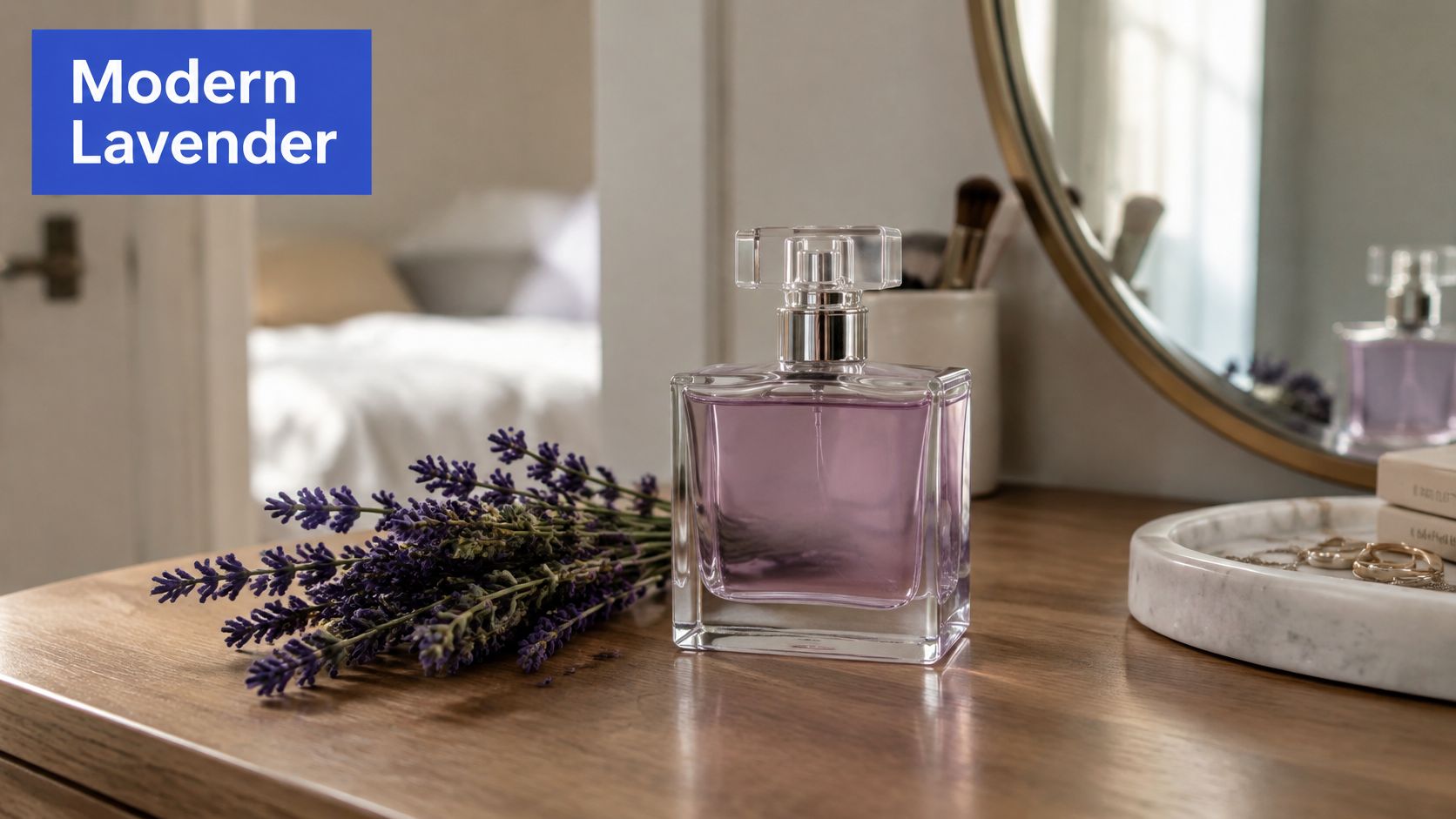
According to Odeuropa's lavender history, Roman bathers scented their water with lavender. European perfumers made it a central ingredient by the 18th century, and improved farming and distillation expanded its industrial use during the 19th century. Perfumers used it both alone and in blends, giving the herb a role beyond that of a supporting note.
Lavender's feminine identity developed over time. Some lavender grooming products were later marketed to women, but the note itself has no fixed gender.
Buying principle: Lavender isn't inherently masculine, feminine, old-fashioned or sleepy. The composition gives it that identity.
Choose the version that fits your mood, whether you want traditional elegance, brisk freshness or a warmer, more intimate feel. If an earlier lavender perfume struck you as soapy, don't rule out the note. A different blend can make it feel fresh, sweet, sharp or sensual. Test the actual perfume on your skin before buying, and judge how its character develops rather than relying on the lavender label alone.
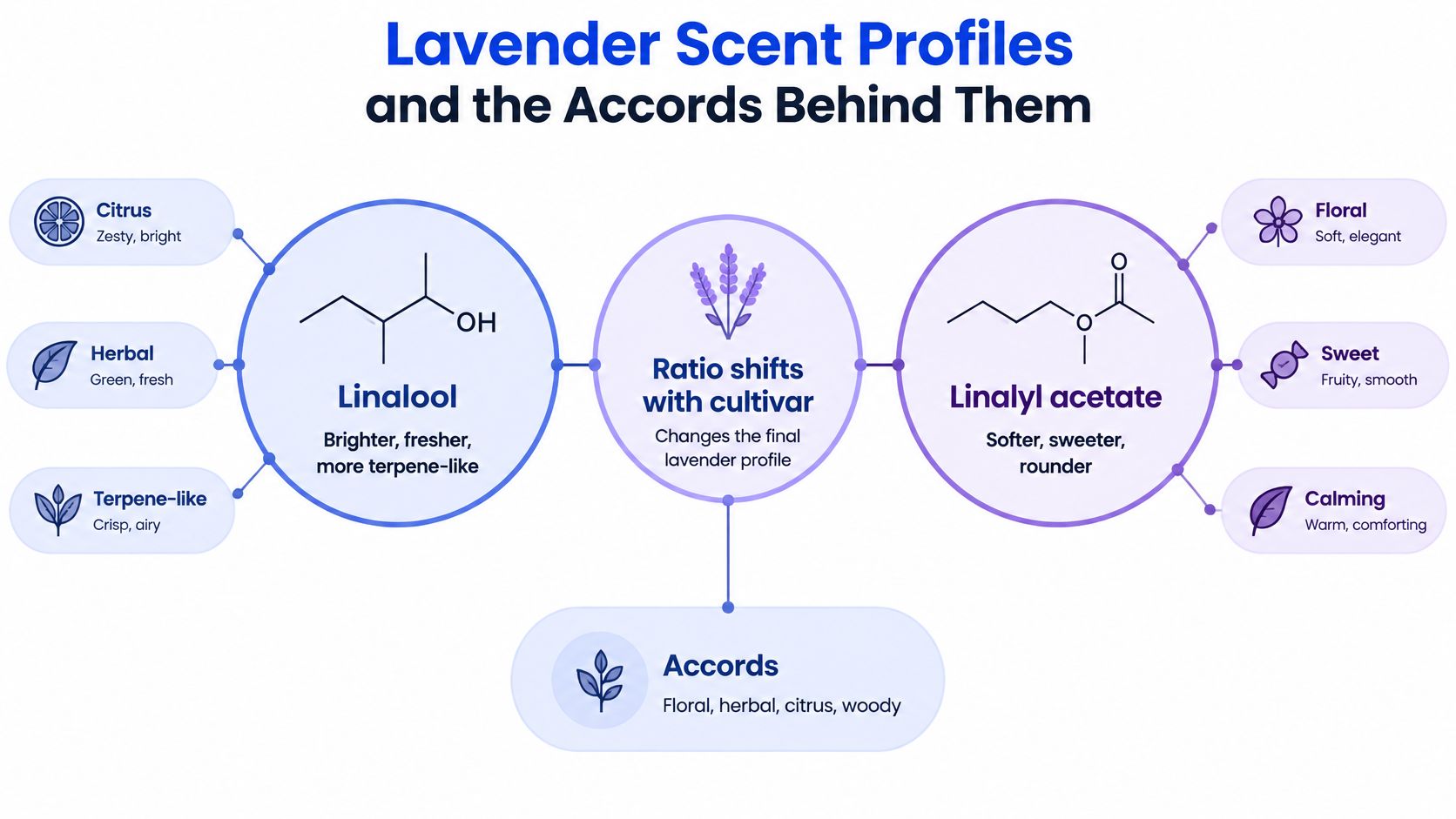
Linalool and linalyl acetate do much of the aromatic work. The lavender-oil study published by Wiley connects linalool with brighter, fresher, more terpene-like character, while linalyl acetate supports a softer, sweeter, rounder floral impression. Cultivar, growing conditions and extraction can shift their balance.
This diagram shows why lavender doesn't have a single fixed personality.
A formula using lavender essential oil can also smell different from one built with isolated or reconstructed aroma molecules. Natural isn't a scent profile, and reconstructed doesn't automatically mean less beautiful. Judge the balance you smell.
| Profile | Notes beside lavender | How it feels |
|---|---|---|
| Soapy and airy | Clean musks, green notes, light florals | Fresh laundry, clean skin |
| Citrus-aromatic | Bergamot, lemon, grapefruit | Bright and sparkling |
| Powdery and elegant | Iris, rose, soft vanilla | Refined and soft-focus |
| Woody and tailored | Cedar, vetiver, sandalwood | Composed and grounded |
| Sweet and sensual | Amber, tonka, vanilla, ripe fruit | Warm, close and enveloping |
Use these profiles as shopping directions, not promises. A little vanilla can soften an herbal opening without turning the perfume into dessert. Likewise, cedar can give lavender a dry outline without making the result stern.
Check for lavandin, too. A review of lavender and lavandin oils reports approximately 6–8% camphor in related lavandin oils, compared with about 0.5–1.0% commonly reported for lavender oil under the cited standards. That helps explain a brisker, more herbal impression, although those percentages describe oils, not the finished perfume.
Read a note list in two passes. First, locate lavender in the opening or heart. Then inspect its companions: citrus and green notes suggest brightness, while woods, amber and vanilla suggest a warmer finish.
Don't mistake the list for a complete formula. It tells you the intended impression, not exactly how much lavender you'll smell or how long it will remain noticeable.
For another way to explore lavender's fragrance character, watch the accompanying video.
My recommendation: choose lavender and bergamot when you want a sunny-lunch perfume with a little lift. Choose lavender and tonka when you want the scent equivalent of soft knitwear after dark. Neither is more authentically lavender. They give the note different company.
Choose concentration for how you want to wear the fragrance, not for bragging rights. An extrait isn't automatically a better purchase than an eau de toilette, and a stronger bottle isn't automatically sexier. A generous aromatic cloud can be less inviting than a discreet scent someone notices close by.
Concentration describes the proportion of fragrance materials in the finished product. Format names offer a useful starting point, but they don't guarantee projection, texture or wear time. A dense vanilla base and a transparent citrus composition won't behave identically just because both say EDP.
| Format | Typical concentration | Expected longevity | Best use |
|---|---|---|---|
| Extrait de parfum | Concentrated format; confirm the maker's specification | Intended for extended wear; test the formula | Special evenings, small dose |
| Eau de parfum (EDP) | Usually more concentrated than an EDT counterpart | A practical candidate for sustained daily wear | Everyday signature, evenings |
| Eau de toilette (EDT) | Generally lighter than an EDP counterpart | Plan for a lighter wearing experience | Daytime, warm weather, layering base |
| Eau de cologne | Light fragrance format | Suited to refreshing rather than all-day expectations | Quick refresh, hot climates |
| Body mist | Lightly fragranced format | Expect to refresh as needed | Light refresh, layering over perfume |
For an everyday signature, start with eau de parfum. For a shared office or warm daytime wear, put the eau de toilette beside it and compare the actual scent trail. For an intimate evening, try an extrait sparingly rather than assuming you need a larger application.
Buy the concentration you'll enjoy wearing, not the strongest version you can afford.
Bottle size tells you how much liquid you're buying, not your cost per wear. Price, spray output, application habits and how often you reach for the bottle all matter. A large bottle that feels too heavy for your daily life isn't economical if it stays untouched.
Don't assume a larger eau de parfum always beats a smaller mist on value, either. Compare prices and your likely usage before making that calculation.
For a compact collection, choose a lighter daytime option and a richer evening option. They don't need to be different concentrations if the formulas already provide enough contrast. Skip the complete format collection unless you enjoy every version.
Start with the effect you want on your own skin. A fragrance can be beautifully composed and still feel wrong for your clothes, your working day or your idea of intimacy. Choose something that feels like you, not something you think a lavender wearer ought to choose.
For a bottle that needs to handle almost everything, choose lavender with gentle citrus, soft musk and restrained woods. That balance gives you freshness without a harsh herbal edge and warmth without a dessert-like finish. Adjust your application to the setting rather than buying a heavy perfume and hoping it behaves discreetly.
A review of lavender and the nervous system discusses aromatherapy findings involving improved mood and reduced psychological distress, but it doesn't establish commercial lavender perfume as a human-attraction chemical. Your perfume can help create an atmosphere you enjoy; it can't promise anyone else's response.
That's a better version of sexy anyway: relaxed shoulders, a scent you love and no need to announce your arrival from the doorway. Let the perfume feel intimate rather than treating it as a seduction trick.
Before buying, answer these questions:
Apply lavender with intention. You want an even, comfortable scent, not overlapping products that compete for attention. Begin with a single layer, then add another scented layer only when you know what the perfume needs.
The application sequence below keeps preparation, spraying and layering separate.
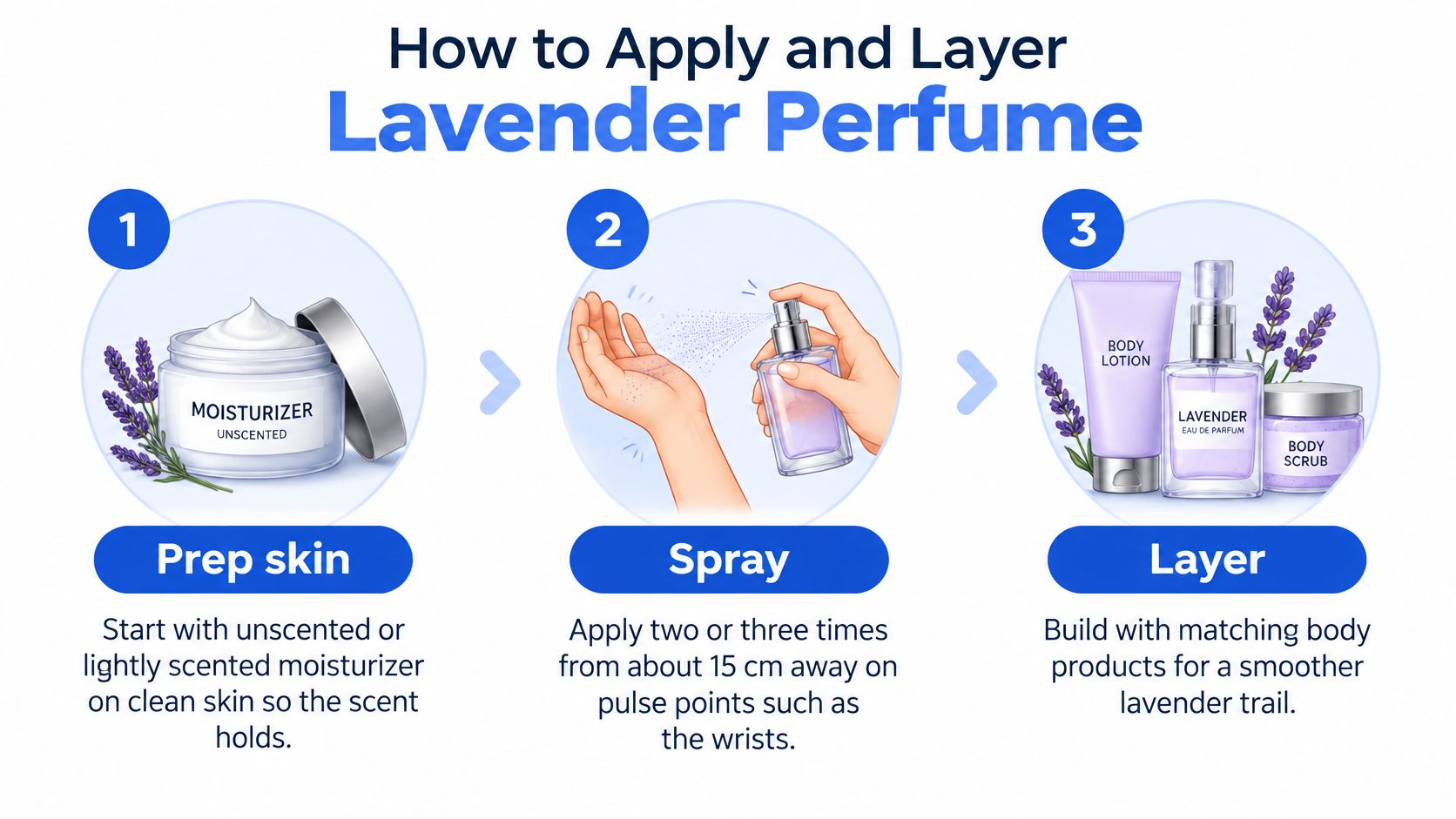
Prepare clean skin. Apply unscented moisturizer and let it absorb before spraying. A strongly perfumed cream can change your lavender before you've even opened the bottle.
Spray lightly and evenly. As a starting technique, use two or three sprays from about 15 cm away, choosing spots such as wrists, the base of the throat or inner elbows. That's a starting application, not a target to meet with a powerful formula; spraying too close can leave a wet, concentrated patch.
Let the application dry. Give it about five minutes before dressing, especially around delicate fabrics. Pulling clothing over wet perfume can transfer the product, and some materials may stain.
Leave your wrists alone. Don't rub them together; let the perfume dry where you applied it. Rubbing spreads the liquid rather than giving you a useful shortcut to its finished scent.
Add a compatible body product. Use a lavender wash or lotion from a similar scent family if you want a more continuous impression. The common mistake is pairing a sharp herbal wash with a syrupy perfume and expecting identical lavender character.
Refresh deliberately. If you want a midday mist, choose a shared note, such as citrus for a bright fragrance or vanilla for a sweeter one. Don't spray repeatedly just because you've stopped noticing your own perfume; first check whether it remains apparent nearby.
A lavender-and-citrus pairing feels lively because the brightness offsets the floral-aromatic softness. Lavender with vanilla or musk feels smoother and more intimate. Try each combination separately before making it your usual routine.
Layering advice: Add the note you wish were more noticeable, not another complete perfume competing for the lead.
Say your lavender smells a little severe for an evening out. Try an understated vanilla lotion beneath it rather than covering it with a loud gourmand fragrance. If it's already sweet, leave the vanilla alone and choose an unscented base.
Less is more with lavender. A controlled application usually feels more polished than a heavy cloud, particularly when the formula has a pronounced herbal edge.
Wear time isn't a concentration-only question. Your skin, the weather, application amount and supporting base notes all affect the experience. Woods, musks and amber may remain noticeable after lavender's brighter facets have softened, so distinguish a perfume that lasts from lavender that stays prominent.
Storage deserves equal attention. According to the European Commission's explanation of fragrance allergens, linalool and linalyl acetate can react with oxygen, producing oxidation products with greater contact-sensitizing potential. Keeping a bottle well isn't merely about preserving a pretty smell.
| Condition | Effect on lavender perfume | What to do |
|---|---|---|
| Prolonged heat, such as a car or steamy bathroom | Encourages degradation and loss of freshness | Store in a drawer away from the shower |
| Direct sunlight | Encourages breakdown and can alter appearance | Keep in the original box |
| Repeated air exposure | Gives linalool and linalyl acetate opportunities to oxidize | Close securely; use a small travel atomizer when needed |
| Cool, dark, stable room | Helps slow unwanted changes | Make this your everyday storage location |
| An older bottle with a changed smell | May smell flat, sour or unusually sharp | Assess before wearing; replace if clearly altered |
Choose a bedroom drawer or cupboard away from a radiator. Keep the original box if you like displaying your collection occasionally, then return the bottle after use. A sunny vanity may photograph beautifully, but it isn't where I'd keep a perfume I wanted to preserve.
For travel, fill a clean, suitable atomizer rather than repeatedly packing your main bottle. Label the decant so you know what's inside, and don't keep topping up an old mixture indefinitely.
A noticeable change in smell deserves attention, whether the bottle is old or recently purchased. Don't use age alone as a pass-or-fail test, and don't assume an unchanged color proves the formula is unchanged.
If the perfume has become unpleasantly sour, flat or sharp, replace it rather than trying to hide the change with another fragrance. A smell check isn't an allergy test, either. Good storage reduces avoidable exposure to heat, light and air; it doesn't make any fragrance risk-free.
Test a lavender perfume on a small area of intact forearm skin before committing to a bottle, unless you have a known fragrance allergy that warrants medical guidance first. A paper strip is useful for screening, but it can't tell you how the full composition wears on you.
A home small-area trial isn't a diagnostic patch test. Reactions can be delayed: a review of essential-oil allergy cites lavender-oil sensitivity in approximately 4% of Japanese patients evaluated for cosmetic allergy, not the general population.
Don't apply perfume to broken or irritated skin, and don't substitute undiluted essential oil for finished perfume. Stop if redness, itching or swelling develops; consult a dermatologist for persistent reactions.
Check for lavender oil, linalool and linalyl acetate. Natural, hypoallergenic and sensitive-skin marketing isn't a safety guarantee. Be particularly cautious with used bottles whose storage history you don't know.
For gifting, match a recipient's established preferences rather than your own. Someone who loves dry woods may enjoy lavender designed to complement that; someone who reaches for soft sweetness is a better candidate for vanilla or tonka.
If you're unsure, my safer starting point is an airy or citrus-aromatic eau de parfum in a smaller size, ideally with a sample to try first. It's a starting recommendation, not a promise that everyone likes clean scents.

Use this buying checklist:
For broader size-and-budget comparisons, our Noa by Cacharel Eau De Toilette Spray 3.4 oz for Women is $33.64, and our women's section lists Obsession by Calvin Klein Eau De Parfum sprays in 1 oz, 1.7 oz and 3.4 oz, plus a gift set. These are shopping comparisons, not lavender recommendations.
At Gotham Fragrances, we offer authentic, name-brand women's perfumes and discovery guidance to help you choose with confidence. Browse for your preferred lavender profile, check the listed sizes and ingredient declarations, and choose a bottle to test this week.