
You're holding a bright bottle that smells like a clean shirt and a sunny sidewalk, and the card just says bergamot. It feels easy. It can also disappear before lunch, turn harsh if you stack it, or ask for a little sun sense once you're outside.
That's the job of perfumes with bergamot. The note is a bridge, and the partners decide which way it leans. Lemon makes it sharper. Neroli or jasmine makes it softer and closer. Read the note list for the mood, then follow the sun rule that matches how you'll wear it. I would do those two checks before I trust the first spritz.
Bergamot shows up in four fragrance families, and it does a different job in each. Same peel, four assignments. The family tells you whether you're buying sparkle, softness, lift, or a cool edge.
| Fragrance family | What bergamot contributes | Typical feel | Example in the store |
|---|---|---|---|
| Aromatic citrus | Opens the scent with sparkle and soft bitterness | Clean, energetic, daytime | Chrome by Azzaro Gift Set for Men, notes include bergamot, lemon and neroli |
| Floral (neroli, lavender, jasmine pairings) | Bridges the fresh top to the petal heart | Soft, airy, polished | A floral bottle that lists bergamot with neroli, lavender, or jasmine |
| Woody or aromatic | Lifts dry woods and herbs so the base feels lighter | Crisp, grounded | A woody bottle that lists bergamot before cedar, oakmoss, or herbs |
| Fresh marine or green | Sharpens the citrus edge with a cool lift | Light, cool, summery | A fresh bottle that lists bergamot with marine or green notes |
In aromatic citrus, bergamot is the sparkle at the opening, sharpened by lemon or grapefruit. Chrome by Azzaro Gift Set for Men is the clear worked example, and it sits in the aromatic citrus family. Its listed notes are pineapple, neroli, lemon, bergamot, rosemary, coriander, jasmine, oakmoss, and cyclamen. Lemon keeps the opening energetic. Rosemary and coriander stop it from reading like juice. Oakmoss gives the dry-down a refined edge, so the citrus doesn't feel empty by noon.
In floral scents, bergamot beside neroli, lavender, or jasmine softens into the petal heart. The bitterness stays, but it reads polished, almost skin-close, once the first rush fades. That's the dressed-up version of the note, not lemonade.
In woody or aromatic scents, bergamot lifts dry woods and herbs so the base doesn't sit heavy. It won't turn cedar into cologne. It cuts the dust. If oakmoss or rosemary follows the citrus, the dry-down stays crisp and grounded.
In fresh marine or green scents, bergamot adds a cool, bright lift for warm weather. Those partners make the citrus feel like shade rather than sugar. Save that style for heat, not a wool coat.
Reading rule: Bergamot beside neroli or lavender signals a floral-citrus opening, while bergamot beside lemon or marine notes signals a sharper, more energetic scent.
Bergamot is a chord, not a single note. Limonene is the bright strum. Linalyl acetate is the soft floral hum underneath. If a bottle only gives you the strum, you're smelling a thinner citrus, not the full fruit.
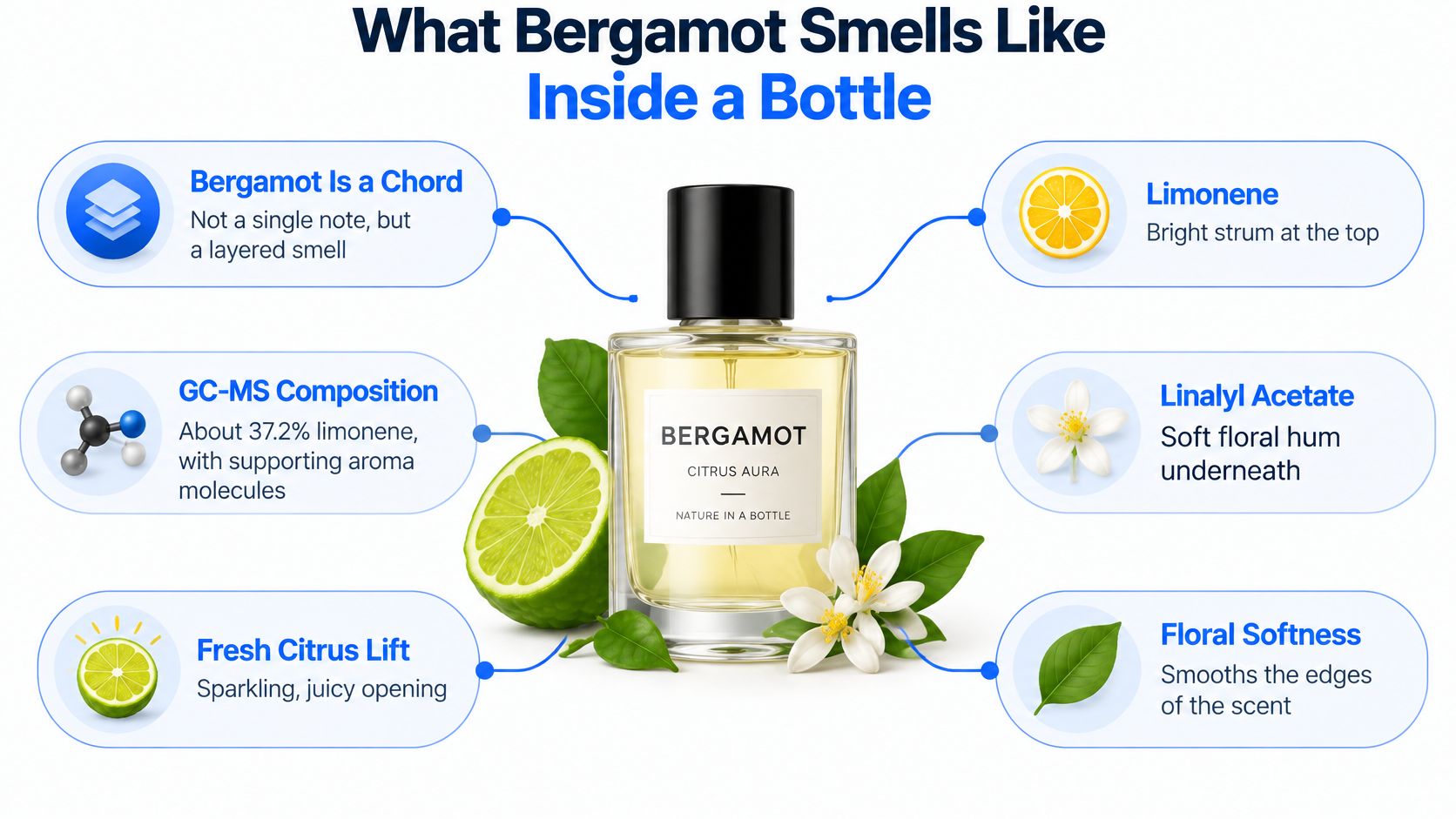
A gas chromatography study in Flavour and Fragrance Journal identified approximately 37.2% limonene, 30.1% linalyl acetate, 8.8% linalool, 6.8% gamma-terpinene, and 6.2% beta-pinene in bergamot essential oil. Limonene and the other terpenes supply the volatile citrus sparkle. Linalyl acetate and linalool add a smoother, sweeter, lavender-like softness.
That same sensory work tied the bergamot-like odor especially to linalyl acetate, geraniol, decanal, and Z-limonene oxide. The fresh citrus effect comes from how these compounds interact, not from limonene alone. More limonene means a sharper, faster sparkle. More linalyl acetate means a rounder, sweeter heart.
Natural bergamot isn't interchangeable with one aroma chemical. Origin, extraction, and processing shift the limonene-to-linalyl-acetate balance, and that changes diffusion, sweetness, and freshness. Two bergamot-led perfumes can smell far apart because their balance differs.
Spray one blotter. For the first ten minutes, chase the sparkle. At thirty minutes, check for floral softness. If only a flat lemon remains, the chord was never really there.
People reach for bergamot when they want calm, ease, and a little intimacy in the air. That association is worth keeping. It is not a promise that a bottle will change your mood or make you more desirable.
In a crossover study of 41 healthy women, 15 minutes of bergamot inhalation was associated with better negative-emotion and fatigue scores and with higher high-frequency heart-rate activity, a marker linked to parasympathetic activity, according to trials compiled by the American Botanical Council's HerbMedPro. Salivary cortisol fell no more than it did with water-vapor inhalation, so that study doesn't show a unique calming chemical effect.
A HerbClip review of 11 human trials found mixed mood and nervous-system results that varied by population, design, and measurement. In one of those studies, 30 minutes of bergamot aromatherapy reduced anxiety on the State-Trait Anxiety Inventory among 109 patients awaiting surgery. Other setups didn't move the scores the same way.
Choose bergamot for the way it feels on you, and treat any mood benefit as a pleasant bonus.
Bergamot can make a scent feel soothing and close. It isn't a guaranteed aphrodisiac, and no bottle owes you a mood change. Buy the feeling. Leave the medical claims on the shelf.
A kilogram of bergamot oil begins as roughly 200 kilograms of fruit, the ratio the American Botanical Council uses to show how material-intensive the oil is. The peel, or flavedo, holds the oil. The juice does not. That is the first cost driver: you are paying for fruit handling, not for a few drops of juice.

A heavy crop and a thin crop do not cost the same. When peel arrives in volume, natural bergamot oil is cheaper and easier to secure. When the harvest disappoints, the same kilogram costs more and perfumers have to use it sparingly. Output swings with the harvest, so the natural material shows up in measured doses even in citrus-forward formulas. Retail price reflects that swing less directly, because bergamot is one part of a larger accord. A small change in oil cost can still ripple through a citrus-led composition, especially when the bergamot is meant to read as fresh peel rather than a sweet citrus blend.
A very cheap "bergamot" scent may lean on synthetic or modified materials. Perfumers still use the natural oil when they want the full peel effect, which is why the note can stay powerful even when it is a small share of the formula. If you are comparing bottles, read where bergamot sits in the note list. First or near the top usually means the opening is built around it. Deep in the list means it is a supporting sparkle.
An academic horticultural review places organized cultivation in Reggio Calabria by about 1750 and credits the Ionian coastal strip from Scilla to Monasterace with more than 90% of global bergamot essential oil. Provenance is supply. For the peel's chemistry in plainer language, a closer look at bergamot oil is a useful companion to the bottle copy.
Bergamot is bright and volatile, so concentration decides whether you get a flash or a longer arc. Match the oil level to the day before you match the brand to your mood.
| Concentration | Fragrance oil content | Typical wear | Best fit for bergamot |
|---|---|---|---|
| Parfum (extrait) | About 20-30% | 8 hours or more | Evening, bergamot under amber or woods |
| Eau de parfum | About 15-20% | 6-8 hours | Date nights, bergamot with floral heart |
| Eau de toilette | About 5-15% | 3-5 hours | Daytime, sparkling bergamot-led citrus |
| Cologne | About 2-5% | 1-3 hours | Hot weather, light refresh |
In warm months, a lighter concentration lets the citrus refresh instead of crowding the air. Cologne and a bright eau de toilette win when the temperature climbs. In cooler months, an eau de parfum with woods or amber gives the citrus something to hold onto, so the opening doesn't vanish with your coat.
Daytime work and errands suit a bergamot-led eau de toilette. You want sparkle, not a trail across the office. A date night suits an eau de parfum where a neroli or jasmine heart blooms after the opening. A formal evening suits a richer parfum, with bergamot tucked under resins and woods.
If the citrus must last past lunch, choose the higher concentration. If you want the sparkle itself, choose the lighter one.
Bergamot isn't "unsafe," and it isn't casual either. The hazard sits in expressed bergamot oil on skin that will see sun, not in the word bergamot on a compliant perfume card.
Bergapten, also called 5-MOP, is a furocoumarin in the oil's nonvolatile fraction. A Drugs.com monograph citing the European Medicines Agency reports approximately 0.2% bergapten in bergamot oil and names it the main contributor to phototoxicity. Under ultraviolet light, furocoumarins can increase skin sensitivity. The International Fragrance Association recommendation cited there limits bergamot oil to 0.4% in finished products applied to sun-exposed skin. That cap is on the oil, not on every perfume that lists a bergamot note. Formulators can use bergapten-reduced or bergapten-free fractions, isolates, or synthetics and keep the odor.
| Case | Limit or reference value | Where it comes from |
|---|---|---|
| Bergapten content of bergamot oil | About 0.2% | EMA assessment, via the Drugs.com monograph above |
| Bergamot oil in fine fragrance and leave-on products on sun-exposed skin | Up to 0.4% of finished product | IFRA recommendation via that EMA assessment |
| Bergapten in finished cosmetics for sun-exposed skin, excluding rinse-off | Up to 15 ppm | EU limit cited by the Tisserand Institute |
| Bergapten in sun-protection and bronzing products | Up to 1 ppm | EU limit cited by the Tisserand Institute |
| Psoralen-free bergamot oil | Removes this particular phototoxic risk | EMA assessment |
The European Medicines Agency's bergamot oil assessment is the reference behind that psoralen-free point. These are formulation rules, not a home-dilution project.
Don't put concentrated essential oil on sun-exposed skin. Follow the finished product's directions. On beach or outdoor days, spray clothing. If skin reacts, wash it off and stay out of the sun. A reputable perfume is built as a compliant product. The habit that matters is how you wear it, and whether you're handling neat oil.
The sparkle is the part worth protecting. Citrus opens fast, and sloppy application spends it early. This routine is short on purpose.
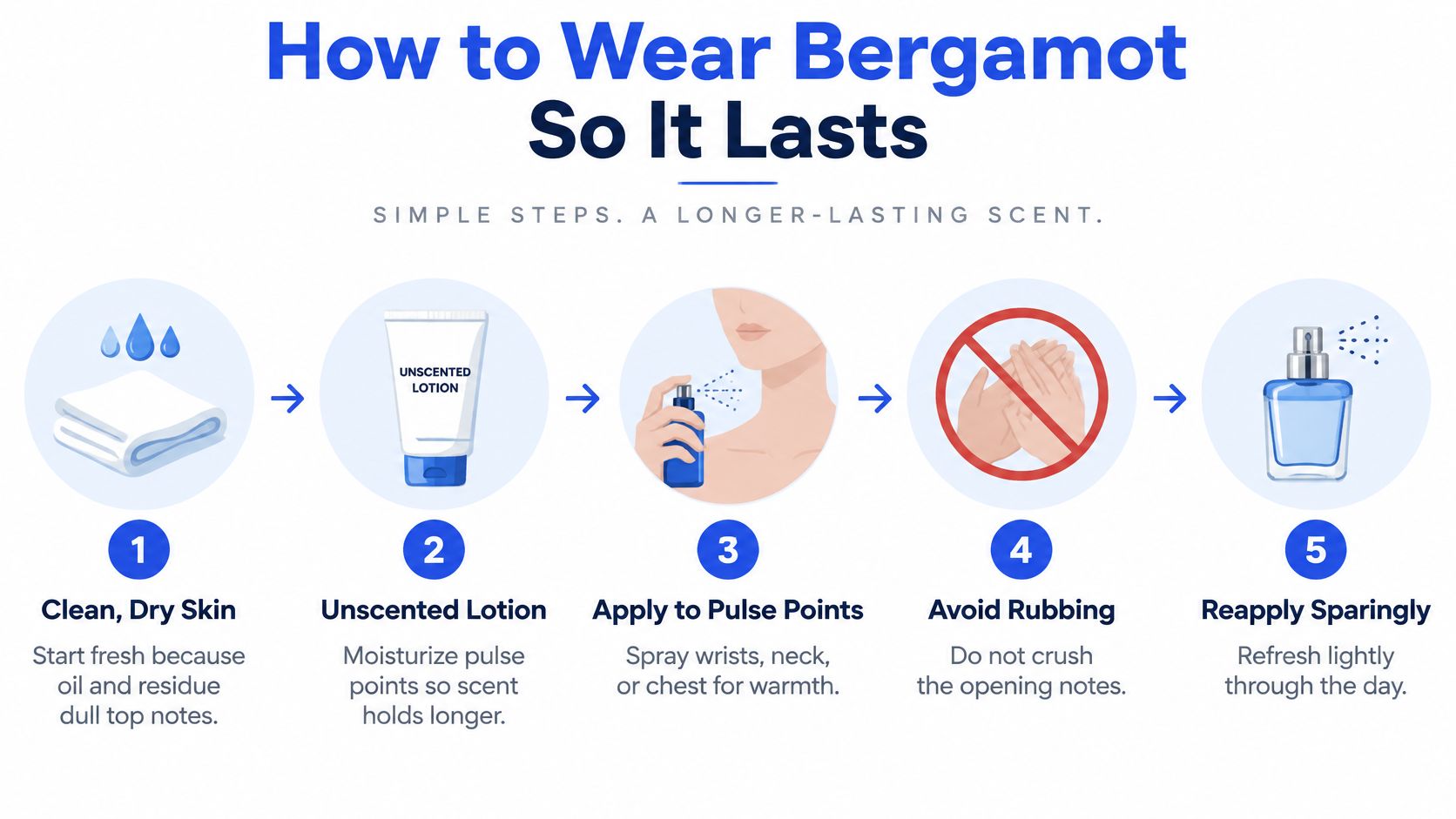
Pair a bergamot perfume with an unscented or lightly scented body product. Two sharp citrus scents layered together often smell harsh, like cleaner rather than skin. One bright perfume is enough.
On outdoor days, keep the oil off sunlit skin and put the spray on clothing when you'll be in full sun. Heat is flattering to this note. Untreated expressed oil in direct light is not.
Let the first spray dry before you decide it isn't enough.
Three checks beat a lucky spritz: confirm bergamot is on the note list, match the fragrance family to the occasion, and match the concentration to the season. Bergamot is a bridge note, so its job changes with the partners around it. The note list matters more than the name on the bottle.
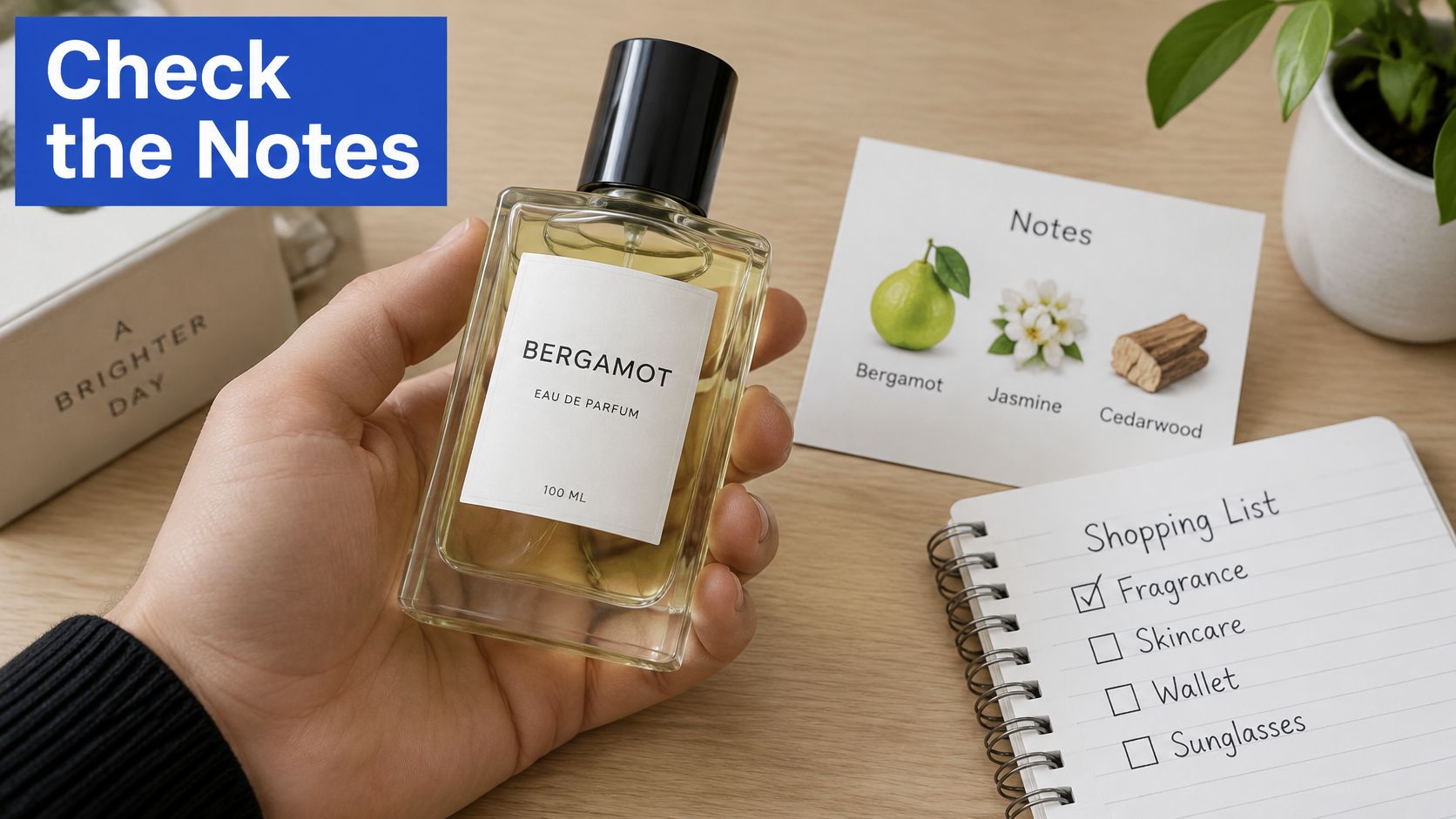
Gotham Fragrances sells authentic designer and niche fragrances, and every bottle is sourced directly from authorized distributors and trusted partners. Product pages include the fragrance notes and an overall scent profile, so you can confirm bergamot before you buy. If you want a straightforward aromatic citrus pick, the Chrome by Azzaro Gift Set for Men lists bergamot alongside lemon, neroli, rosemary, coriander, jasmine, oakmoss and cyclamen.
Discounts run up to 70% off retail, which matters once you compare a light daytime bottle with a richer evening one. Let the note lists do the proving. A floral heart should show neroli, lavender, or jasmine after bergamot. A sharper daytime scent should show lemon, grapefruit, or a marine or green partner. For strong sun, follow the sun rule: keep expressed bergamot oil off sunlit skin and put the spray on fabric or shaded skin.
Search bergamot on the site, open three note lists, and set them against those family roles. Pick one bright daytime bottle and one evening bottle. I would keep the lighter one for heat and the deeper one for when you want citrus to linger under something warmer. Use the store's site search to compare those two candidates and shortlist your two bergamot perfumes today.