
You sprayed it on your wrist at the counter, told the assistant you were just looking, then spent the next hour sniffing your own arm in public. Black cherry and cherry liqueur hit first, bitter almond stops it sliding into candy territory, and somewhere underneath, the tonka and balsam start warming up. Then you turned the bottle over, saw the price, and put it down.
That gap between wanting the smell and refusing the receipt is exactly why people search for a tom ford lost cherry dupe. Most guides go wrong in the same place: they rank clones by how close they smell in the first three minutes, then crown a single winner. The opening is the easy part. Load a formula with sugary cherry and a bit of almond, and you've cleared the first hurdle.
The hard part comes four hours in, when the cherry has burned off and what's left is either warm balsamic woods or a thin, sharp nothing. Judge your dupe there. Pick your clone by the moment of the scent you love, not by a percentage claim.
Start with the reference bottle. You can't judge a copy of something you haven't read properly. Tom Ford released Lost Cherry in 2018 as a unisex eau de parfum in the Private Blend collection, composed by perfumer Louise Turner and first sold in 50 ml and 250 ml sizes. It landed during the late-2010s push of luxury houses into edible, dessert-like accords, an expansion traced in Grand View Research's fragrance industry analysis, which is why a whole shelf of cherry gourmands now sits well below the Private Blend price.
Read the note pyramid as a timeline, not a shopping list. Tom Ford Beauty's product page describes the scent as sweet and tart first, floral in the middle, then woody and balsamic at the end. That sequence is what a dupe has to reproduce.
Lost Cherry notes by wear stage
| Stage | Key notes | What a dupe must match |
|---|---|---|
| Opening (0 to 15 minutes) | Black cherry, cherry liqueur, bitter almond | Boozy cherry with an almond edge |
| Heart (around 30 minutes) | Sour cherry, plum, Turkish rose, jasmine sambac | Tart fruit turning soft and floral |
| Dry-down (around 4 hours) | Vanilla, tonka bean, cinnamon, Peru balsam, cloves, benzoin, sandalwood, cedar, vetiver, patchouli | Warm, balsamic, woody finish |
Cherry is the headline, almond is the raised eyebrow, tonka and balsam are the afterglow. Judge a clone on all three or you're reviewing a different fragrance.
A formula built entirely on sugary cherry will smell cheerful and cheap within the hour. It catches the playful opening and misses the darker, evening-wear density the original earns from balsam, spice and woods.
The opposite mistake is a bottle that leans hard into woods and spice with a thin cherry on top. You get the moody dry-down and lose the flirt. Both failures are visible before you buy, if the seller publishes a full note list.
The checklist: cherry and almond for recognition, florals for the transition, tonka and balsamic woods for lasting warmth. A dupe that nails only the opening has nailed the easy third.
A clone can smell almost identical for half an hour and become a different fragrance by dinner. That isn't your nose failing, it's evaporation. The fruit, liqueur and citrus materials carrying the opening are volatile and leave fast, while woods, balsam and musk linger for hours, which is precisely why formulas diverge late. The published research on fragrance evaluation and skin chemistry makes the same point about matching structure rather than note lists.
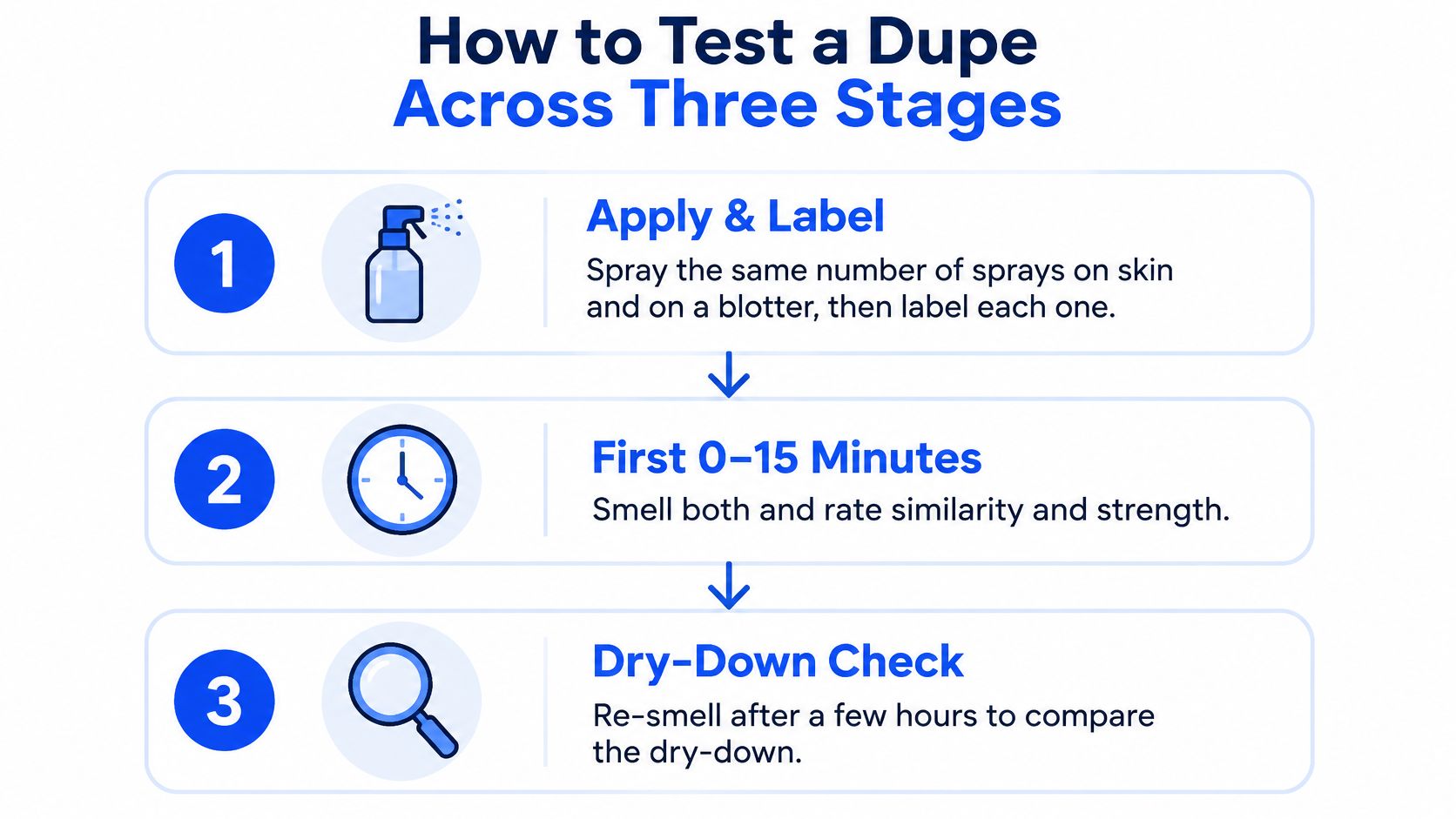
Here's the routine. It takes one afternoon and it will save you from a full bottle you resent.
Your skin is the wild card in all of this. It carries its own volatile compounds, including fatty acids, aldehydes, ketones, alcohols, esters and sulfur or nitrogen-containing molecules, and those shift how sweet, how tart and how long-lasting a fragrance reads from one person to the next. A dupe that sings on your friend's arm can turn syrupy on yours.
The most common slip is judging from the opening alone, usually in the first five minutes in a shop, usually while distracted. Resist it. A strong candidate keeps the cherry-almond impression alive and then moves into warm, resinous, woody territory. A weak one just gets sweeter and then disappears.
Dupe reviews are the least reliable content in fragrance, and the reason is structural. Some reviewers received the bottle free. Others never wore the original alongside it, so they're describing one fragrance from memory and calling it a comparison. The fragrance forum threads on Lost Cherry clones show the pattern clearly, with shoppers noting that reviews get shaky when the product was gifted or the original was never tested directly.
Claims like "90% similar" are the tell. That number comes from nowhere and describes no stage of wear.
Run every review through four questions before you trust it.
Longevity is not accuracy. A clone can outlast the original by three hours and still sound less convincing the whole time.
The most reliable evidence you'll get is the notes you wrote yourself in the three-stage test. Two candidates, one afternoon, your own handwriting. That beats a hundred ranked lists.
There is no universal best clone, and any list that names one is selling you something. Different people love different parts of Lost Cherry. The person who lives for the boozy opening is not shopping for the same bottle as the person who wants the almond to hang around.
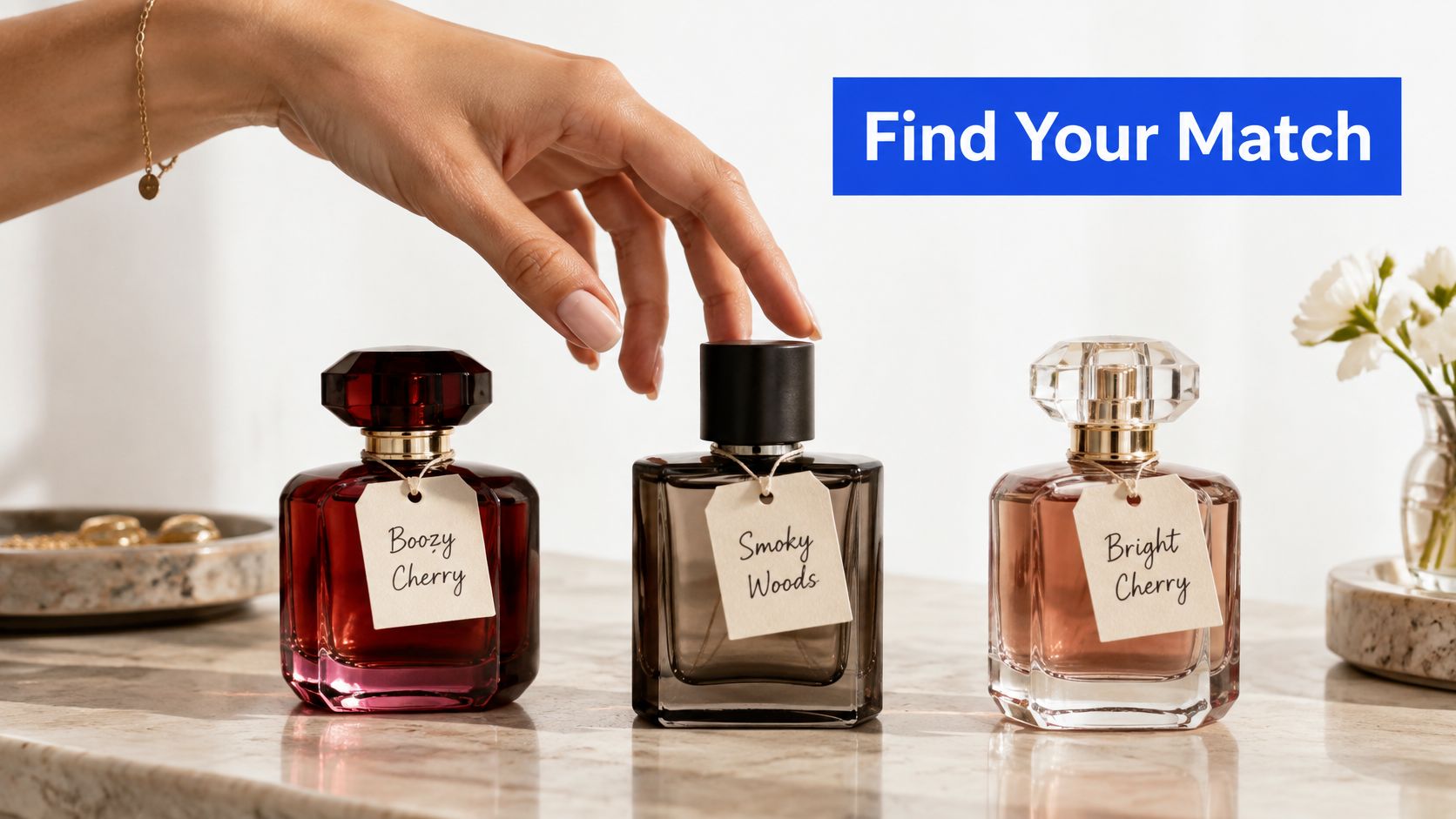
The reports from people who've compared clones point the same way: some alternatives open with a sharper, more artificial cherry, and some lack the original's boozy dry-down entirely, as the community comparison of Lost Cherry clones lays out. So match the bottle to your goal, not to a ranking.
Lost Cherry dupe goals and trade-offs
| Scent goal | Look for | Accept if |
|---|---|---|
| Boozy cherry with creamy almond | Liqueur-like opening and almond in the first hour | Less sweetness in the base |
| Smoky woods for evenings | Dark tonka and woods in the dry-down | A softer cherry at the start |
| Brighter fruit for daytime | Juicy cherry with a lighter base | A shorter, less dense finish |
| Stronger projection | Sillage that holds for several hours | Some deviation in the floral heart |
| Low-risk everyday cherry | Pleasant cherry without heavy almond | A simpler, less complex base |
Boozy cherry with creamy almond is the closest thing to the original and the pick for anyone who wants the full arc. Smoky woods is the evening version, darker and less sweet, and it's a deliberate departure rather than a failure. Brighter fruit suits daytime wear and warm weather, where the dense balsamic base can feel heavy.
Stronger projection matters if you want the scent to travel before you do, and you'll usually pay for it with a slightly off floral heart. Low-risk everyday cherry is the category for people testing whether they even like cherry gourmands, and it should be cheap enough that you don't care if it becomes a gym-bag spray.
Then weigh the things that decide whether you reach for the bottle: the occasion, how sweet you like your fragrance, and how much deviation you'll tolerate. Perceived gender expression is worth naming too, because some alternatives read brighter and more feminine while others come off darker and more unisex. Neither is wrong, but one will feel more like you.
If the almond showing up in the first hour is your favourite moment, shop creamy almond. If it's the drama of a boozy opening you're after, shop boozy cherry. Don't buy the middle ground and hope.
And keep the contrarian point in view: plenty of users praise dupes for outlasting the original while still finding their character less convincing. Longer doesn't mean truer.
For a closer look at how these cherry alternatives compare in practice, this walkthrough covers wear and value side by side.
The original's launch economics set the bar for every comparison that follows. Contemporary launch reporting listed $320 for the 50 mL bottle and $815 for the 250 mL, according to the Fragrantica entry for Lost Cherry, and that gives you real unit numbers to argue with.
Lost Cherry launch price per milliliter
| Size | Launch price | Price per mL |
|---|---|---|
| 50 mL | $320 | About $6.40 |
| 250 mL | $815 | About $3.26 |
The smaller bottle works out to roughly $6.40 per milliliter, the larger to about $3.26 per milliliter, which makes the 250 mL format around 49% cheaper per milliliter than the 50 mL at launch. Same juice, very different economics.
Run that maths on any dupe before you decide. Total price divided by milliliters, then a second question: does this formula reproduce the cherry-liqueur opening, the floral heart and the tonka-woody dry-down? A low number per milliliter means nothing if you stop wearing it after a week.
Cheap is not automatically good value. Some alternatives still cost real money, and a disappointing full bottle wastes more than a sample ever would. The calculation also shifts with the goal you picked earlier. A frequent wearer chasing the boozy-almond profile should weigh cost per milliliter and buy the size that makes sense. An occasional wearer buying a gift should weigh the upfront commitment instead.
Worth knowing where the rules sit, too, since inspired alternatives live in a grey area of labeling and marketing. This primer on the legality of inspired perfume alternatives is a useful starting point before you spend.
Pay for the stage of the scent you love most, not for the size of the bottle. A 100 ml of the wrong dry-down is the worst deal on the shelf.
Safety is where cheap alternatives separate. The International Fragrance Association's standards rest on ingredient-specific safety assessments, exposure analysis and risk management, and it restricts or prohibits materials where the evidence shows unsafe use, as set out in the IFRA standards on safe fragrance use. High oil concentration doesn't prove quality. It just means the formula needs compliant ingredient selection.
Three checks before you commit.
In the EU, allergens above regulatory thresholds must be disclosed on the label, so read it if you're sensitive. And keep the authenticity line straight: a dupe should be sold as inspired by the scent profile, never as a Tom Ford product, and never in packaging that implies otherwise.
Then sample before you commit to a bottle, because your skin decides how sweet and how artificial a cherry formula reads. If you want a structured way to do that, this guide to how to sample perfume before buying walks through the try-first approach properly.
Here's the single next step. Pick one goal from the segments, shortlist two candidates, and run both through the three-stage test on the same afternoon. Only then buy a full bottle. Our fragrance specialists will help you narrow that shortlist and talk through the options, and orders over $80 ship free.
Gotham Fragrances carries 100% authentic designer and niche bottles sourced directly from authorized distributors and trusted partners, so you can explore the Tom Ford line and the broader cherry-gourmand shelf without gambling on authenticity. Start with a cherry-forward pick from our collection, wear it through the three-stage test, and let the dry-down make the decision for you. Visit Gotham Fragrances to build your shortlist and take advantage of everyday discounts of up to 70% off retail.