

Walk through any fragrance aisle, and you'll see the words "Eau de Parfum" whispered everywhere. But what does it actually mean? Think of it as the sweet spot in the world of scent—a perfectly balanced fragrance dripping with a high concentration of perfume oils, usually between 15-20%. It’s the little black dress or the perfectly tailored suit of your scent wardrobe: sophisticated, devilishly long-lasting, and always ready to make an unforgettable impression.
Ever wonder why some fragrances seem to whisper sweet nothings while others command attention? It all comes down to concentration, darling. An Eau de Parfum (EDP) isn't just a fancy French term; it's a promise of intensity and endurance. This beloved formula strikes the perfect, seductive chord between the fleeting freshness of an Eau de Toilette and the powerful punch of a pure Parfum.
This balance is exactly why EDP has become the undisputed superstar of the fragrance world. In fact, Eau de Parfum dominates the global perfume market, commanding a staggering 54.3% market share. This powerful position shows a clear preference for scents that deliver both longevity and a touch of luxury. You can explore more data on the growing perfume market and see how EDP continues to lead the charge.
So, what makes an Eau de Parfum so ridiculously irresistible? It’s all about hitting that magical middle ground. An EDP offers a richer, more complex scent experience that unfolds on your skin throughout the day like a secret love story.
It has enough potency to last from a morning meeting straight through to a late-night rendezvous, typically lingering for a solid 6 to 8 hours.
An Eau de Parfum doesn't just sit on the skin; it becomes a part of your story for the day. Its balanced concentration allows the heart and base notes to truly shine, creating a scent trail that’s memorable without being overwhelming.
This staying power means you get more bang for your buck and a more profound sensory journey from every single spritz.
To make it even clearer, let's break down the essential details that make EDP the go-to choice for so many fragrance lovers.
| Characteristic | Details |
|---|---|
| Oil Concentration | 15-20% |
| Typical Longevity | 6-8 hours |
| Sillage (Scent Trail) | Moderate to Strong |
| Best For | Daily wear and special occasions |
| Price Point | Mid-to-high range |
This quick snapshot shows exactly why Eau de Parfum holds its own—it delivers on all the key aspects of a great fragrance without compromise.
Understanding Eau de Parfum is a bit like knowing your favorite character in a great drama. But to really get why it’s the star of the show, you need to meet the rest of the cast. Every member of the fragrance family has a specific role, and it all comes down to one thing: the concentration of pure perfume oil.
This single factor dictates everything—from how loud the scent is when you first spray it to how long it sticks around on your skin. Think of it like a playlist you’d curate for different moods. Some fragrances are an all-day symphony, while others are more like a fleeting, catchy tune. Let’s figure out where Eau de Parfum fits in this scandalous lineup.
Diving into the world of scents can feel overwhelming, but it's actually simpler than you might think. The main players are all defined by the percentage of aromatic oils they contain, which are blended with alcohol and water. This clever little balance is the secret behind a fragrance's personality and performance.
Here’s the juicy breakdown of the most common types you'll see on a bottle:
So, how do you pick the right one? It’s all about matching the scent’s character to the occasion and the impression you want to make. An intense Parfum is perfect for a glamorous evening out, while a light Eau de Cologne is ideal for a quick refresh after the gym.
The real beauty of an Eau de Parfum is its incredible versatility. It has enough substance to make a statement at a special event, but it’s balanced enough not to overwhelm your colleagues in the office. It's that reliable, chic choice that moves from day to night without missing a beat.
Think of it this way: Parfum is the deep, resonant bass note in a song, while an Eau de Toilette is the bright, playful melody. An Eau de Parfum is the rich, harmonious chord that ties it all together, creating a complete and memorable composition.
This perfect balance is exactly why so many iconic scents, from a classic Tom Ford to a modern Dior, are offered as an EDP. It’s the sweet spot of the fragrance world.
To make it even easier to see the differences, here’s a side-by-side comparison of the fragrance family. Use this chart as a quick guide to find the perfect concentration for any moment.
| Fragrance Type | Oil Concentration (%) | Longevity (Hours) | Best For |
|---|---|---|---|
| Parfum | 20-40% | 8+ Hours | Formal events, intimate evenings, making a bold statement. |
| Eau de Parfum | 15-20% | 6-8 Hours | All-day wear, date nights, signature daily scent. |
| Eau de Toilette | 5-15% | 3-5 Hours | Work, casual daytime activities, warmer weather. |
| Eau de Cologne | 2-4% | 1-2 Hours | A quick refresh, post-workout, hot summer days. |
| Eau Fraîche | 1-3% | < 1 Hour | A light, barely-there hint of scent. |
As you can see, each concentration has its own time and place. An Eau de Parfum, however, remains the go-to for its ability to fit beautifully into almost any scenario, making it a true staple in any fragrance collection.
What’s the point of wearing a gorgeous scent if no one gets to enjoy it? The real secret to making a lasting impression isn't just the fragrance itself, but its sillage (pronounced see-yazh)—that beautiful, invisible trail it leaves behind as you move through a room.
It’s the fragrant whisper that lingers in the air after you’ve gone, turning heads and sparking delicious curiosity.
Think of it this way: projection is the immediate scent bubble around you, the first impression you make when someone leans in close. Sillage, on the other hand, is your unforgettable exit. It’s the difference between a charming introduction and leaving someone thinking about you long after you've departed.
This is where the magic of an Eau de Parfum truly comes into play. Its balanced 15-20% oil concentration creates the perfect sillage—it's present enough to be noticed but elegant enough not to overwhelm. An EDP doesn’t shout for attention; it confidently announces your presence with a graceful, alluring trail that invites people closer.
This hierarchy of fragrance strength directly impacts its performance and the kind of trail it leaves behind. As the infographic shows, Eau de Parfum sits perfectly in the middle, striking that ideal balance.
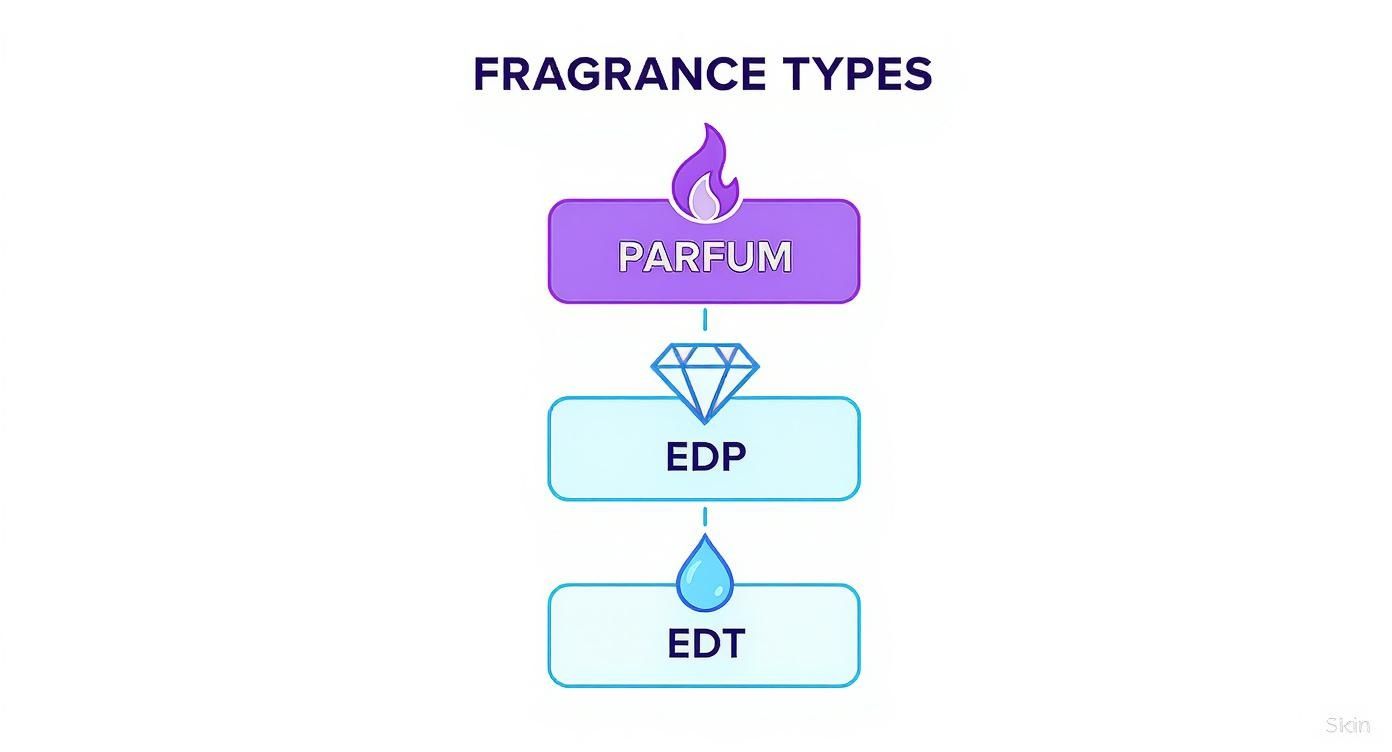
This visualization perfectly positions EDP as the sweet spot between the powerhouse intensity of a pure Parfum and the fleeting lightness of an EDT, making it a superior choice for creating a memorable sillage.
Of course, the perfume itself is only half the story. Your unique body chemistry plays a starring role in how any fragrance performs. Things like your skin's pH balance, moisture level, and even your diet can tweak how a scent projects and lingers on you.
Several key elements influence your personal sillage:
Mastering your sillage isn’t about dousing yourself in more perfume; it’s about understanding how to make your chosen scent work in harmony with your body and your environment. It’s the art of becoming unforgettable.
By choosing a quality Eau de Parfum and applying it strategically, you ensure your fragrance doesn’t just stay on you—it creates a subtle, sexy, and entirely personal signature that leaves an impression wherever you go.
So you’ve found it—that perfect Eau de Parfum that feels like it was made just for you. But how do you stop that incredible scent from pulling a vanishing act by noon? The trick to making a fragrance last isn’t about drenching yourself in it. It’s a subtle art of preparation and placement that ensures your signature scent stays with you from your morning coffee straight through to your evening plans.
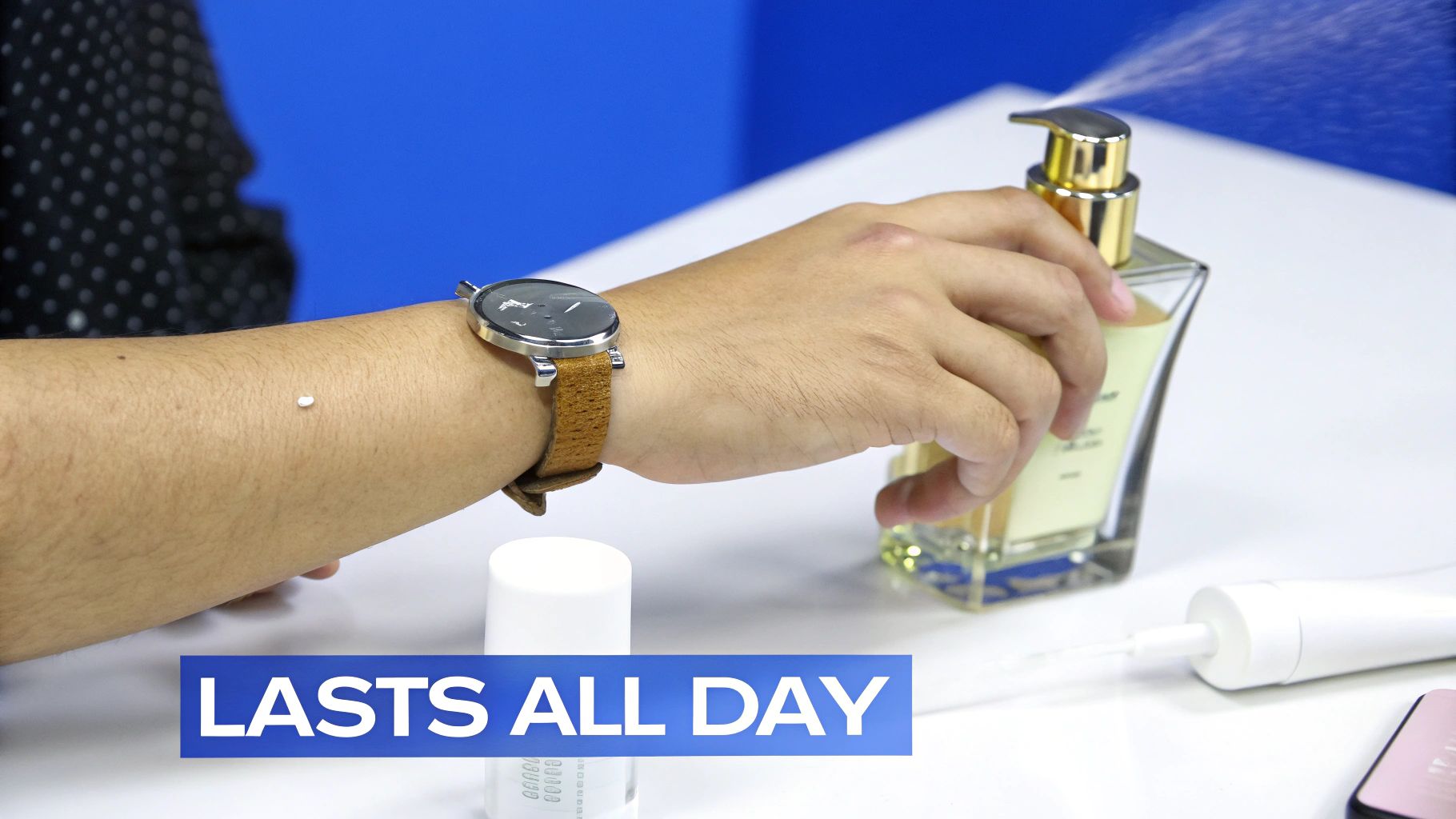
First, let’s bust a huge myth you’ve probably seen in movies a dozen times: rubbing your wrists together after a spritz. This innocent-looking move is actually a fragrance killer. It crushes the delicate top notes, fundamentally changing the scent and making it evaporate much faster. Instead, just let it be. Allow the fragrance to air-dry on your skin so its layers can unfold naturally, exactly as the perfumer intended.
The real secret to all-day wear begins before you even touch the bottle. Fragrance molecules love moisture; it gives them something to hold onto. Think of it this way: dry skin is like a sieve, letting the scent slip right through, while moisturized skin is like a sponge, soaking it up. Applying an unscented lotion or a tiny bit of Vaseline first creates the perfect canvas for your Eau de Parfum.
Now, it's all about location, location, location. Your pulse points are the best real estate for fragrance. These are the spots where your blood vessels are closer to the skin, generating warmth that helps gently diffuse the scent throughout the day.
For the biggest impact, focus on these key areas:
Think of your Eau de Parfum as an accessory, like a beautiful watch or a favorite scarf. The goal isn’t to announce your presence from across the room, but to be discovered. Smart application creates an intimate, personal scent bubble that’s far more intriguing.
Once you've nailed the application, you need to protect the fragrance itself. Perfume has three sworn enemies: heat, light, and humidity. Keeping your beautiful bottles on a sun-drenched windowsill or in a steamy bathroom is the quickest way to break down their complex chemical structure, turning a masterpiece into a whisper of its former self.
To keep your Eau de Parfum smelling as vibrant and true as the day you bought it, just follow a few simple storage rules.
By giving your fragrances a little extra care, you're not just storing a bottle—you're preserving an experience. These small steps will make sure every single spritz is as rich and captivating as the very first one.
Choosing a new fragrance is an intimate journey—almost like finding a song that perfectly captures your mood. It’s so much more than just a scent; it's an invisible accessory, a piece of your personal story. Here's how to navigate the world of fragrance with confidence, whether you're testing in-store or falling for a scent online.
The search for "the one" is a deeply personal quest, and it's a journey worth taking. Investing in a quality EDP isn't just a purchase; it's an investment in your personal style and confidence, tapping into a global desire for quality.
The golden rule of fragrance shopping? Never, ever judge a perfume by its first spritz. Like any good story, a scent needs time to unfold. An Eau de Parfum is a complex creation, crafted with three distinct layers that reveal themselves over hours.
To truly experience an Eau de Parfum, you have to let it live on your skin—not on a paper strip. Spray it on your pulse points and wear it for a full day. Pay attention to how it changes, how it makes you feel, and how it mingles with your unique body chemistry. It's the only real way to know if you've found your match.
Finding your signature Eau de Parfum online can feel like a blind date, but it's much easier than you think if you have a strategy. Scent descriptions and note breakdowns are your best friends here—look for things you already know you love in the real world.
If you adore the smell of fresh laundry, look for scents with notes of cotton, white musk, or aldehydes. If a cozy café is your happy place, seek out fragrances with hints of coffee, vanilla, or sandalwood. It's all about connecting the dots between what you love and the language of perfumery.
Better yet, many online retailers like Gotham Fragrances offer sample sizes or discovery sets. This is a fun, low-commitment way to "date" a few fragrances before you commit to a full bottle. Trying samples at home lets you experience the full scent journey, from top to base notes, in your own element and on your own time.
This shift toward premium, personal experiences is driving major market trends. The high-end fragrance segment, where Eau de Parfum reigns supreme, leans heavily on the power of heritage brands. While women are still the primary consumers, making up 64% of perfume sales, the men's and unisex markets are growing like crazy. This is all fueled by a global taste for luxury over mass-market options. You can discover more insights on fragrance market dynamics to see how this trend continues to shape the industry. Finding your perfect EDP means you're part of a worldwide appreciation for genuine quality and artistry.
We’ve explored the intoxicating world of Eau de Parfum, from its ideal concentration to that captivating scent trail it leaves behind. But I know you still have questions. Let's get them answered.
Think of this as your own private consultation—a chance to get the inside scoop so you can choose and wear your next fragrance with total confidence.
Absolutely! In fact, that's one of its best qualities. An EDP strikes that perfect balance—it's potent enough to last through a hectic workday without ghosting on you, but it’s not so intense that it overwhelms a room.
It’s like your favorite leather jacket or a classic red lipstick; it just elevates everything. The secret is all in the application. One or two well-placed spritzes are all you need for daily wear. This versatility is exactly why so many people land on an EDP for their "signature scent."
Yes, and it’s an investment you’ll be glad you made. That higher concentration of precious perfume oils means you’re getting far superior performance compared to a lighter Eau de Toilette. You’ll find yourself applying less and reapplying far less often, which means that beautiful bottle can actually last you longer.
You're not just paying for longevity; you're paying for artistry. EDPs often feature a more complex and developed scent profile that blossoms on your skin, revealing different facets of its personality over hours. It's a richer, more intimate, and longer-lasting sensory experience.
Your nose (and your eyes) will tell you everything you need to know. There are three dead giveaways that your beloved scent has turned.
Honestly? It's mostly just marketing. For decades, fragrances were put into strict boxes—florals and fruits for women, woods and spices for men. Thankfully, those outdated rules have been beautifully shattered.
A "unisex" Eau de Parfum is simply designed and marketed for everyone, focusing on universally loved notes like citrus, oud, leather, or fresh aquatic accords. The most important rule in the world of fragrance is simple: wear what makes you feel incredible. If you love how it smells on you, it’s for you, regardless of the label on the bottle.
Ready to find a scent that speaks to you? Explore the curated collection of authentic designer fragrances at Gotham Fragrances and discover your next signature Eau de Parfum today. Find your perfect match at Gotham Fragrances.